MAK100: Overview
The MAK100 is a compact fiber tube laser for small tubes, Ø10 to 100 mm, with a 1.5 kW source. It is the machine for shops that today saw, drill and deburr small tubes by hand or buy the parts in, and want to bring that work in-house without a large investment.
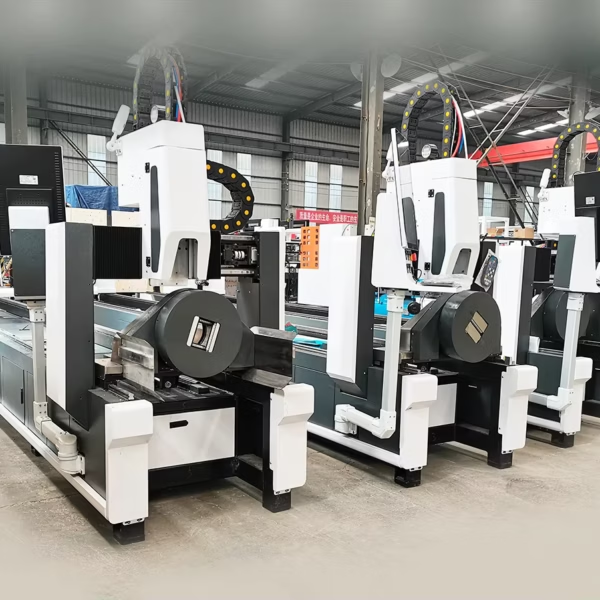
MAK100 in Operation
Rotation and cutting on small tube profiles.
Technical Specifications
| Laser power | 1500 W fiber |
|---|---|
| Tube diameter | Ø10–100 mm |
| Chuck max speed | 150 r/min |
| Processing length | 3000 mm or 6000 mm |
| Price | USD 5,000 FOB Qingdao (stock units) |
| Certification | CE, ISO 9001 |
| Warranty | 24 months on the whole machine (consumables excluded) |
What One Clamping Replaces
A typical small-tube part, for example a chair leg or a rack upright, goes through a saw, a drill or a punch, a notching tool and a deburring station. Each step needs set-up, measuring and handling. On the MAK100 the operator loads a 3 m or 6 m tube, the program nests the parts along it, and the machine cuts the ends, holes, slots and notches in one clamping. Parts come off the same every time because the geometry comes from the file, not from a stop on a saw.
Thin Walls: Speed and Clamping
Most small-tube work is thin wall: furniture, shelving, fitness equipment and display systems. Here the questions are speed and handling, not power. A 1.5 kW source cuts thin walls fast with a clean edge, and the 150 r/min chuck keeps the head moving instead of waiting for rotation.
Thin tubes also dent easily. If the clamping pressure is set for heavy tube, the jaws leave marks or squeeze a round tube oval, and holes end up out of position. Set the chuck pressure for the wall you are cutting, and check the first part of a new batch for clamping marks.
Count the Whole Cost, Not Only the Price
For a small tube laser the purchase price is the smallest part of the decision. Add the running cost (electricity, gas, protective windows and nozzles), maintenance, the time lost when tube sizes change, and the material lost in tailings and scrap. Then set against it what the machine removes: sawing, drilling, deburring, outside processing and the rework of parts that did not fit. Shops that buy small tube parts from outside often find that this last line decides the case.
Common Problems and How to Fix Them
| Problem | Usual cause | What to do |
|---|---|---|
| Clamp marks or oval tube | Chuck pressure too high for a thin wall | Reduce the pressure; check jaw condition |
| Spatter on the inside of the far wall | The beam leaves the cut and hits the opposite wall | Adjust focus and power at break-through; use the slag-protection setting in the program |
| Burr at the end of a part | Speed or gas pressure not matched to the wall | Use the material library values for that wall thickness and check the nozzle |
| Holes slightly off along the tube | Tube not straight or not centred | Run edge-finding before cutting; reject badly bowed stock |
| Parts fall and get scratched | No support at the unloading end | Add a catching tray or support for finished parts |
What Decides the Price
| Item | Options | Effect on price and use |
|---|---|---|
| Length | 3 m or 6 m | A 6 m bed takes full stock lengths and wastes less material per part |
| Software | Nesting and 3D import | Decides how fast new parts are programmed |
| Stock unit or custom | Standard configuration at USD 5,000 | Changes to the standard configuration are quoted separately |
Stock units are offered at USD 5,000 FOB Qingdao; freight, duties and options are quoted separately.
Where It Sits in the PCL Tube Laser Range
| Model | Tube size | Power | Best for |
|---|---|---|---|
| MAK100 (this machine) | Ø10–100 mm | 1.5 kW | Entry model, small tubes |
| LT120S | Ø120 / □120 mm | 1.5–3 kW | Side-mounted, heavy walls up to 10 mm |
| LT240 | Ø20–240 mm | 1.5–6 kW | Round, square, rectangular, oval |
| LT240S | Ø/□20–240 mm | 1.5–6 kW | Side-mounted, dual chucks, 200 kg tubes |
| LT360 | Ø20–360 mm | 1.5–6 kW | Large diameters, 6 m or 9 m stock |
From Inquiry to Production
- Tube list and samples. Send the tube sizes, materials and a few part drawings; we confirm the MAK100 covers them.
- Configuration and layout. We fix chuck size, bed length, source and loading, and send a layout drawing with the floor space, power and air connections.
- Build and test. The machine is assembled and tested before shipment; lead time is confirmed in the quotation.
- Site preparation. A level floor, the power connection, compressed air for the chucks and assist gas, and fume extraction ready before arrival.
- Installation and training. Installation and operator training are quoted with the machine; operators learn programming, nesting, daily checks and parameter adjustment.
- Support. 24-month warranty on the whole machine, consumables excluded.
Before You Order
- Largest tube diameter and wall you cut (the MAK100 takes up to Ø100 mm).
- Stock length: 3 m or 6 m.
- Daily volume and how parts are unloaded.
- Who will program the parts, and in which CAD format they arrive.
Maintenance
| When | What |
|---|---|
| Daily | Clean the protective window and nozzle; check chuck jaws for slag; empty the slag tray. |
| Weekly | Clean dust from the chuck and rails; drain water from the air filter. |
| Periodically | Lubricate rails and racks; change the chiller water; replace worn jaws and nozzles. |
Safety Around a Tube Laser
Two hazards are specific to tube cutting. The tube rotates, often several metres of it outside the enclosure, so the area along the bed must be kept clear while the chucks turn. And the beam leaves the far side of the tube when it cuts through, so the cutting zone has to stay enclosed or shielded. Keep the interlocks on the doors and light curtains working, wear laser safety glasses rated for the laser wavelength where the cutting area is open, and connect the extraction before cutting coated or galvanized tube.
Strengths and Limits
Strengths
- Lowest cost way into tube laser cutting
- Replaces sawing, drilling and notching of small tubes
- Takes 6 m stock
Limits to know
- Limited to Ø100 mm and 1.5 kW
- Thick walls are better on the LT120S
- Manual loading only
MAK100 FAQ
How much does the MAK100 cost?
Stock units are USD 5,000 FOB Qingdao. Freight to your port is quoted separately.
What tube sizes can it cut?
Tubes from Ø10 to 100 mm, in 3 m or 6 m lengths.
Is 1.5 kW enough?
For thin and medium walls on small tubes, yes. For heavy walls choose the LT120S.
Can it cut square and rectangular tube?
Send the profile and size; we confirm whether it fits the chuck and cut samples.
How long does it take to learn?
Operators who know CAD usually learn the nesting software quickly; training is part of installation.
Can you cut samples on my tube?
Yes. Send a drawing, the tube size and material.
What does it cost to run?
Mainly electricity, assist gas and consumables such as protective windows and nozzles. We give you the consumables list with the quotation so you can work out the cost per part.
Compare all tube laser cutting machines side by side in our selection guide.
Ask for stock availability. We confirm the unit, configuration and freight to your port.
Get a quote