Welding Robots and Robotic Welding Systems
Six robotic welding systems for parts from small brackets to bridge girders: hand-guided cobots, positioner workstations, teaching-free rail and cantilever robots, gantry and mobile welding robots.
- 6 models
- USD 5,000 – 30,000 FOB Qingdao
- 24 months warranty
- CE ISO 9001
-
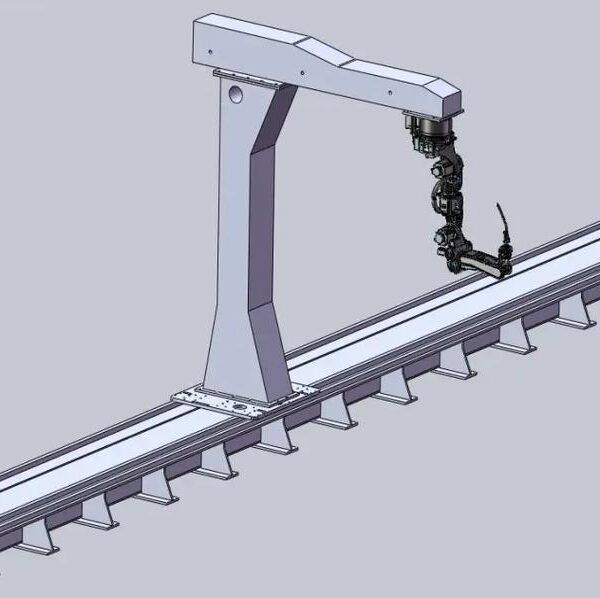
Cantilever Welding Robot solution
Price on request View details -
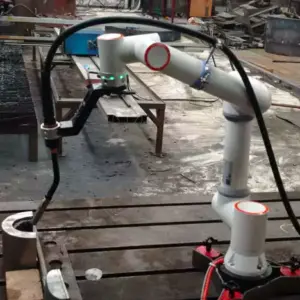
Cobot Welding Station
USD 5,000 – 12,000 View details -
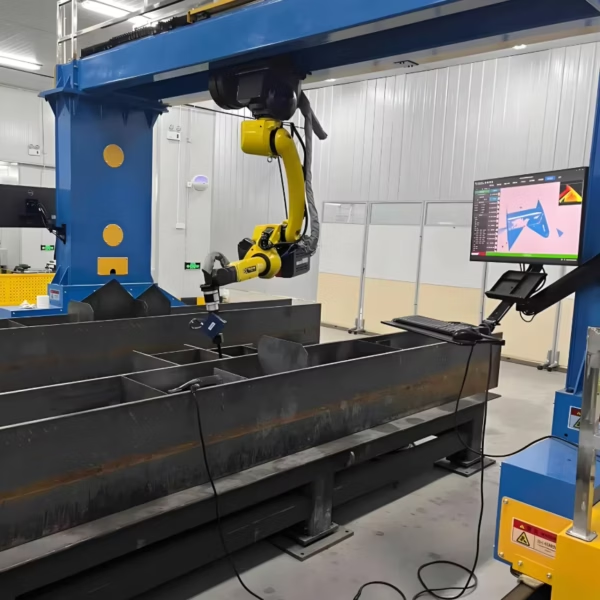
Gantry welding robot solution
Price on request View details -
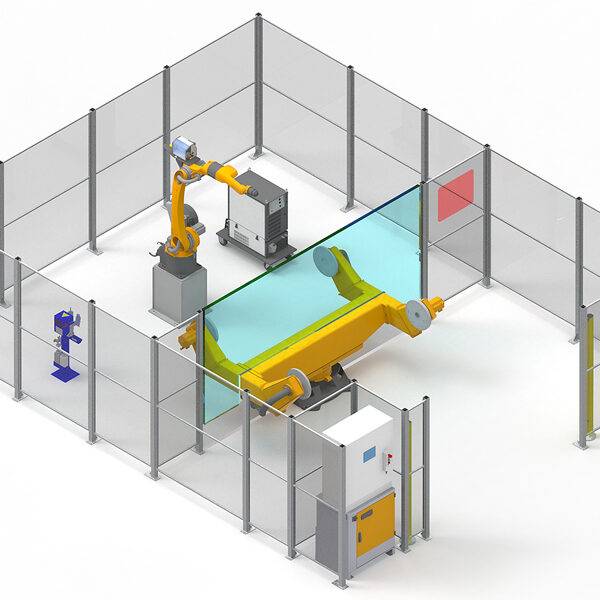
robot welding workstation
USD 18,000 – 30,000 View details -
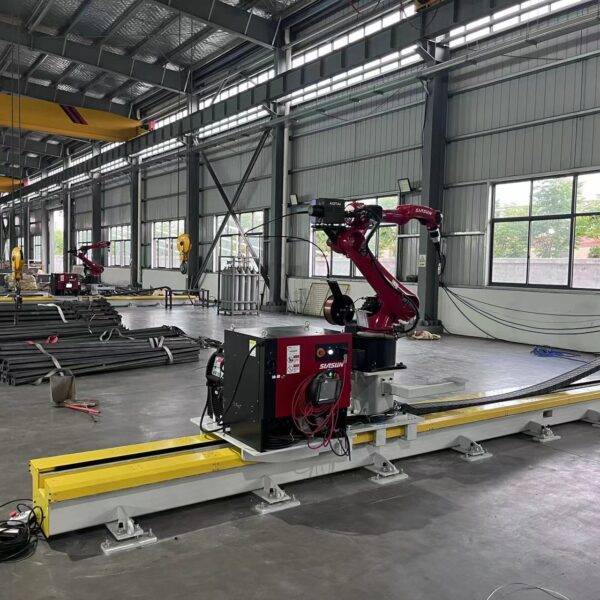
robotic welding machine
Price on request View details -
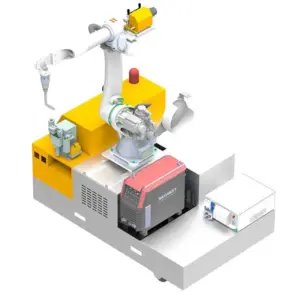
Tracked Wheeled AGV Welding robot
Price on request View details
Welding Robot ROI Calculator
Estimate the payback period with your own numbers. Nothing is sent anywhere; the result updates as you type.
Estimate only. It does not include higher output, less rework or financing costs, which usually shorten the payback further. Ask us for a calculation based on your parts.
What Is a Welding Robot and When Does It Pay Off?
A welding robot is an arm that holds the welding torch and repeats a programmed path with the same speed, angle and parameters on every part. Around the arm sits a system: a welding power source, a wire feeder, sensors that find the seam, and often a positioner, rail or gantry that brings the robot to the seam or the seam to the robot.
A robot pays off when welding time is a bottleneck, when skilled welders are hard to hire, or when quality varies from shift to shift. It does not need to replace people: in most shops the robot takes the long, repetitive seams, and the welders move to fit-up, difficult joints and inspection.
Which Welding Robot Fits Your Parts?
The right welding robot depends mostly on the size of your parts and how many of them you make. Use this table as a starting point:
| System | Best for | Typical parts | Price (FOB Qingdao) |
|---|---|---|---|
| Cobot welding station | Small batches, frequent changeovers | Parts up to about 2 m; cabinets, brackets, pipes and flanges | USD 5,000–12,000 |
| Robot welding workstation | Repeat parts in batches | Parts up to several tonnes on a positioner | USD 18,000–30,000 |
| Rail-mounted 7-axis robot | Steel-structure members | H-beams, columns, base plates and brackets | On request |
| Cantilever welding robot CWR500A | Long, wide parts loaded by crane | Bridge plate units, box girders, H-beams | On request |
| Gantry welding robot | Very large or wide parts | Trailer chassis, ship panels, large frames | On request |
| Mobile welding robot | Parts too big to move | Tanks, pressure vessels, ship sections, wind towers | On request |
The Six Systems at a Glance
Cobot welding station
A collaborative arm on a welding table, taught by hand in minutes. It suits small and medium batches of parts up to about 2 m and can often work without a fence after a risk assessment.
Robot welding workstation
An industrial robot with a single-axis, L-type or C-type positioner from 500 kg to over 5 t. The positioner turns the part so every seam is welded in the best position; it is the standard choice for repeat parts.
Rail-mounted 7-axis robot
A robot on a 9 m or 12 m travel rail with a 3D laser scanner. It calculates its own paths for steel-structure members and reads Tekla and SolidWorks models.
Cantilever welding robot CWR500A
A 7-, 8- or 9-axis robot on a travelling column with a horizontal arm, for bridge plate units, box girders and long plates loaded by crane. It welds 3–6 mm gaps automatically and is programmed from models or scans.
Gantry welding robot
One or more robots carried by an overhead gantry over a working area such as 12 m × 4 m. It suits very wide parts and multi-station layouts.
Mobile welding robot
A robot on a tracked, lifting wheeled or steering-wheel chassis that drives to the workpiece. It suits tanks, pressure vessels and other parts too large to move.
Choosing in Three Questions
- How big and heavy are your parts? Up to about 2 m: cobot or workstation. Long members: rail-mounted or cantilever. Very wide parts: gantry. Too large to move at all: mobile robot.
- How many of each part do you make? Frequent changeovers favour the cobot's hand-guided teaching or the teaching-free systems; large repeat batches favour a workstation with fixtures.
- How will the robot be programmed? Hand guiding for cobots, offline programming from CAD, or teaching-free path generation from a 3D model or scan for steel structures and bridges.
Welding Robots by Industry
| Industry | Typical parts | Systems used |
|---|---|---|
| Steel structures | H-beams, columns, base plates, brackets | Rail-mounted, cantilever, workstation |
| Bridges | Deck plate units, T-ribs, diaphragms, box girders | Cantilever, gantry |
| Shipbuilding and offshore | Panels, sections, stiffeners | Gantry, mobile |
| Pressure vessels and LNG | Shells, nozzles, supports | Mobile, workstation |
| Wind towers | Tower sections, flanges, door frames | Mobile, workstation |
| Construction machinery | Booms, frames, buckets | Workstation, mobile |
| Sheet metal and equipment | Cabinets, enclosures, kitchen and medical equipment | Cobot |
Three Ways to Program a Welding Robot
| Method | How it works | Best for |
|---|---|---|
| Hand guiding | The operator drags the torch along the seam and saves points | Cobots; small batches |
| Offline programming | Paths are created on a computer from the CAD model | Repeat parts with good models |
| Teaching-free | A 3D scan or model is turned into welding paths automatically | One-off steel-structure and bridge parts |
Welding Processes
| Process | Typical use | Available on |
|---|---|---|
| MIG / MAG | Carbon and stainless steel structures; the most common robot process | All systems |
| Flux-cored wire | Thick plate, outdoor-grade structures, high deposition | All industrial systems |
| Tandem twin-wire | Long, heavy seams at higher speed | Cantilever, gantry, rail-mounted |
| TIG | Thin stainless and visible welds | Cobot, workstation |
| Laser welding | Thin sheet with low distortion | Cobot |
How the Robot Finds the Seam
| Method | How it works | When to use it |
|---|---|---|
| Touch sensing | The wire touches the part to find its position before welding | Repeat parts with small position variation |
| Arc tracking | The robot reads the welding arc and corrects the path while welding | Long fillet welds with some distortion |
| Laser seam tracking | A laser sensor scans the joint ahead of the torch | Varying fit-up and long seams |
| 3D vision / point cloud | The whole part is scanned and the seams are found automatically | Teaching-free welding of one-off parts |
What Affects the Investment
- The number of robots and external axes (rail, gantry, positioner).
- Working area: rail length, gantry stroke or positioner capacity.
- Welding power source brand: Aotai, Megmeet, Panasonic, Lincoln Electric or Miller.
- Sensing and software: seam tracking, 3D vision, teaching-free path generation.
- Fixtures, installation and training, which are quoted separately.
Use the ROI calculator on this page to estimate the payback with your own wages and shifts.
From Inquiry to Production
- Send drawings or photos. We review your parts, materials, thicknesses and output targets.
- Configuration and quote. We recommend the system, axes and process and quote FOB Qingdao.
- Production and factory test. 20–45 days depending on the configuration; the system is test-welded before shipment.
- Installation and training. About one week on site, quoted separately.
- Production and support. 24-month warranty and remote support for software and welding procedures.
Common Mistakes When Buying a Welding Robot
- Buying for the average part. Size the system for your largest regular part, or you will keep welding it by hand.
- Ignoring fit-up. A robot repeats exactly what it is given; poor cutting and tacking upstream cost more than any robot option.
- Forgetting programming time. On one-off parts, choose hand guiding or teaching-free systems, or the robot will wait for programs.
- No plan for loading. Check crane access, fixtures and a second station so the robot is not idle while parts are loaded.
- Skipping procedure qualification. Plan weld procedure tests early if your welds must meet AWS D1.1, ISO or class rules.
What Every PCL Welding Robot Includes
- Welding procedures that can be qualified to ISO, AWS D1.1 and classification-society rules (ABS, LR, CCS).
- CE and ISO 9001 certification.
- Lead time of 20–45 days depending on the configuration.
- About one week of on-site installation and training, quoted separately.
- 24-month warranty on the whole machine, consumables excluded, with remote support.
Welding Robot FAQ
How much does a welding robot cost?
A cobot welding station starts at about USD 5,000 and a robot welding workstation is typically USD 18,000–30,000, FOB Qingdao. Rail, cantilever, gantry and mobile systems are configured to your parts and quoted on request.
Do I need a skilled welder to run a welding robot?
A welding engineer or skilled welder sets up the procedures once. After that, operators load parts and start programs; one welder can supervise several cobots or two to three teaching-free stations.
Which welding processes are supported?
MIG, MAG, TIG and tandem twin-wire welding; laser welding is available on the cobot. Solid and flux-cored wire, multi-layer and multi-pass.
What is teaching-free welding?
The robot creates its own welding paths from a 3D model, a converted 2D drawing or a scan of the part, so nobody has to teach every point.
Cobot or industrial robot?
A cobot is quicker to program and can often work without a fence after a risk assessment, which suits small batches. An industrial robot cell is faster on large repeat batches and heavier welding.
Can a robot weld large structures?
Yes. Cantilever, gantry and mobile welding robots are built for bridge plate units, box girders, ship sections, tanks and wind towers.
How long is the lead time?
20–45 days depending on the configuration, plus about one week for installation and training on site.
Which industries use your welding robots?
Steel structures, bridges, shipbuilding, pressure vessels and LNG equipment, wind towers and construction machinery.
Can one robot weld different parts?
Yes. Each part has its own program. Cobots are taught by hand in minutes, and teaching-free systems create programs from models or scans, so frequent part changes are practical.
What do I need to prepare in my workshop?
Electrical supply, shielding gas, fume extraction and floor space. Rail, cantilever and gantry systems also need a level foundation and crane access.
Which welding power sources do you use?
Aotai, Megmeet, Panasonic, Lincoln Electric or Miller, chosen to suit your process and local service.
Do you offer a payback calculation?
Yes. Use the ROI calculator on this page, or send us your parts, wages and shifts for a calculation based on your production.
Send us a drawing or photo of your parts. We will recommend the welding robot and configuration, and quote FOB Qingdao.
Get a quote