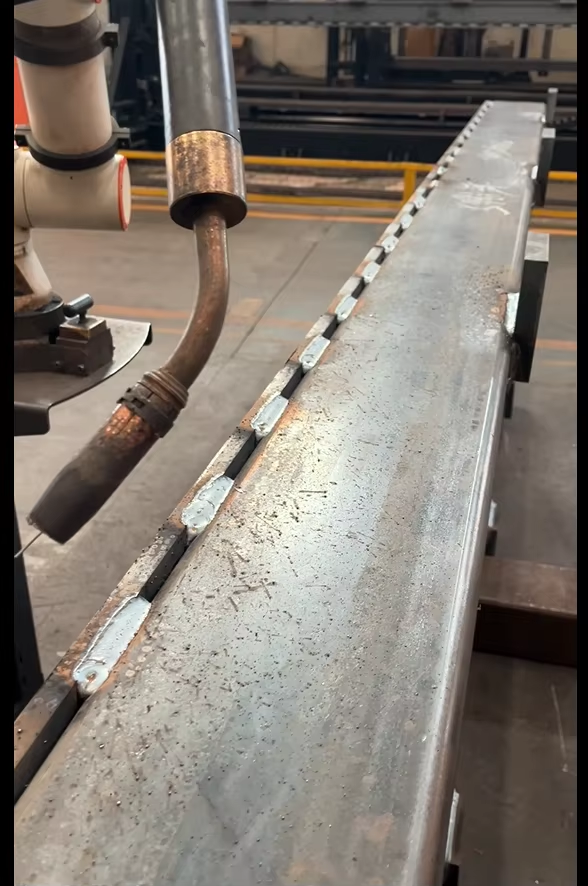
Cobot Welding Station: Overview
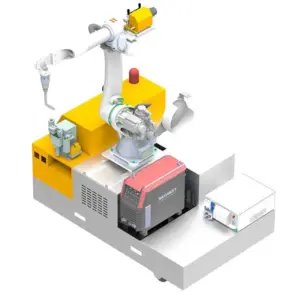
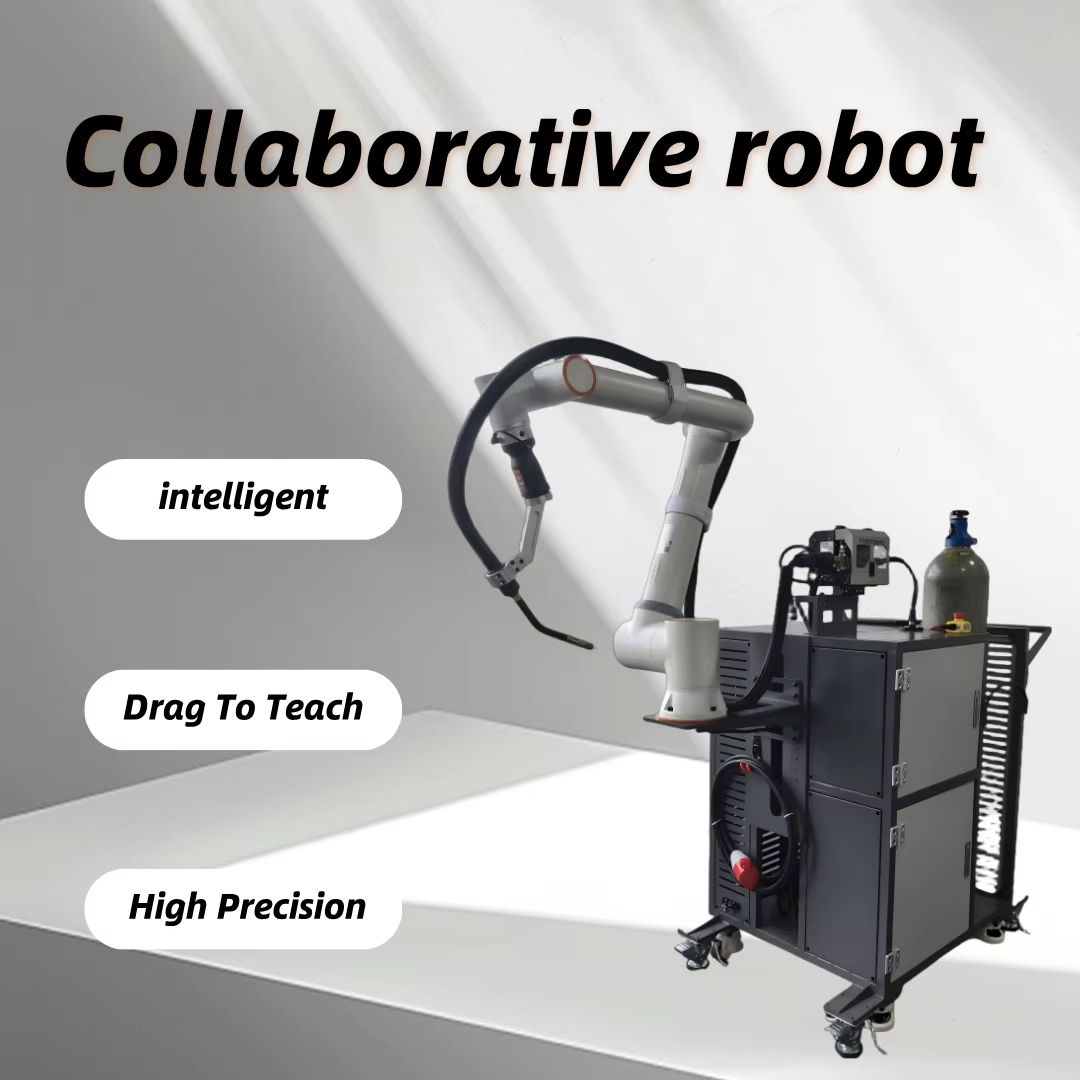
The cobot welding station pairs a collaborative robot arm with a welding power source on a compact welding table. You teach a seam by guiding the torch by hand, so a new part can be programmed in minutes. It is built for small and medium-sized workshops that weld many different parts in small batches and cannot justify a fenced industrial robot cell.
A skilled welder sets up the program; after that, operators without a welding certificate can load parts and start the cycle. One welder can supervise several cobots, which is how most shops use it to cope with a shortage of welders.
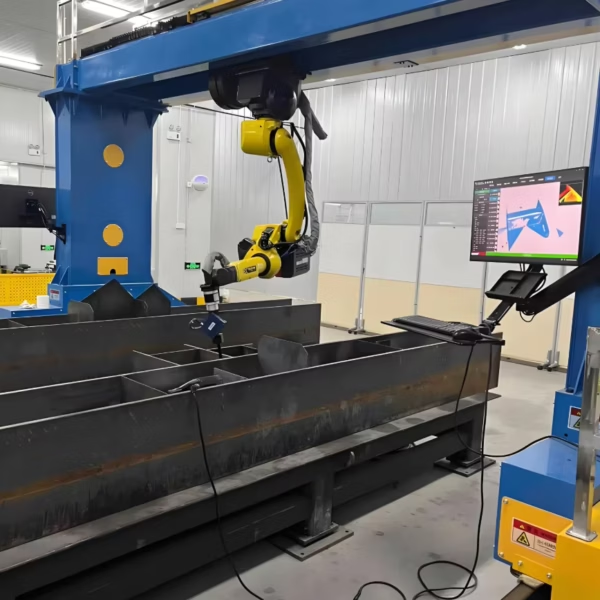
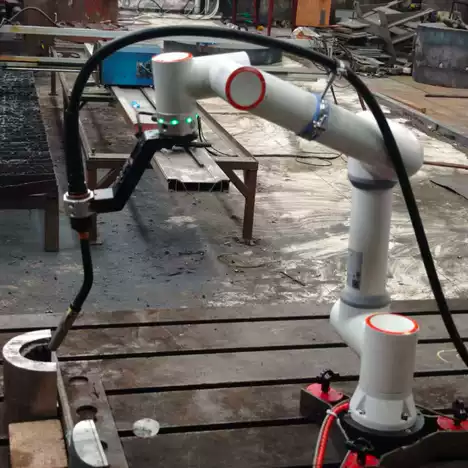
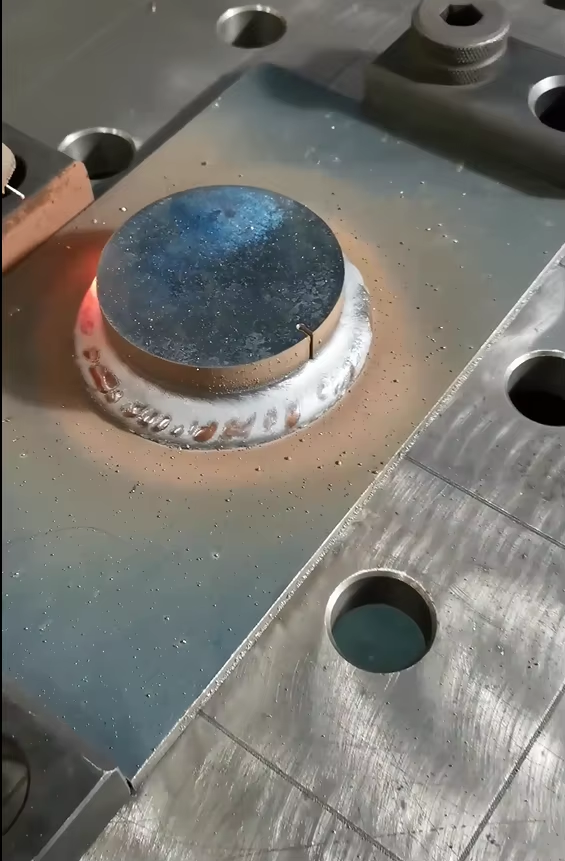
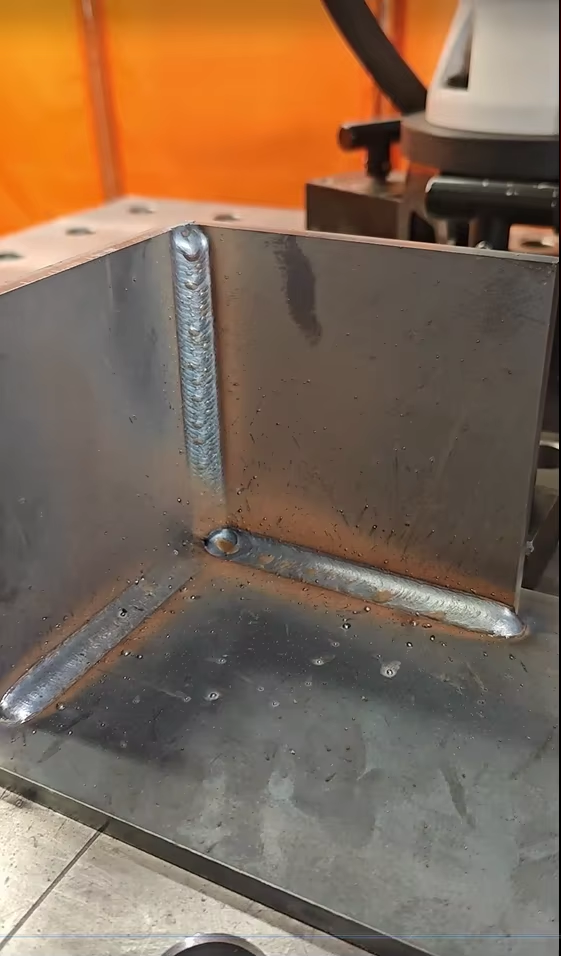
Cobot Welding in Action
Hand-guided teaching: drag the torch along the seam, save the points, weld.
Technical Specifications
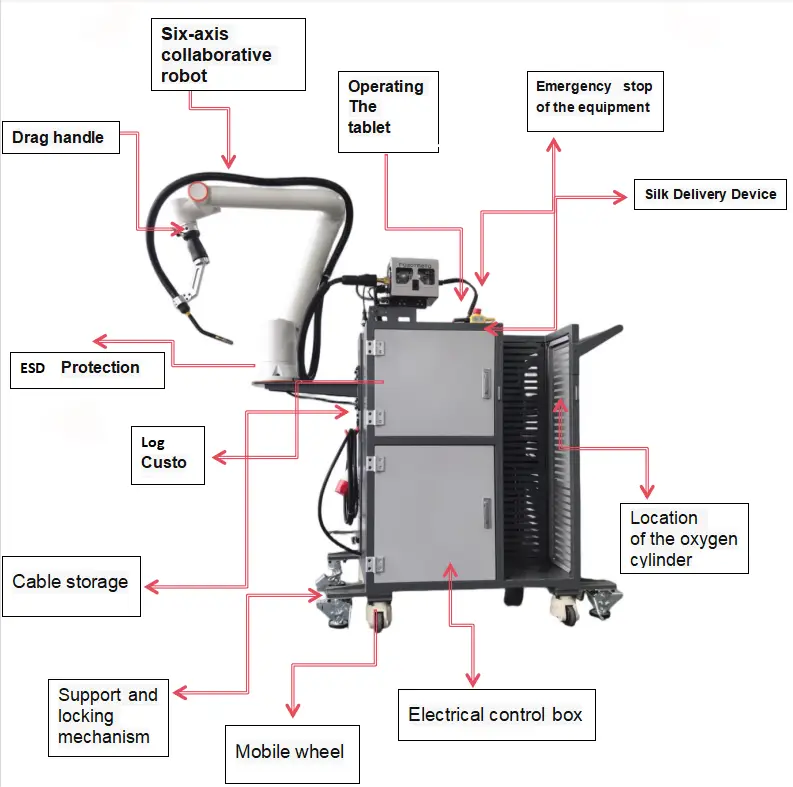
| Robot type | Collaborative robot arm |
|---|---|
| Payload | 5, 10 or 20 kg options |
| Reach | 900–1300+ mm |
| Welding processes | MIG / MAG / TIG / laser welding |
| Materials | Carbon steel, stainless steel, aluminum |
| Material thickness | 0.5–20 mm depending on configuration |
| Programming | Hand-guided teaching (drag the torch along the seam) and tablet app |
| Safety | Force and collision sensing stops the arm on contact; designed to ISO 10218-1 and ISO/TS 15066 |
| Positioners | Optional, 500 kg to 2 t |
| Maximum workpiece | About 2 m |
| Welding power source | Aotai, Megmeet, Panasonic, Lincoln Electric, Miller or others on request |
| Certification | CE, ISO 9001 |
| Lead time | 20–45 days depending on configuration |
| Warranty | 24 months on the whole machine (consumables excluded) |
How Hand-Guided Teaching Works
- Clamp the part. Fix the part on the welding table, or on a positioner for circumferential seams.
- Guide the torch. Hold the torch and drag the arm to the start, along the seam and to the end. Save each point with a button on the arm or the tablet.
- Choose the weld settings. Pick the process, wire and parameters in the tablet app, or load a saved procedure.
- Weld and repeat. Run the program. For the next identical part, the operator only loads and starts the cycle.
Where a Cobot Pays Off
- Frequent changeovers: new parts are taught in minutes, so batch sizes of a few pieces are still worth automating.
- Compact workshops: after a risk assessment, the cobot can work without a safety fence, so it fits on an existing manual welding table.
- Welder shortage: repetitive straight, circumferential and stitch welds and thin stainless sheet move to the cobot; your welders handle the difficult joints.
- On-site work: mounted on a cart or an AGV base, the cobot can be taken to the job for repairs.
Best-Fit Parts
Highly recommended
- Sheet-metal cabinets and electronic enclosures
- Stainless kitchen and medical equipment
- Pipe and flange circumferential welds
Also a good fit
- Small parts for special vehicles and farm machinery
- Steel-structure brackets and connection plates
- Fitness equipment and outdoor metal furniture
How It Compares with Other Welding Robots
| System | Strength | Choose it when |
|---|---|---|
| Cantilever welding robot CWR500A | Open front and back for crane loading; 3.5 m reach | Long plate units, H-beams and box girders loaded by crane |
| Gantry welding robot | Covers a full rectangular area, e.g. 12 m × 4 m | Very wide parts such as ship sections and trailer frames |
| Rail-mounted 7-axis welding robot | Compact single-robot line with 3D scanning | Steel-structure members of similar size |
| Mobile welding robot | Drives to the workpiece; no rail needed | Parts too large or heavy to move to any station |
| Robot welding workstation | Positioner turns the part to the best welding angle | Repeat parts up to several tonnes in batches |
| Cobot welding station (this machine) | Hand-guided teaching, no fence after risk assessment | Small, mixed parts and frequent changeovers |
What Determines the Price of a Cobot Welding Station
The published range of USD 5,000–12,000 (FOB Qingdao) depends mainly on these choices:
| Cost factor | Options | How it affects the price |
|---|---|---|
| Payload class | 5, 10 or 20 kg | Higher payloads carry heavier torches and longer reach |
| Process | MIG/MAG, TIG or laser | Laser welding adds the laser source and head |
| Welding power source | Aotai, Megmeet, Panasonic, Lincoln Electric, Miller | Imported brands cost more; local brands are easier to service in some regions |
| Positioner | None, or 500 kg to 2 t | Needed for circumferential and multi-side welds |
| Mobility | Fixed table, cart or AGV base | A mobile base adds cost but serves several work areas |
| Service | On-site installation and training | Quoted separately, usually about one week on site |
For a quote, send photos of your typical parts, the material and thickness, and the joints you want to automate.
Delivery, Installation and Support
- Configuration and drawings. We match the payload, process and table or positioner to your parts.
- Production and factory test. Lead time is 20–45 days depending on the configuration. The system is assembled and test-welded before shipment.
- Site preparation. Prepare the electrical supply, shielding gas and a level area for the table. A risk assessment of the work area decides whether a fence or light curtain is needed.
- Installation and training. On-site installation and operator training usually take about one week and are quoted separately. Operators learn programming, daily operation and routine maintenance.
- After-sales support. 24-month warranty on the whole machine, consumables excluded, with remote technical support for software and process questions.
Common Welding Problems and How the Cobot Handles Them
Most quality problems in small-batch welding come from inconsistent manual technique. These are the ones a cobot station removes, and the ones that still need attention:
| Problem | Typical cause | How the system handles it |
|---|---|---|
| Uneven bead and stitch spacing | Hand speed and angle change from weld to weld | The cobot repeats the stored path, speed and torch angle on every part |
| Burn-through on thin sheet | Too much heat input for the material thickness | Lower-current and short-circuit parameters are stored per part; TIG or laser welding is available for very thin stainless |
| Porosity | Poor gas coverage, drafts or a dirty nozzle | Gas flow is set in the procedure; nozzle cleaning stays part of the daily routine |
| Distortion on thin stainless | Long continuous welds and uneven heat | Stitch sequences and clamping are programmed once and repeated exactly |
| Missed welds | Operator fatigue on repetitive parts | The program welds every seam in the same order every time |
Before You Buy: A Cobot Welding Checklist
Answer these points before you request a quote. They decide the payload, process and table setup:
- List your typical parts with size and weight; the cobot station handles parts up to about 2 m.
- Note materials and thicknesses: carbon steel, stainless steel or aluminum, from 0.5 to 20 mm depending on configuration.
- Identify the joint types: fillet, butt, lap, circumferential or stitch welds.
- Estimate batch sizes and how often parts change; cobots pay off with frequent changeovers.
- Plan clamping: welding table, simple fixtures or a positioner of 500 kg to 2 t for round parts.
- Check the electrical supply, shielding gas and space around the table.
- Decide who will set up procedures: a skilled welder sets them once, then operators run the cycle.
- Carry out a risk assessment to decide on fencing, screens and fume extraction.
Daily and Periodic Maintenance
| Interval | Task |
|---|---|
| Every shift | Clean the nozzle and remove spatter; check the contact tip and replace it when the bore is worn; check the wire feed and wire stock; confirm shielding-gas flow |
| Weekly | Check torch cables and hoses for wear; check gas connections for leaks; clean the torch cleaning station or anti-spatter unit if fitted |
| Monthly | Clean the wire liner and drive rolls; check the welding table and clamps for spatter build-up; check the ground connection |
| Yearly | Inspect cables routed along the arm; service the robot as specified by its manufacturer |
Follow the robot and power-source manufacturers' manuals for reducer grease and battery replacement intervals. Back up robot programs and welding procedures after every change.
Safety in a Fenceless Work Area
- The arm stops when it senses a collision; the welding arc, spatter and fumes are still hazards and must be controlled.
- Use welding screens or curtains to protect people nearby from arc light.
- Fit fume extraction at the torch or above the table.
- Base the decision to work without a fence on a documented risk assessment of your work area.
Cobot, Manual Welding or Industrial Robot?
| Factor | Manual welding | Cobot welding station | Industrial robot cell |
|---|---|---|---|
| Programming a new part | None | Minutes, by hand guiding | Longer; teaching or offline programming |
| Consistency | Depends on the welder | Repeats the stored path | Repeats the stored path |
| Safety fencing | Not needed | Often not needed after risk assessment | Needed |
| Best batch size | One-offs | Small and medium batches | Large repeat batches |
| Investment | Lowest | USD 5,000–12,000 (FOB Qingdao) | Higher; see the robot welding workstation |
Advantages and Limitations
Advantages
- Programs a new part in minutes by hand guiding
- Fits into existing workshops; no fence after risk assessment
- Non-certified operators can run it once a welder sets it up
- Lowest entry price of our welding robots
- Handles MIG, MAG, TIG and laser welding
Limitations
- Not built for parts much larger than 2 m: use a gantry or mobile welding robot
- Slower than an industrial robot in high-volume, short-cycle production; a robot welding workstation fits that better
- Heavy multi-pass welding on thick plate is better done by an industrial robot
Cobot Welding Station FAQ
Can the cobot work without a safety fence?
It is designed to ISO 10218-1 and ISO/TS 15066 and stops when it senses a collision. Whether it can run without a fence depends on a risk assessment of your work area, especially the welding arc and fumes.
How long does it take to program a new part?
Usually minutes. You guide the torch along the seam by hand and save the points; the weld settings come from the tablet app or a saved procedure.
Who can operate it?
A skilled welder sets up the procedures. After that, operators without a welding certificate can load parts and start programs, and one welder can supervise several cobots.
Which materials and thicknesses can it weld?
Carbon steel, stainless steel and aluminum from 0.5 to 20 mm, depending on the process and configuration.
Can it weld round parts such as pipes and flanges?
Yes. Combined with a positioner of 500 kg to 2 t, it welds circumferential seams on pipes and flanges.
What does it cost?
Most configurations fall between USD 5,000 and 12,000, FOB Qingdao. The payload class, welding process and positioner make the difference.
Can a cobot weld aluminum?
Yes. Carbon steel, stainless steel and aluminum can be welded, from 0.5 to 20 mm depending on the process and configuration. Aluminum needs the matching wire, drive rolls and shielding gas.
How many cobots can one welder supervise?
One skilled welder can supervise several cobots, while operators without a welding certificate load parts and start programs.
See all welding robots to compare cantilever, gantry, mobile, workstation and cobot systems side by side.
Send us photos of your parts. We will recommend the payload, process and table setup, and quote FOB Qingdao.
Get a configuration and quote