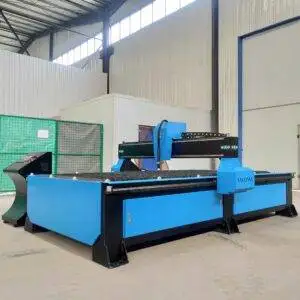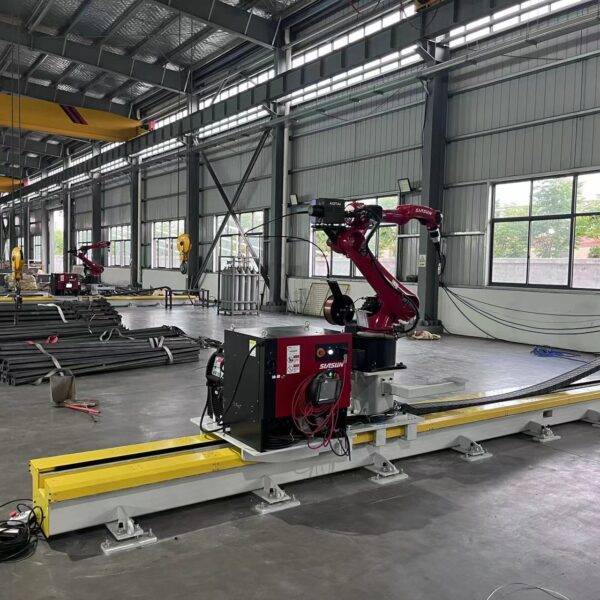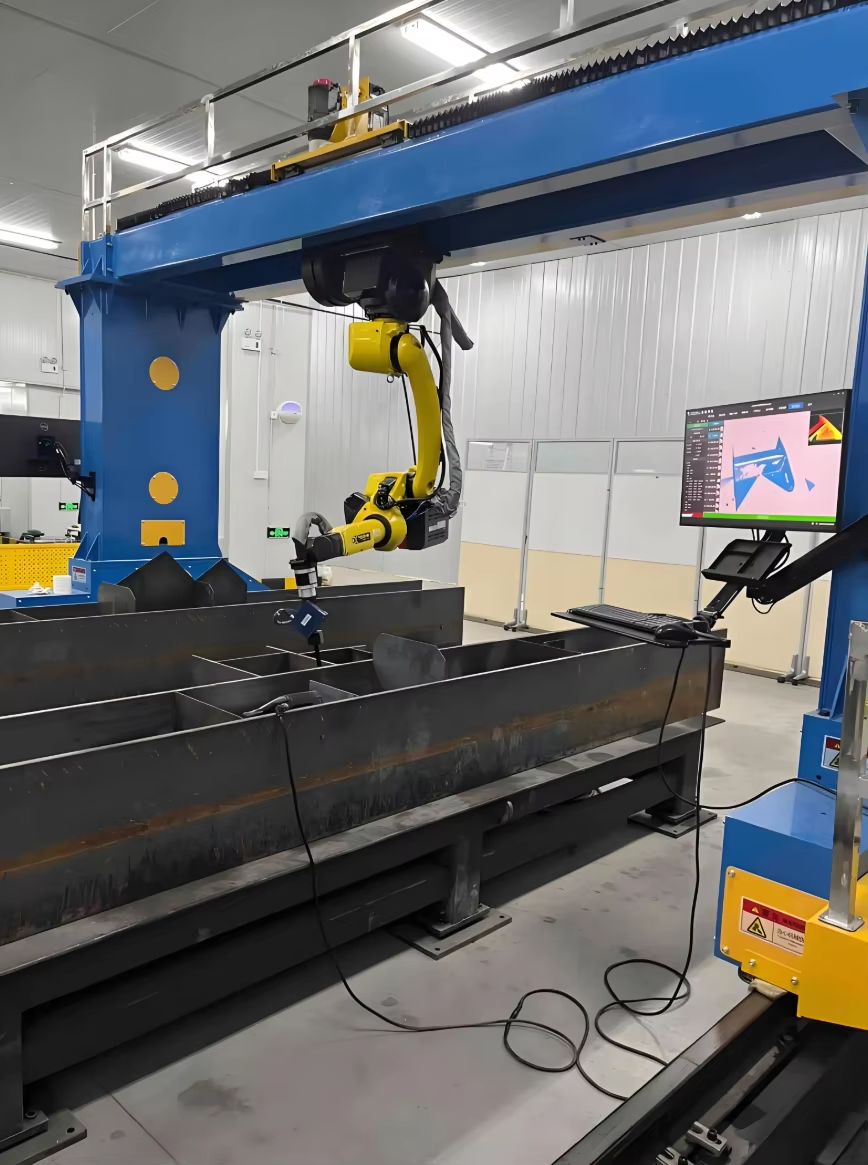
Gantry Welding Robot: Overview
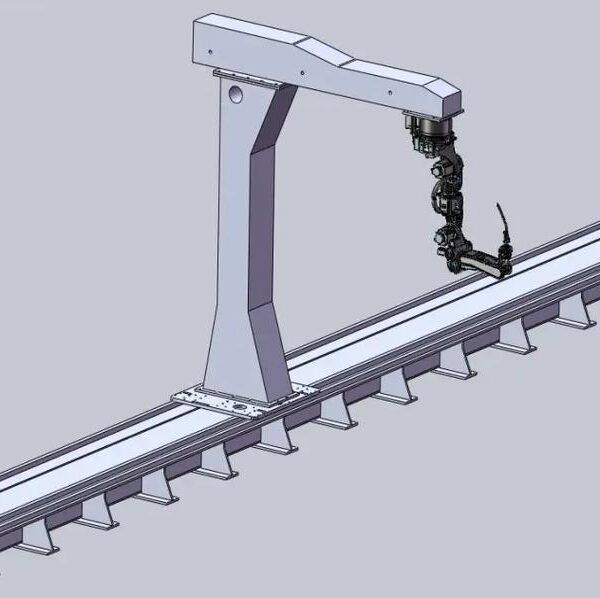
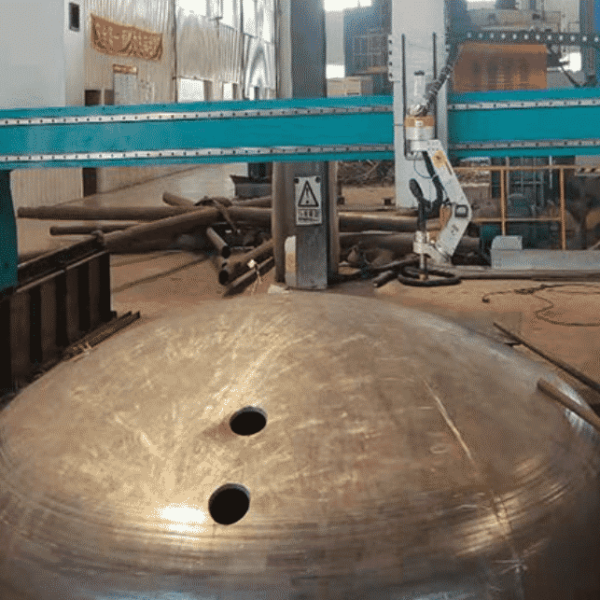
A gantry welding robot hangs a 6-axis welding robot from an overhead gantry, or mounts it on a column that travels along a floor rail. The gantry works as extra axes, so the robot reaches every seam on parts far larger than its own arm: trailer chassis, ship panels, bridge beams and large steel frames.
The stroke is built to your parts, for example 12 m × 4 m × 2 m, and beams of about 20 m can be welded in one pass along their length. Because the robot moves over a large area, one gantry can also serve several stations: it welds at one end while operators load the next part at the other.
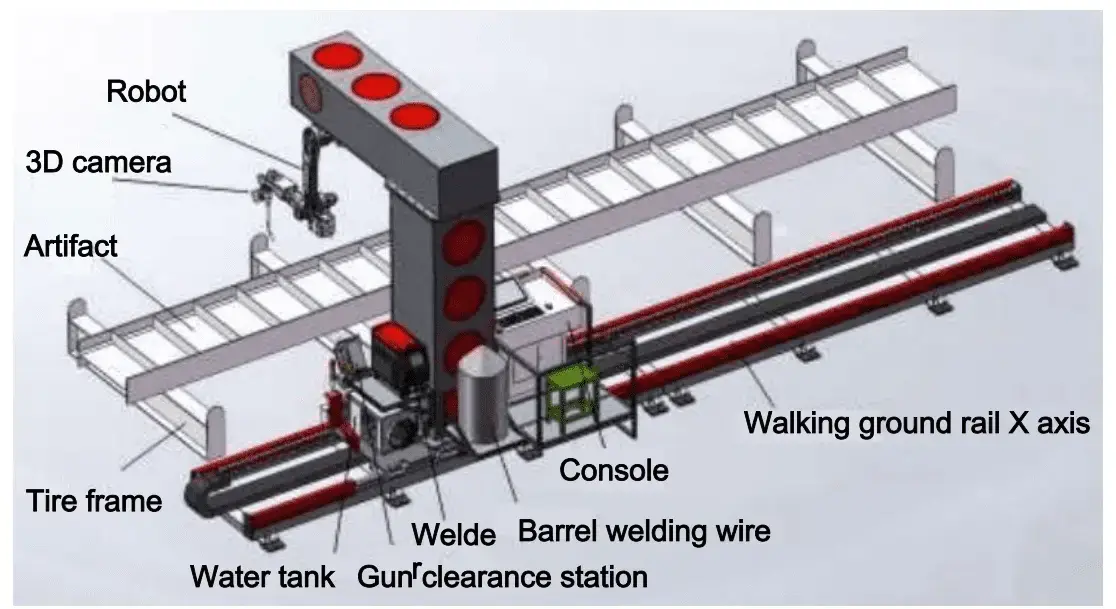
Technical Specifications
| Frame configuration | Overhead gantry or ground-rail column |
|---|---|
| Stroke (X / Y / Z) | Fully customizable, for example 12 m × 4 m × 2 m |
| Robot | 6-axis welding robot; the gantry adds the travel axes |
| Drive | Precision rack and pinion with AC servo motors |
| Welding processes | MIG / MAG / TIG / tandem twin-wire |
| Seam finding | Laser seam tracking and arc sensing (options) |
| Programming | Offline programming or teaching-free path generation |
| Welding power source | Aotai, Megmeet, Panasonic, Lincoln Electric, Miller or others on request |
| Welding standards | Procedures can be qualified to ISO, AWS D1.1 and classification-society rules (ABS, LR, CCS) |
| Certification | CE, ISO 9001 |
| Lead time | 20–45 days depending on configuration |
| Warranty | 24 months on the whole machine (consumables excluded) |
Overhead Gantry or Ground-Rail Column?
| Layout | How it works | Best for |
|---|---|---|
| Overhead gantry | The robot hangs from a bridge that travels on two rails | Wide parts and multi-station layouts; keeps the floor clear around the part |
| Ground-rail column | The robot sits on a column that travels on one floor rail | Long, narrower parts; lower building height needed |
How a Gantry Station Runs
- Load the part. Set the part on the welding bed or fixture with the crane. With two stations, one part is loaded while the other is welded.
- Generate the program. Import the model for offline programming, or let the teaching-free system generate the paths, depending on the configuration.
- Find the real seam. Laser seam tracking and arc sensing correct the torch for fit-up variation and heat distortion.
- Weld long seams continuously. The gantry carries the robot along the full length of the part, so long seams are welded without stops and restarts.
Typical Workpieces and Industries
Workpieces
- Truck and trailer chassis
- Ship panels and ship sections
- Bridge and structural beams
- Construction-machinery components
- Railway carriage frames
- Storage tanks and pressure vessels
Why a gantry
- Reach is set by the gantry, not by the robot arm
- Several stations under one gantry raise arc-on time
- Long seams welded in one continuous run
- Floor around the part stays free for crane loading (overhead version)
- Real-time seam tracking compensates for distortion
How It Compares with Other Welding Robots
| System | Strength | Choose it when |
|---|---|---|
| Cantilever welding robot CWR500A | Open front and back for crane loading; 3.5 m reach | Long plate units, H-beams and box girders loaded by crane |
| Gantry welding robot (this machine) | Covers a full rectangular area, e.g. 12 m × 4 m | Very wide parts such as ship sections and trailer frames |
| Rail-mounted 7-axis welding robot | Compact single-robot line with 3D scanning | Steel-structure members of similar size |
| Mobile welding robot | Drives to the workpiece; no rail needed | Parts too large or heavy to move to any station |
| Robot welding workstation | Positioner turns the part to the best welding angle | Repeat parts up to several tonnes in batches |
| Cobot welding station | Hand-guided teaching, no fence after risk assessment | Small, mixed parts and frequent changeovers |
What Determines the Price of a Gantry Welding Robot
A gantry is built to your floor space and parts, so it is quoted per project. The main cost drivers:
| Cost factor | Options | How it affects the price |
|---|---|---|
| Stroke | Length, width and height of the working area | The steel structure and rails grow with the working area |
| Number of robots | Per project | Each robot adds an arm, power source and torch set |
| Layout | Overhead gantry or ground-rail column | Overhead gantries need more steel but keep the floor clear |
| Process | Single wire or tandem twin-wire | Tandem needs a second power source and twin torch |
| Seam finding and programming | Laser tracking, arc sensing, offline or teaching-free | Software and sensors decide how fast new parts can be welded |
| Welding power source | Aotai, Megmeet, Panasonic, Lincoln Electric, Miller | Imported brands cost more; local brands are easier to service in some regions |
| Service | On-site installation and training | Quoted separately, usually about one week on site |
For a quote, send drawings of your largest and most common parts, the plate thickness, the material and the floor space available. We quote FOB Qingdao.
Delivery, Installation and Support
- Configuration and drawings. Our engineers lay out the gantry, stroke and stations to fit your floor space and parts.
- Production and factory test. Lead time is 20–45 days depending on the configuration. The system is assembled and test-welded before shipment.
- Site preparation. Prepare the foundation for the rails, the electrical supply and shielding gas, and check the crane clearance above the gantry. Confirm the foundation requirements with our engineers before the machine arrives.
- Installation and training. On-site installation and operator training usually take about one week and are quoted separately. Operators learn programming, daily operation and routine maintenance.
- After-sales support. 24-month warranty on the whole machine, consumables excluded, with remote technical support for software and process questions.
Common Problems on Large Weldments and How the Gantry Handles Them
Large parts bring their own problems: long seams, heat distortion and slow loading. This is how the gantry station deals with them:
| Problem | Typical cause | How the system handles it |
|---|---|---|
| Seam moves during welding | Heat distortion on long seams | Laser seam tracking and arc sensing correct the torch in real time |
| Fit-up varies from part to part | Cutting and assembly tolerances on large frames | The seam is located before welding instead of trusting the nominal model |
| Robot cannot reach deep or far seams | Fixed robot base and limited arm reach | The gantry carries the robot along X, Y and Z over the whole working area |
| Robot waits while parts are loaded | One station only | Two or more stations under one gantry: weld one while loading the other |
| Stop-start marks on long welds | Re-positioning a fixed robot | Continuous seams of about 20 m in one run |
Before You Buy: A Gantry Planning Checklist
A gantry is built around your parts and your building. Collect this information first:
- Dimensions and weight of the largest and the most common parts.
- Crane capacity and hook height over the planned working area.
- Available floor length, width and building height.
- Floor condition and space for rail foundations.
- Number of stations you want under the gantry.
- Welding process: single wire or tandem twin-wire, and plate thicknesses.
- Programming data: 3D models available for offline programming, or parts to be scanned.
- Electrical supply, shielding gas and fume extraction.
Daily and Periodic Maintenance
| Interval | Task |
|---|---|
| Every shift | Clean the nozzle and remove spatter; check the contact tip and replace it when the bore is worn; check the wire feed and wire stock; confirm shielding-gas flow |
| Weekly | Check torch cables and hoses for wear; check gas connections for leaks; clean the torch cleaning station or anti-spatter unit if fitted |
| Monthly | Clean the rails and racks; lubricate the rack and pinion and guides; check the cable chains and the cables inside them |
| Yearly | Check rail alignment and fixing bolts; service the robot and gantry drives as specified by the manufacturers |
Follow the robot and power-source manufacturers' manuals for reducer grease and battery replacement intervals. Back up robot programs and welding procedures after every change.
Safety Around a Gantry Station
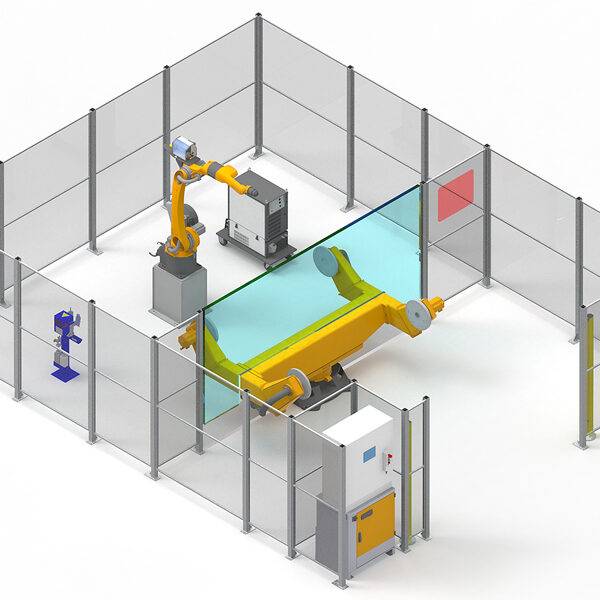
- Fence the working area and interlock the access gates with the robot controller.
- Use light curtains or area scanners between a welding station and a loading station.
- Coordinate crane movements with the gantry so that loads never pass over a moving robot.
- Fit fume extraction sized for the welding process and the length of the working area.
Advantages and Limitations
Advantages
- Welds parts far larger than any robot arm can reach
- Multi-station layouts keep the robot welding while parts are loaded
- Continuous long seams up to about 20 m
- Overhead version keeps the floor free
- Configurable for tandem twin-wire on thick plate
Limitations
- Needs floor space, foundations and crane clearance
- A fixed installation; for parts spread across a large shop a mobile welding robot may be more flexible
- For small repeat parts a workstation with a positioner is faster and cheaper
- Thin sheet parts are often better done with laser welding
Wire Size Reference for MAG Welding
Typical current windows for solid-wire MAG welding. The process library selects parameters automatically, but this table helps when you plan wire stock and plate thickness.
| Wire Ø | Short-circuit (A) | Globular (A) | Spray (A) | Typical plate |
|---|---|---|---|---|
| 0.8 mm | 40–120 | 120–170 | 170–200 | 0.8–4.0 mm |
| 1.0 mm | 60–140 | 140–190 | 190–300 | 2.0–8.0 mm |
| 1.2 mm | 80–180 | 180–240 | 240–400 | from about 4 mm |
| 1.6 mm | 130–220 | 220–280 | 280–500 | from about 8 mm |
Short-circuit transfer runs at about 14–22 V, globular transfer at about 22–26 V (the spatter zone to avoid), and spray transfer above 26 V.
Gantry Welding Robot FAQ
What is the maximum workpiece size?
The stroke is built to your parts. A typical working area is 12 m × 4 m × 2 m, and beams of about 20 m are welded along their full length. Larger strokes are possible.
Should I choose an overhead gantry or a ground-rail column?
An overhead gantry suits wide parts and multi-station layouts and keeps the floor clear. A ground-rail column suits long, narrower parts and needs less building height.
Can one gantry serve several stations?
Yes. The robot welds at one station while operators load or unload the next one, which raises arc-on time.
How is the robot programmed?
By offline programming from the part model, or with teaching-free path generation, depending on the configuration.
How does it handle distortion and fit-up gaps?
Laser seam tracking and arc sensing correct the torch position in real time while welding.
Can the welds meet AWS D1.1 or classification-society requirements?
Welding procedures can be qualified to ISO, AWS D1.1 and classification-society rules such as ABS, LR and CCS, for your specific joints and materials.
Does a gantry welding robot need a foundation?
Yes. The rails need a level, stable foundation. Confirm the foundation requirements with our engineers before the machine arrives.
How long does it take from order to production?
Lead time is 20–45 days depending on the configuration, plus about one week for on-site installation and training. Foundation work should be finished before delivery.
Which drive system moves the gantry?
A precision rack and pinion with AC servo motors.
See all welding robots to compare cantilever, gantry, mobile, workstation and cobot systems side by side.
Send us your part drawings and floor plan. Our engineers will propose the gantry layout, stroke and process, and quote FOB Qingdao.
Get a configuration and quote