Mobile Welding Robot: Overview
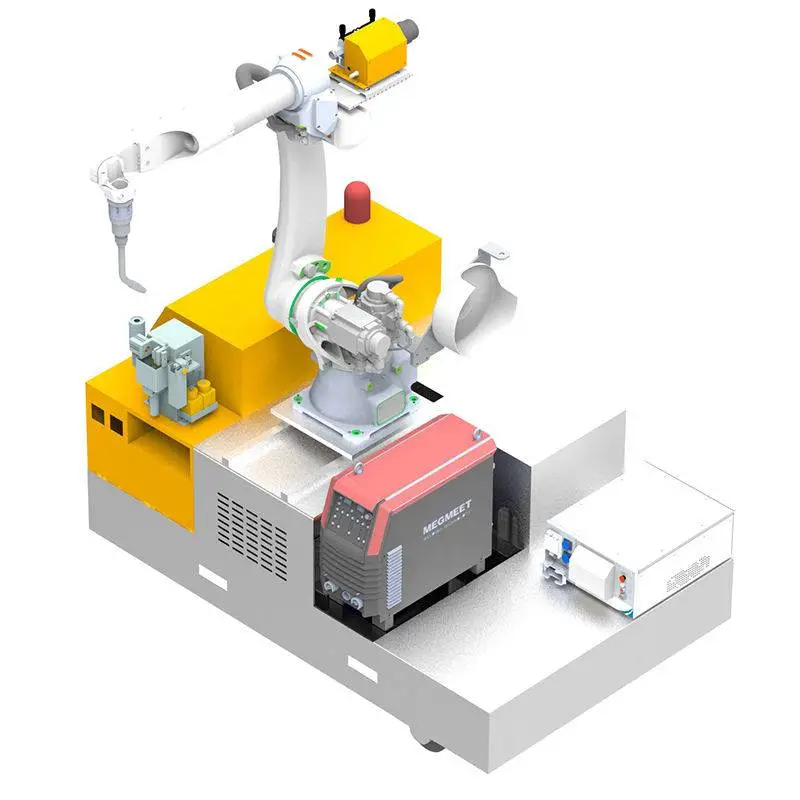
A mobile welding robot puts a 6-axis welding robot, its welding power source and sensors on a self-propelled chassis. Instead of craning a heavy workpiece into a fixed welding cell, you drive the robot to the workpiece. That makes it the practical choice for parts that are longer than about 3 m, heavier than about 1 t, or simply too awkward to move.
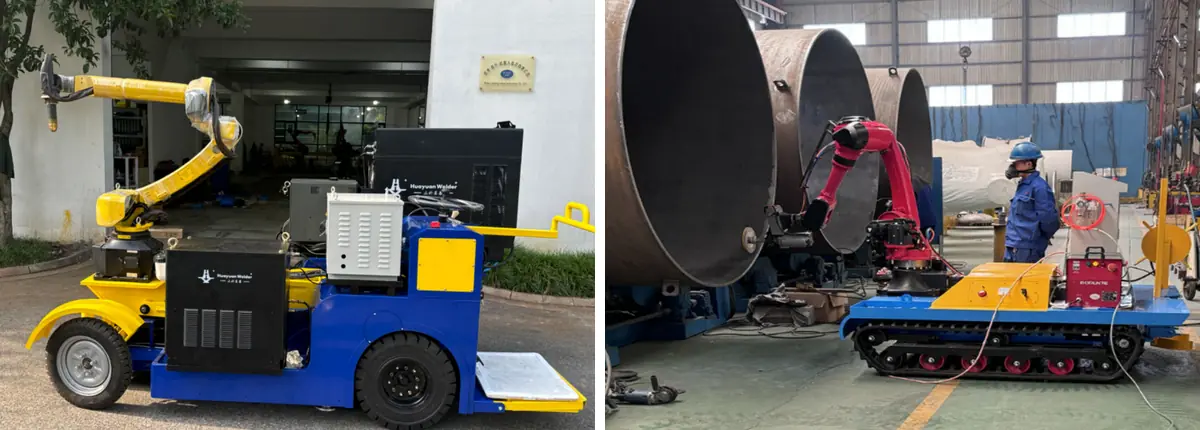
We build the mobile welding robot in three chassis configurations: a tracked version for compact, rugged work, a lifting wheeled version with a 4 m vertical reach for tall parts, and a steering-wheel version powered by cable for long shifts on one site. All three are sold; the right one depends on your parts and floor.
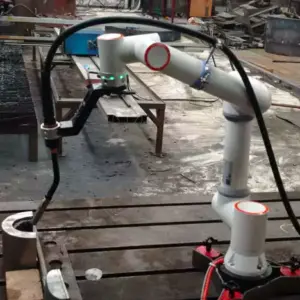
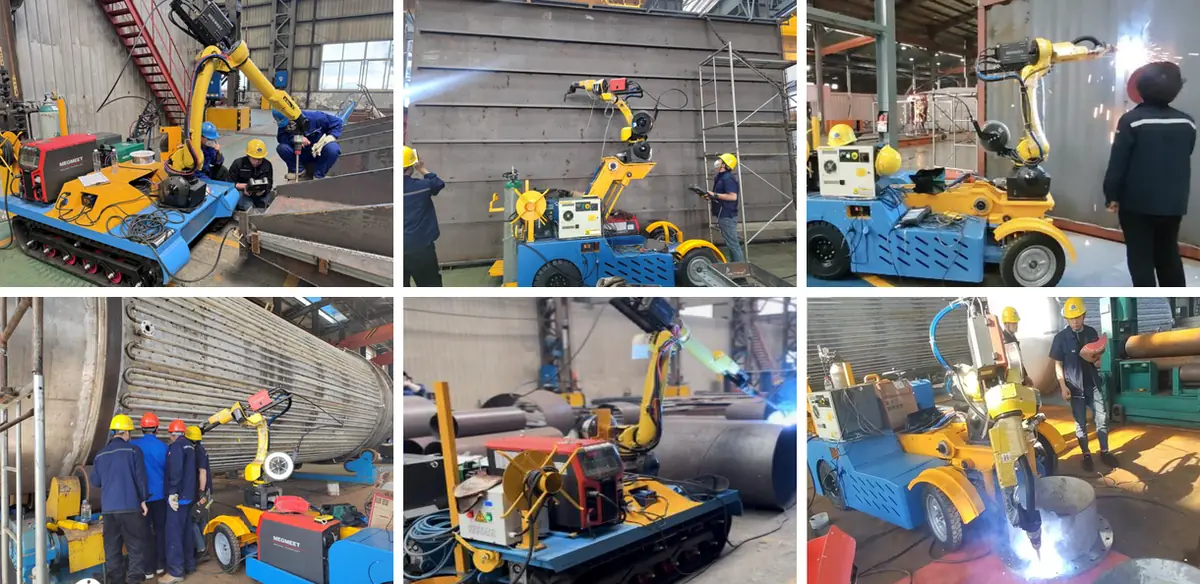
Mobile Welding Robot in Action
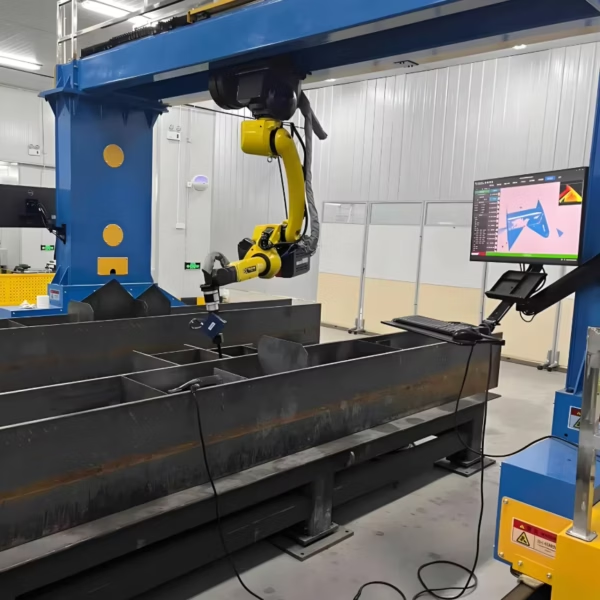
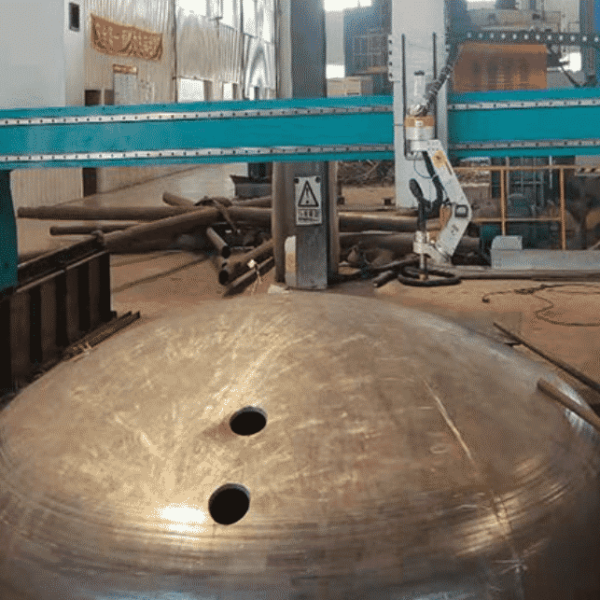
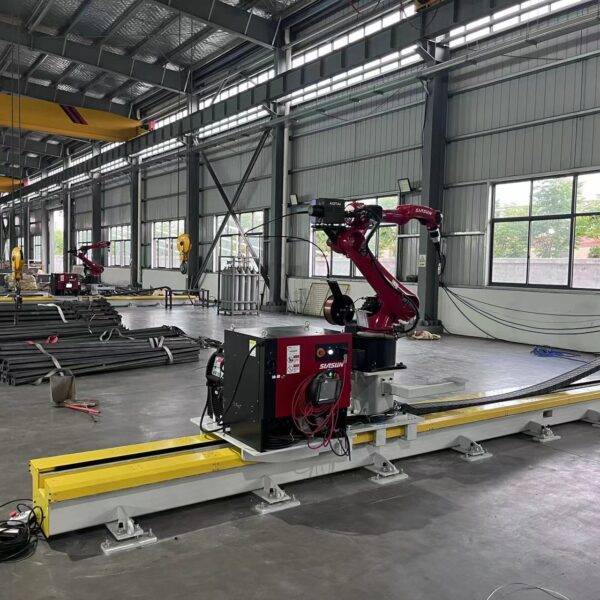
The robot drives to the workpiece, locates the seam and welds without a fixed cell.
Three Configurations
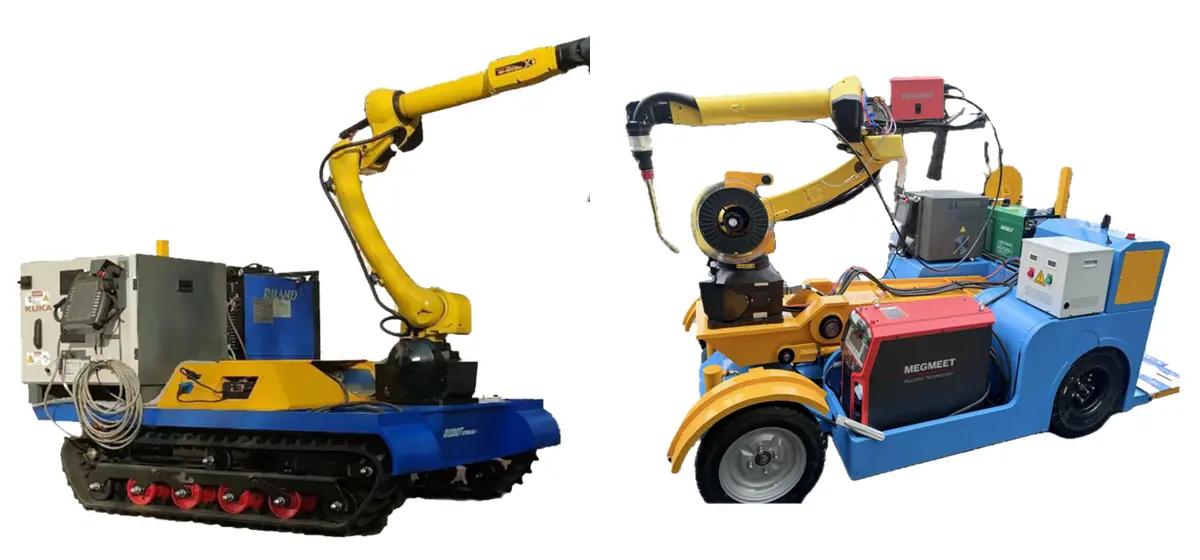
| Item | Tracked | Lifting wheeled | Steering-wheel |
|---|---|---|---|
| Robot | FANUC M-10iD/8L | FANUC M-10iD/8L | CRP2010A |
| Welding power source | Megmeet EHAVE2 CM500R | Megmeet EHAVE2 CM500R | Aotai NBC500RP Plus |
| Rated current / voltage | 500 A / 12–45 V | 500 A / 12–45 V | 500 A class |
| Horizontal / vertical reach | 4 m / 2.7 m | 4 m / 4 m | per workpiece layout |
| Power | 30 kW, battery 72 V 180 Ah × 6 | 26.8 kW, battery 48 V 120 Ah × 6 | 50 kVA, 3 × 380 V 50 Hz cable supply |
| Dimensions | 1940 × 1460 × 1300 mm | 2600 × 1400 × 2100 mm | 3000 × 1500 × 2400 mm |
| Weight | 1100 kg | 1700 kg | 2500 kg |
| Running gear | Tracks 1750 × 1390 × 400 mm, 230 mm wide | Tyres Ø530 mm, 130 mm wide, wheelbase 1600 mm | Steering-wheel drive, remote control |
| Minimum turning radius | 1200 mm | 3000 mm | — |
| Travel speed | 15 km/h rated | 15 km/h rated | 2.2 km/h |
| Range per charge | 20–50 km | 20–50 km | unlimited on cable |
| Torch | TRM-602W water-cooled | TRM-602W water-cooled | per process |
| Vision | Arc tracking or laser tracking | Arc tracking or laser tracking | Point cloud, 0.1 mm accuracy; TracerStudio software |
| Operating environment | — | — | 0–45 °C, up to 90% RH (non-condensing) |
Common to all versions: carbon steel and stainless steel; flat, fillet, vertical and low-current overhead positions; shielding gas Ar 80% + CO₂ 20%, pure CO₂ or pure Ar. Certification CE, ISO 9001.
The robot arm
The tracked and lifting versions use the FANUC M-10iD/8L: a 6-axis arm with 8 kg payload and 2032 mm reach. The welding cables run inside the arm, so they do not snag on the workpiece, and the gear-driven arm stays rigid at full reach. ROBOGUIDE offline teaching is available as an option.
How It Works on the Shop Floor
- Drive to the workpiece. The operator drives the robot next to the part by remote control. The part can stay where the crane put it; no large fixture is needed.
- Program on site or reuse a program. New seams are taught on the spot. Similar seams reuse a stored program with a few adjusted points, which takes minutes rather than hours.
- Locate and correct. Touch sensing, laser positioning or 3D vision finds the real seam and corrects for the parking position of the robot.
- Weld with real-time tracking. Arc tracking adjusts the torch while welding. Multi-layer, multi-pass packages handle thick plate; carbon-steel fillet welds up to 8 mm can be welded from one side with formation on both sides.
Is a Mobile Welding Robot Right for Your Parts?
Use this checklist. If most rows match your production, a mobile robot is usually the better investment than a fixed cell:
| Factor | Good fit when |
|---|---|
| Workpiece size and weight | Longer than 3 m, heavier than 1 t, costly to crane |
| Weld time per part | Long welds per part (more than 15 minutes), flexible takt |
| Floor | Level shop floor, aisles wider than 1.5–2 m |
| Product mix | High-mix, low-volume, frequent path changes |
Typical Workpieces and Industries
Workpieces
- Excavator booms and construction-machinery frames
- Ship sections and large steel structures
- Wind towers and large fans
- Pressure vessels and energy-storage containers
- Shipping containers and rail car bodies
- Bridge box girders, building beams and columns
- Oil and gas manifolds
Why mobile wins here
- No skilled welder needed to operate
- No large fixtures for big structures; parts can be placed freely
- Consistent beads without missed welds
- One robot can serve several stations, raising equipment utilisation
- Several robots can work on one large part
- Replaces manual welding in confined, hazardous or fume-heavy areas
How It Compares with Other Welding Robots
| System | Strength | Choose it when |
|---|---|---|
| Cantilever welding robot CWR500A | Open front and back for crane loading; 3.5 m reach | Long plate units, H-beams and box girders loaded by crane |
| Gantry welding robot | Covers a full rectangular area, e.g. 12 m × 4 m | Very wide parts such as ship sections and trailer frames |
| Rail-mounted 7-axis welding robot | Compact single-robot line with 3D scanning | Steel-structure members of similar size |
| Mobile welding robot (this machine) | Drives to the workpiece; no rail needed | Parts too large or heavy to move to any station |
| Robot welding workstation | Positioner turns the part to the best welding angle | Repeat parts up to several tonnes in batches |
| Cobot welding station | Hand-guided teaching, no fence after risk assessment | Small, mixed parts and frequent changeovers |
What Determines the Price of a Mobile Welding Robot
Every mobile robot is configured to the parts it will weld. These items move the quote up or down:
| Cost factor | Options | How it affects the price |
|---|---|---|
| Chassis | Tracked, lifting wheeled or steering-wheel | The lifting column and battery capacity add cost; the cable-powered version has no battery |
| Robot arm | FANUC M-10iD/8L or CRP2010A | Imported arms cost more and suit demanding processes |
| Sensing | Arc tracking, laser tracking, 3D vision / point cloud | Vision makes repositioning faster on mixed parts |
| Welding power source | Aotai, Megmeet, Panasonic, Lincoln Electric, Miller | Imported brands cost more; local brands are easier to service in some regions |
| Number of robots | One or several working together | Each extra robot is a complete unit |
| Service | On-site installation and training | Quoted separately, usually about one week on site |
For a quote, send photos or drawings of your largest parts, the plate thickness, the material and how far the robot needs to travel between parts. We quote FOB Qingdao.
Delivery, Installation and Support
- Configuration and drawings. Our engineers choose the chassis, robot and sensing from your parts, floor conditions and aisle widths.
- Production and factory test. Lead time is 20–45 days depending on the configuration. The system is assembled and test-welded before shipment.
- Site preparation. Check that aisles are at least 1.5–2 m wide and the floor is level. The steering-wheel version needs a 3 × 380 V supply; battery versions need a charging point.
- Installation and training. On-site installation and operator training usually take about one week and are quoted separately. Operators learn programming, daily operation and routine maintenance.
- After-sales support. 24-month warranty on the whole machine, consumables excluded, with remote technical support for software and process questions.
Advantages and Limitations
Advantages
- Brings the robot to parts that are too big to move
- Works without large fixtures or floor rails
- Short programming time for similar seams
- Battery versions work away from power outlets
- Lifting version reaches seams up to 4 m high
- Takes welders out of confined and fume-heavy spaces
Limitations
- Needs level floors and clear aisles
- Small parts in high volume with short takt (for example automotive stampings) are faster and cheaper in a fixed robot welding workstation
- Thin sheet parts are often better done with laser welding
- Battery range limits continuous travel; plan charging into the shift

Wire Size Reference for MAG Welding
Typical current windows for solid-wire MAG welding. The process library selects parameters automatically, but this table helps when you plan wire stock and plate thickness.
| Wire Ø | Short-circuit (A) | Globular (A) | Spray (A) | Typical plate |
|---|---|---|---|---|
| 0.8 mm | 40–120 | 120–170 | 170–200 | 0.8–4.0 mm |
| 1.0 mm | 60–140 | 140–190 | 190–300 | 2.0–8.0 mm |
| 1.2 mm | 80–180 | 180–240 | 240–400 | from about 4 mm |
| 1.6 mm | 130–220 | 220–280 | 280–500 | from about 8 mm |
Short-circuit transfer runs at about 14–22 V, globular transfer at about 22–26 V (the spatter zone to avoid), and spray transfer above 26 V.
Mobile Welding Robot FAQ
What is the difference between the tracked and the wheeled version?
The tracked version is compact (1940 × 1460 × 1300 mm), turns in a 1200 mm radius and suits rough or tight floors. The lifting wheeled version is larger but lifts the robot to reach seams up to 4 m high. The steering-wheel version runs on a cable supply for unlimited working time in one area.
Does the operator need to be a certified welder?
No. The operator drives the robot, starts the program and checks the result. A welding engineer sets up the procedures once; similar seams then reuse stored programs.
How does the robot find the seam after it parks?
Touch sensing, laser positioning or 3D vision measures the real position of the part, so the program is corrected for wherever the robot stopped.
Which positions can it weld?
Flat, fillet and vertical welds, and overhead welds at low current, on carbon steel and stainless steel.
How far can it travel on one charge?
The battery versions are rated for a range of 20–50 km depending on use. The steering-wheel version is cable-powered and does not need charging.
Can the welds meet AWS D1.1 or classification-society requirements?
Welding procedures can be qualified to ISO, AWS D1.1 and classification-society rules such as ABS, LR and CCS. Procedure qualification is carried out for your specific joints and materials.
What is the lead time?
Lead time is 20–45 days depending on the configuration. On-site installation and operator training take about one week and are quoted separately. The machine has a 24-month warranty, consumables excluded.
Can several mobile robots work on one large part?
Yes. Several robots can work on the same large structure at the same time, each welding its own seams.
Can the platform do anything besides welding?
The same mobile platform can carry a cutting or grinding tool, so one chassis design covers welding, cutting and grinding work on large parts.
See all welding robots to compare cantilever, gantry, mobile, workstation and cobot systems side by side.
Send us photos of your largest parts. Our engineers will recommend the chassis, robot and sensing package, and quote FOB Qingdao.
Get a configuration and quote