H-Beam Production Line with Laser Seam Tracking for Oil & Gas Tanks
In this article
- Optimizing H-Beam Fabrication for Oil and Gas Storage Infrastructure
- Advanced Intersection Accuracy in H-Beam Processing
- Eliminating Geometric Deviations
- Complex Cut-Outs and Coping
- Laser Seam Tracking for Real-Time Path Correction
- Dynamic Sensing Capabilities
- High-Precision Beveling for Enhanced Weld Preparation
- Robotic Beveling Versatility
- Heat-Affected Zone (HAZ) Control
- Low Maintenance and Operational Longevity
- Consumable Management and Duty Cycles
- Environmental and Physical Footprint
- Integrating Data and Automation for Future-Proof Production
Optimizing H-Beam Fabrication for Oil and Gas Storage Infrastructure
In the demanding environment of the Oil and Gas industry, the structural integrity of storage tanks depends heavily on the precision of the underlying H-beam framework. These beams provide the essential skeletal support required to withstand massive hydrostatic loads and environmental stresses. To meet these rigorous standards, modern production lines have shifted toward automated Plasma Cutting technology integrated with sophisticated sensing systems. This shift ensures that every structural component adheres to the tight tolerances required for heavy-duty energy infrastructure.
The transition from traditional mechanical sawing and drilling to automated plasma solutions addresses the primary bottlenecks in H-beam processing: geometric variability and prep-time for assembly. When fabricating supports for tanks, the H-beams must be processed with extreme attention to the web and flange intersections, as any deviation can compromise the load-bearing capacity of the entire structure.
Advanced Intersection Accuracy in H-Beam Processing
One of the most critical challenges in H-beam fabrication is achieving high intersection accuracy. H-beams, by their nature, are not perfectly uniform; they often possess slight deviations in flange parallelism or web centering from the mill. Standard CNC programming assumes a “perfect” beam, which leads to gaps or overlaps during the fit-up phase of tank construction.

Eliminating Geometric Deviations
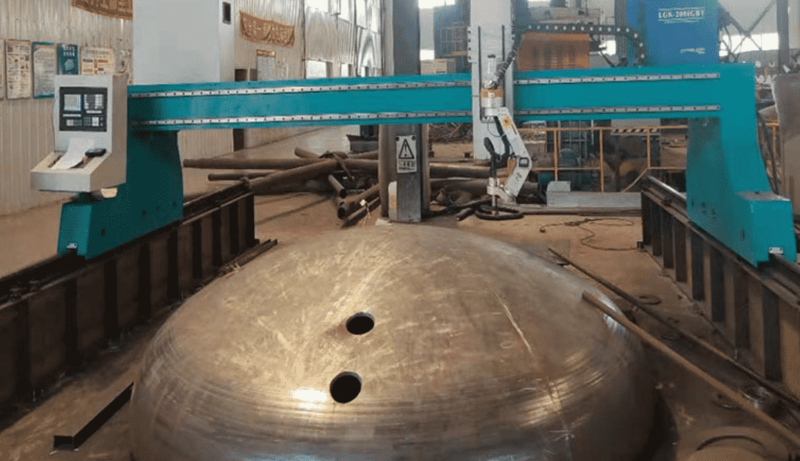
Modern plasma cutting stations utilize multi-axis robotic arms or specialized gantry systems that can articulate around the H-beam’s profile. By incorporating laser seam tracking, the system performs a pre-cut scan or real-time adjustment to map the actual surface of the steel. This allows the plasma torch to maintain a consistent standoff distance and compensate for any twisting or warping in the raw material. In the context of Oil and Gas tanks, where structural supports must meet exact seismic and pressure specifications, this level of accuracy ensures that the beams mate perfectly with curved tank walls or secondary support plates.
Complex Cut-Outs and Coping
The ability to execute complex “coping” cuts—where the ends of the H-beam are notched to fit into other structural members—is where plasma cutting excels. The high energy density of the plasma arc allows for clean, sharp corners at the web-flange intersection. This precision reduces the need for manual grinding and ensures that the structural load is distributed evenly across the joint, a non-negotiable requirement for high-capacity liquid storage systems.
Laser Seam Tracking for Real-Time Path Correction
The integration of laser seam tracking serves as the “eyes” of the plasma cutting system. In heavy industrial fabrication, thermal expansion during the cutting process can cause the workpiece to shift. Without real-time tracking, a programmed cut might drift, leading to scrap material and costly delays.
Dynamic Sensing Capabilities
The laser sensor is typically mounted ahead of the plasma torch. It projects a laser line across the beam’s surface, and a high-speed camera captures the deformation of that line to calculate the exact topography of the metal. This data is fed back to the CNC controller at millisecond intervals. For Oil and Gas tank fabricators, this means that even the thickest H-beams used in foundation piling or secondary containment structures are processed with a precision that exceeds manual layout capabilities.
Consistency Across Batch Production
When producing hundreds of identical support beams for a tank farm, consistency is paramount. Laser tracking ensures that the first beam is identical to the last, regardless of minor variations in the raw steel batches. This repeatability is the cornerstone of H-beam fabrication efficiency, allowing for streamlined downstream assembly where components can be “bolted into place” with zero field modification.
High-Precision Beveling for Enhanced Weld Preparation
In Oil and Gas applications, the structural joints are often subjected to extreme tension and fatigue. Simple square cuts are rarely sufficient. Automated plasma systems allow for multi-axis beveling accuracy, creating V, Y, or K-shaped profiles on the beam ends or web cut-outs. These profiles are essential for achieving full penetration during the final assembly phases of the tank framework.
Robotic Beveling Versatility
Traditional beveling requires secondary operations, often involving manual oxy-fuel torches or portable beveling machines. Integrating a 5-axis or 6-axis plasma head into the production line allows the bevel to be cut simultaneously with the length-cut. This “one-hit” processing significantly reduces the cycle time per beam. The plasma system can vary the bevel angle dynamically as it moves along the profile, accommodating the complex geometry where an H-beam meets the radius of a cylindrical storage tank.
Heat-Affected Zone (HAZ) Control
Modern high-definition plasma systems offer superior control over the heat-affected zone. By optimizing the cutting speed and gas flow (typically oxygen or nitrogen mixtures), engineers can ensure that the metallurgical properties of the H-beam remain intact. This is vital for the carbon steels and high-strength low-alloy (HSLA) steels commonly used in energy infrastructure, where brittle edges could lead to stress fractures under the weight of several million gallons of stored product.
Low Maintenance and Operational Longevity
From an industrial engineering perspective, the Total Cost of Ownership (TCO) is a primary metric. Compared to mechanical cutting methods—which involve saw blades that dull or drill bits that break—plasma cutting offers a remarkably low maintenance profile. There are no mechanical forces exerted on the machine structure from the cutting process itself, reducing wear on bearings, rails, and motors.
Consumable Management and Duty Cycles
The primary maintenance requirements for plasma systems are the replacement of electrodes and nozzles. Modern “long-life” consumable technology has extended the duty cycle of these components, allowing for several hours of continuous arc-on time. Furthermore, because the system is digitized, the software can track consumable wear and alert operators before cut quality degrades. This predictive maintenance approach is essential for high-volume H-Beam Production Lines that must operate 24/7 to meet project deadlines for refinery expansions or new terminal builds.
Environmental and Physical Footprint
Plasma systems are generally more compact than the massive saw-and-drill lines they replace. This allows for a more efficient factory layout. Additionally, the integration of dust extraction and fume filtration systems ensures that the production environment remains safe and compliant with industrial health standards. The lack of oily lubricants (required for mechanical saws) also results in a cleaner workpiece, which is a significant advantage when the H-beams move to the painting or coating stage for corrosion protection in offshore or coastal tank farms.
Integrating Data and Automation for Future-Proof Production
The final layer of the modern H-beam production line is the integration of BIM (Building Information Modeling) and CAD/CAM software. Digital designs of Oil and Gas tanks can be directly imported into the plasma cutting system. The software automatically calculates the nesting patterns to minimize scrap and generates the toolpaths for the laser seam tracker and plasma torch.
Summary of Engineering Advantages
By focusing on the synergy between plasma cutting and laser sensing, fabricators can achieve a level of structural reliability that was previously unattainable. The combination of intersection accuracy, beveling accuracy, and the inherent low maintenance of the system creates a robust production environment. For the Oil and Gas sector, this translates to faster project completion, reduced field errors, and infrastructure that is built to withstand the rigors of the energy landscape for decades to come.






