Engineering Review: Deep Penetration Collaborative Arc Welding System – Seoul, South Korea
In this article
- Field Report: Implementation of Deep Penetration Collaborative Arc Welding Systems
- Location: Guro-gu Industrial Complex, Seoul, South Korea
- 1. Project Overview and Objectives
- 2. Technical Synergy: Collaborative Arc Welding System and Automated Welding
- 3. Carbon Steel Welding: Material Behavior and Preparation
- 4. Real-World Application and On-Site Calibration
- 5. Lessons Learned from the Seoul Field Test
- 6. Productivity Gains and Economic Impact
- 7. Safety and Collaborative Environment
- 8. Conclusion
Field Report: Implementation of Deep Penetration Collaborative Arc Welding Systems
Location: Guro-gu Industrial Complex, Seoul, South Korea
Date: October 23, 2023
1. Project Overview and Objectives
This report details the field implementation and performance evaluation of a Deep Penetration Collaborative Arc Welding System deployed at a heavy fabrication facility in Seoul. The facility specializes in structural components for high-rise infrastructure, requiring extensive Carbon Steel welding on plates ranging from 20mm to 50mm in thickness.
The primary objective was to transition from manual Flux-Cored Arc Welding (FCAW) to a hybrid model of Automated Welding. By utilizing a Collaborative Arc Welding System, we aimed to achieve deeper penetration in a single pass, reducing the total number of layers required for full-penetration V-groove joints, while maintaining the flexibility of a human-operated workshop floor.
2. Technical Synergy: Collaborative Arc Welding System and Automated Welding
In the context of the Seoul workshop, the synergy between a Collaborative Arc Welding System and Automated Welding is not merely about replacing a human hand with a robotic arm; it is about managing the thermal and physical demands of deep penetration arcs that exceed the limits of manual endurance.
Traditional Automated Welding (gantry or rail-based) requires rigid fixtures and significant floor space—a luxury not available in the high-density industrial zones of Seoul. The Collaborative Arc Welding System solves this by allowing a compact footprint where the welder works alongside the machine. The “Collaborative” aspect handles the complex torch angles and constant Contact-to-Work Distance (CTWD) required for deep penetration, while the “Automated” logic maintains the high-current parameters (up to 450A) that would be physically impossible for a manual operator to stabilize over a long seam.
3. Carbon Steel Welding: Material Behavior and Preparation
The project utilized S355JR and S355K2 carbon steels. Carbon Steel welding at high depths of penetration introduces specific metallurgical risks, primarily regarding the Heat Affected Zone (HAZ) and grain growth. Our field tests focused on a 1.2mm solid wire with a 90% Argon / 10% CO2 shielding gas mix to stabilize the arc during deep penetration cycles.
Joint Configuration
We moved from a 60-degree V-groove to a narrow-gap 35-degree V-groove. This change was only possible because the Collaborative Arc Welding System provides the precision necessary to track the root without wandering, which is a common failure point in manual Carbon Steel welding. The automated control of the oscillation parameters allowed for a 6mm root face with zero gap, achieving 100% penetration in the first pass.
4. Real-World Application and On-Site Calibration
During the first week in Seoul, we encountered several challenges related to the local power supply and ambient humidity in the workshop. The Automated Welding software initially struggled with voltage fluctuations, which affected the arc force required for deep penetration. We recalibrated the power source to include a secondary inverter stabilizer, ensuring the Collaborative Arc Welding System received constant input.
Deep Penetration Parameters
To achieve the “Deep Penetration” designation, we utilized a modified spray transfer mode. The parameters were locked at:
- Current: 420A – 440A
- Voltage: 34V – 36V
- Travel Speed: 35 cm/min
- Wire Feed Speed: 14.5 m/min
These settings on Carbon Steel welding allowed us to reach a penetration depth of 8mm in a single pass, nearly double the 4.5mm limit of our previous manual FCAW procedures.
5. Lessons Learned from the Seoul Field Test
I. Thermal Drift in Cobot Sensors
One of the most critical lessons learned was the impact of radiant heat. When performing Automated Welding at 400A+ on thick Carbon Steel welding plates, the heat soak into the collaborative arm is immense. Despite the “collaborative” rating, the sensors in the arm joints began to drift after 45 minutes of continuous duty cycle.
Correction: We implemented a mandatory cooling cycle and integrated a high-capacity water-cooled torch specifically designed for heavy-duty Collaborative Arc Welding System applications. We also added a localized heat shield between the torch and the cobot’s sixth-axis sensor.
II. Surface Contamination and Gas Coverage
The Seoul facility is located near a high-traffic industrial port area. We found that atmospheric particulates were more aggressive than anticipated. In Automated Welding, the machine does not “see” a slightly contaminated surface like a human welder does.
Correction: We updated the SOP to include a mechanical grind to bright metal within 2 hours of welding. For Carbon Steel welding, even a thin layer of oxidation was found to cause micro-porosity when the deep penetration arc agitated the weld pool at high currents.
III. The “Hand-Guiding” Paradox
The staff in Seoul initially treated the Collaborative Arc Welding System as a simple playback device. However, deep penetration requires active monitoring of the molten pool. We learned that the most effective use of the system was “active collaboration”—where the welder uses the lead-through teaching mode to set the path, but stays within the safety zone to adjust the voltage trim in real-time via the HMI (Human-Machine Interface) if the gap varies.
6. Productivity Gains and Economic Impact
After three weeks of implementation, the data showed a significant shift in production metrics. The Automated Welding approach reduced the arc-on time by 55% per joint. For a standard 2-meter seam on 25mm carbon steel, the manual process took 140 minutes (including cleaning between 5 passes). The Collaborative Arc Welding System completed the same joint in 3 passes over 65 minutes.
Furthermore, the rejection rate for ultrasonic testing (UT) dropped from 4.2% to 0.8%. Most manual failures were found at the start/stop points; the automated system handles these transitions with ramp-down crater fill logic that a human simply cannot replicate with 100% consistency.
7. Safety and Collaborative Environment
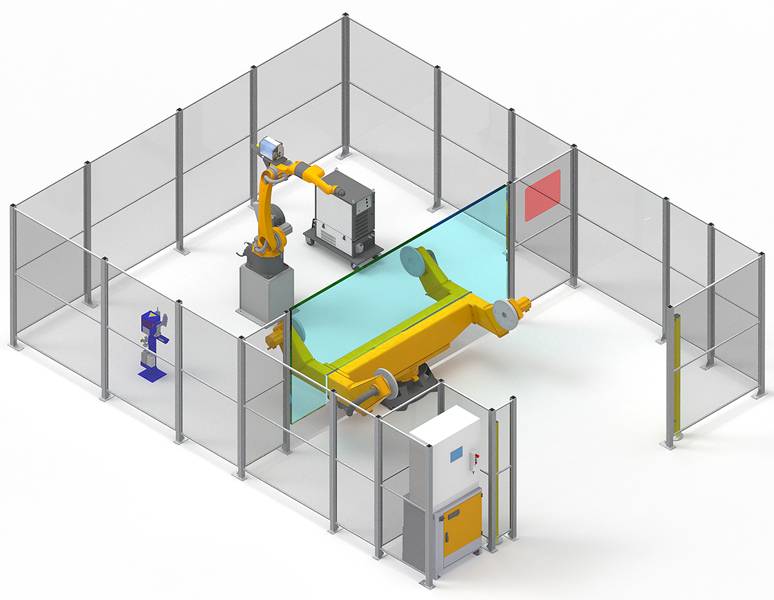
Integrating a Collaborative Arc Welding System into a crowded Seoul workshop requires a culture shift. Unlike traditional Automated Welding cells that are fenced off, this system shares the floor. We had to establish a “flash-zone” protocol where blue-light safety curtains were replaced with portable laser-safe barriers. Because the system is collaborative, the force-torque sensors were tuned to detect an obstruction (a human worker) and stop within 0.08 seconds, ensuring that the high-power arc is extinguished immediately if the workspace is breached.
8. Conclusion
The deployment in Seoul confirms that for heavy-duty Carbon Steel welding, the future lies in the hybrid application of Automated Welding and Collaborative Arc Welding System technology. The ability to execute deep penetration welds with the precision of a machine and the situational awareness of a senior welder provides a competitive edge in both quality and speed.
The “Seoul Model”—compact, high-output, and collaborative—should be the blueprint for urban-based heavy fabrication. Moving forward, we recommend the permanent adoption of these systems for all S355 structural projects, provided that the cooling requirements and surface preparation protocols identified in this report are strictly maintained.
Report Compiled By:
Senior Welding Engineer, Global Operations
Field Division – Seoul Office







