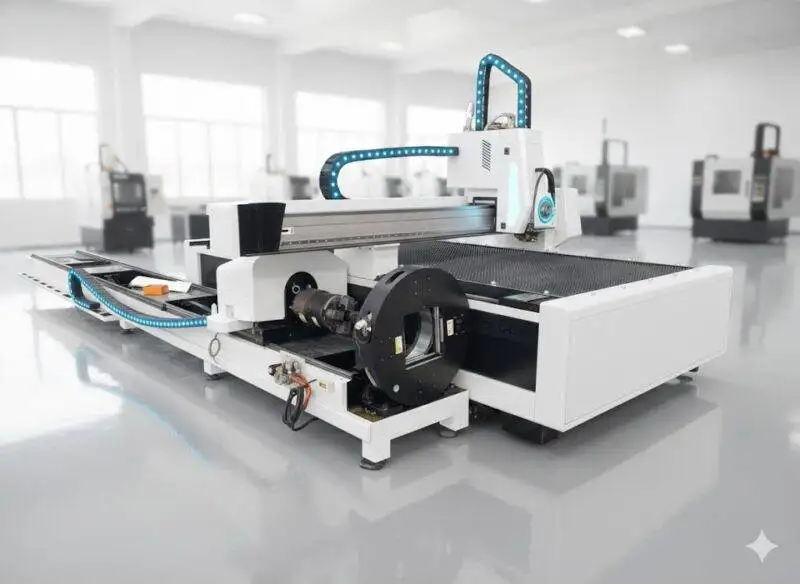
Fiber Laser Cutting Machine with Offline Programming for Oil & Gas Tanks
In this article
Optimizing Oil & Gas Tank Fabrication through High-Power Fiber Laser Integration
In the heavy industrial landscape of oil and gas equipment manufacturing, the demand for precision in pressure vessel and storage tank fabrication has reached an inflection point. Traditional methods of preparing large-format plates and dished ends often involve multi-stage handling that introduces cumulative error. The implementation of Fiber Laser Cutting technology, coupled with sophisticated offline programming environments, represents a fundamental shift in production efficiency. This transition allows industrial engineers to consolidate several manufacturing steps into a single, high-speed automated cycle.
Mechanical Superiority: Precision and Edge Quality
Fiber laser resonators, operating at wavelengths typically around 1.06 microns, offer superior absorption rates in reflective materials and carbon steels common in the oil and gas industry. For tank walls and end caps, the focus is on maintaining structural integrity. The fiber laser provides a high power density that results in an extremely narrow kerf width. This precision is critical when cutting complex nozzle intersections or manway openings on curved surfaces.
One of the primary advantages for an industrial engineer is the elimination of secondary processes. High-quality fiber laser cuts produce a surface finish that requires no grinding. The Heat Affected Zone (HAZ) is significantly reduced compared to older thermal cutting technologies. This localized heat input prevents metallurgical changes in the base metal, ensuring that the material properties of the alloy—such as its corrosion resistance and tensile strength—remain intact for the life of the vessel.
The Integrated Sequence: Punch, Mark, and Cut
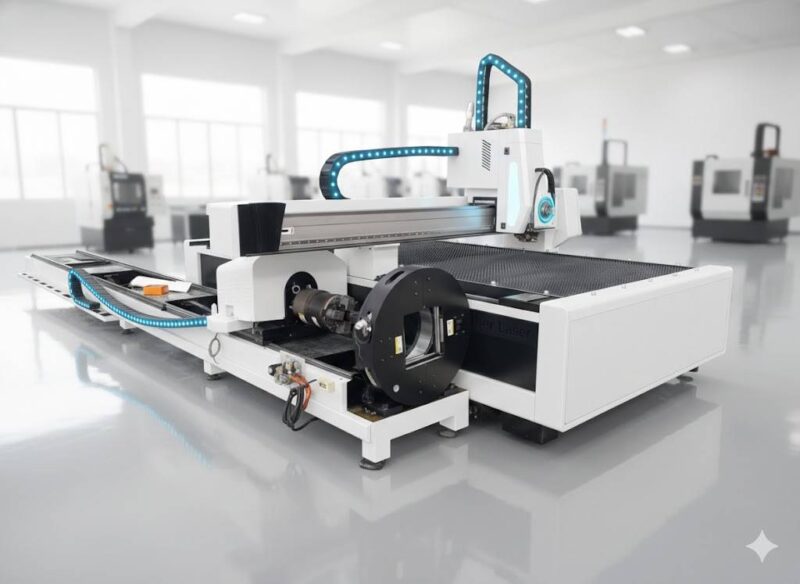
A modern fiber laser system for tank production is not merely a cutting tool; it is a multi-functional processing center. The “Punch, Mark, and Cut” workflow allows the machine to perform three distinct operations in one setup:
1. Piercing and Punching
The laser system utilizes ultra-fast pulsing to “punch” start holes for internal geometries. Unlike mechanical punching, this process does not induce mechanical stress or deformation in the surrounding material. For thick-walled tanks, controlled piercing parameters prevent cratering and ensure a clean entry point for the subsequent cut.
2. Precision Marking
Before the final separation of parts, the laser can be defocused to etch or mark the plate surface. This is utilized for part identification, bend lines, and assembly layout guides. By marking the exact locations for nozzles and internal baffles during the cutting phase, downstream assembly becomes a matter of following high-precision “maps,” eliminating manual layout time and the risk of human error.
3. Final Profile Cutting
The final cut is executed with high-pressure assist gases (typically Oxygen for carbon steel or Nitrogen for stainless steel). The result is a dross-free edge ready for immediate fit-up. In the context of oil and gas tanks, where tolerances for fit-up are governed by strict codes such as ASME Section VIII, the ability to achieve sub-millimeter accuracy over large spans is a significant competitive advantage.
The Role of Offline Programming (OLP) in Throughput Maximization
The bottleneck in many fabrication facilities is not the machine speed, but the programming time and machine idle time during setup. Offline Programming addresses this by decoupling the software engineering from the physical operation of the laser. Industrial engineers can generate toolpaths, simulate movements, and optimize nesting patterns on a remote workstation while the machine remains in active production.
Eliminating Machine Downtime
Traditional “teach-pendant” programming requires the machine to be stationary while the operator defines points. OLP software allows for the import of 3D CAD models (STEP or IGES files) of the entire tank assembly. The software automatically calculates the optimal cutting angles, especially for 3D beveling on dished ends. By the time the code reaches the machine controller, it has been verified for kinematics and collision avoidance, ensuring that the laser head never makes contact with the workpiece or fixtures.
Dynamic Nesting and Material Utilization
Material costs represent the largest portion of the total cost of goods sold (COGS) in tank manufacturing. OLP systems utilize advanced algorithms to improve Nesting Efficiency. By nesting components for multiple different projects on a single large sheet or coil, the software minimizes scrap rates. For the oil and gas sector, where specialized alloys are expensive, even a 5% increase in material utilization can translate to six-figure annual savings.
Data-Driven Process Control and Quality Assurance
From an industrial engineering perspective, the fiber laser system provides a wealth of data for continuous improvement. Real-time monitoring of gas pressure, power output, and cutting speed allows for the calculation of OEE (Overall Equipment Effectiveness). Because the fiber laser is a fully digital system, every cut is repeatable. This level of process control is vital for meeting the stringent safety requirements of the oil and gas industry, where a single weld failure due to poor edge preparation can be catastrophic.
Reduction in Labor Intensity
By automating the marking and cutting of complex intersections, the labor hours required per tank are significantly reduced. The “no grinding” result means that workers who previously spent hours on manual surface preparation can be reassigned to higher-value assembly tasks. Furthermore, the high speed of the fiber laser reduces the lead time from raw plate to finished tank components, allowing for a “Just-In-Time” manufacturing approach that reduces inventory holding costs.
Conclusion: The Strategic Advantage of Laser Integration
The integration of high-power fiber laser cutting with robust offline programming is no longer an optional upgrade for competitive oil and gas tank manufacturers; it is a technical necessity. The ability to perform high-precision piercing, marking, and cutting in a single operation removes the variability associated with manual labor and secondary grinding. For the industrial engineer, this technology provides the tools to optimize material flow, increase yield through superior nesting, and maintain the highest levels of structural integrity through minimal thermal distortion. By investing in these automated systems, facilities can achieve a faster ROI through increased throughput and the consistent delivery of high-tolerance components that meet the rigorous demands of the global energy sector.






