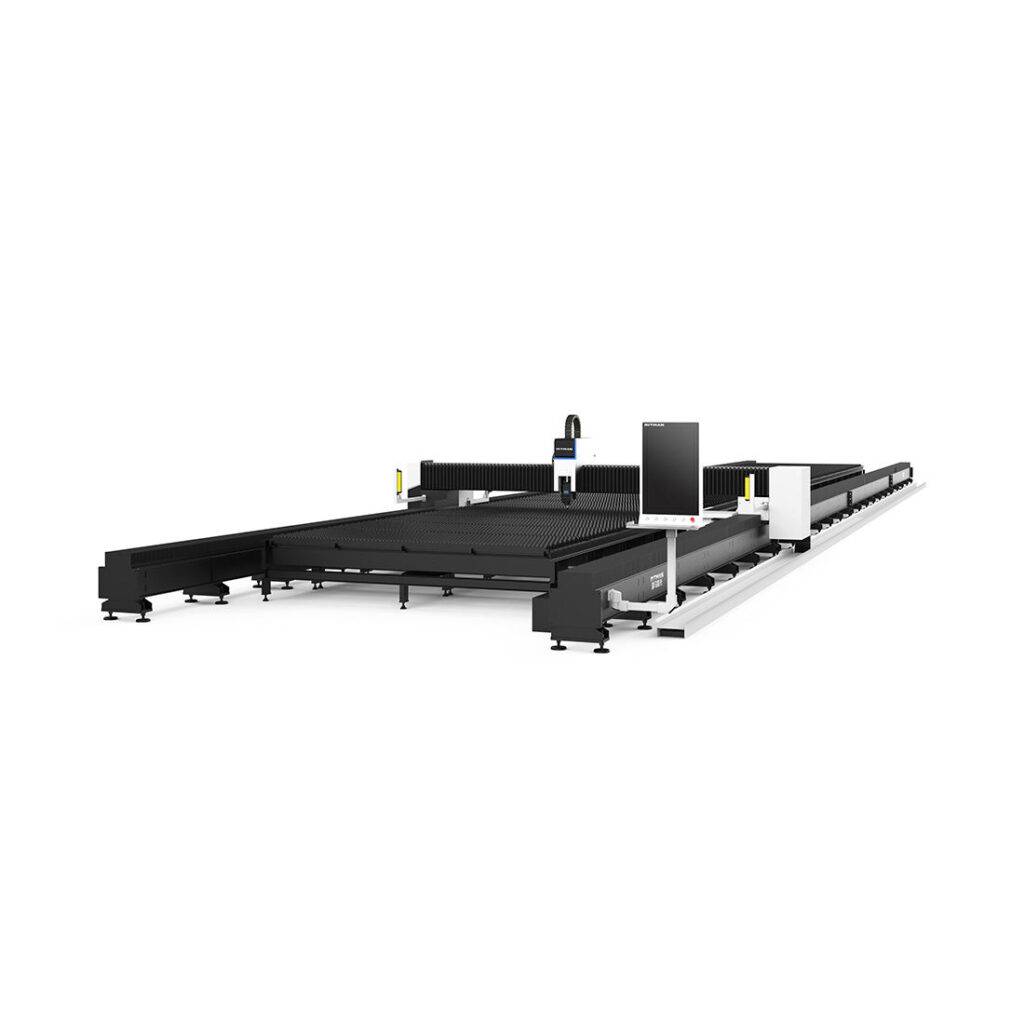
Fiber Laser Cutting Machine with Narrow Gap welding for Construction Machinery
In this article
- Optimizing Heavy Fabrication: The Synergy of Fiber Laser Cutting and Narrow Gap…
- Precision Engineering Requirements for Narrow Gap Welding
- The Triple-Function Workflow: Punch, Mark, and Cut
- Eliminating the Grinding Bottleneck
- Dimensional Accuracy and Thermal Distortion Management
- Impact on Overall Equipment Effectiveness (OEE)
- Technical Integration with NGW Automated Cells
Optimizing Heavy Fabrication: The Synergy of Fiber Laser Cutting and Narrow Gap Welding
In the current landscape of construction machinery manufacturing—encompassing the production of excavator booms, crane chassis, and heavy-duty frames—efficiency is measured by the reduction of non-value-added activities. The transition toward Fiber Laser Cutting as the primary fabrication method is not merely a preference for speed; it is a fundamental shift in ensuring the tolerances necessary for advanced joining techniques like Narrow Gap Welding (NGW). For the industrial engineer, the objective is to create a seamless flow from raw plate to finished weldment without the intervention of manual grinding or secondary edge preparation.
Precision Engineering Requirements for Narrow Gap Welding
Narrow gap welding represents a high-efficiency joining process that utilizes a reduced groove angle, typically between 1 to 5 degrees, or even a zero-degree square butt joint. This technique drastically reduces the volume of weld metal required and minimizes the total heat input into the workpiece. However, the success of NGW is entirely dependent on the quality of the fit-up. A standard mechanical shear or traditional thermal cutting method cannot provide the edge perpendicularity or the dimensional consistency required.
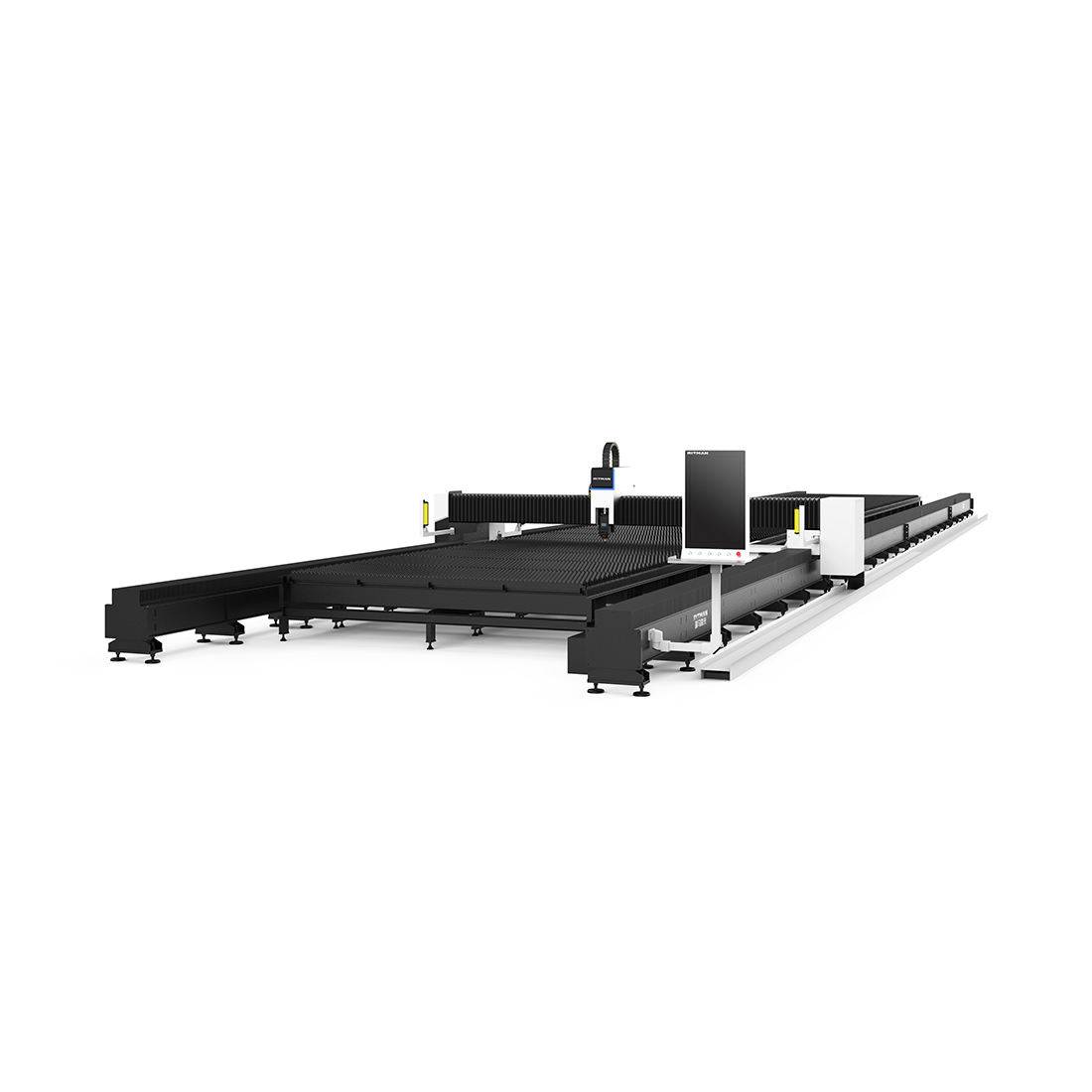
Fiber laser systems, particularly those in the 12kW to 30kW range, deliver a highly concentrated energy density. This allows for a narrow kerf and a minimal heat-affected zone (HAZ). In the context of Narrow Gap Welding, the cutting machine must maintain a positional accuracy of ±0.05mm over large formats. When the edge is cut with a fiber laser, the resulting surface roughness (Rz) is often low enough to be used in the welding cell immediately. This precision ensures that the automated welding torch maintains a consistent arc length and optimal gas shielding throughout the deep-groove pass.
The Triple-Function Workflow: Punch, Mark, and Cut
Modern fiber laser machines optimized for Construction Machinery are no longer single-purpose tools. They function as integrated fabrication centers. The “Punch, Mark, and Cut” workflow is essential for downstream assembly synchronization.
Integrated Marking for Traceability and Assembly
Before the perimeter of a structural component is cut, the fiber laser performs high-speed surface marking. This includes etching part numbers, heat codes for material traceability, and, most importantly, assembly locators. For complex 3D structures like telescopic crane jibs, these marks guide the robotic welding cells, indicating exactly where stiffeners or internal diaphragms must be placed. Because the marking is done in the same coordinate system as the cut, there is zero margin for layout error.
Automated Punching and Hole Quality
While the laser can “cut” holes, the “punch” functionality in this context refers to the high-frequency piercing capabilities of the fiber source. Through advanced pulsing parameters, the laser can create high-aspect-ratio holes for pins and bolts with zero taper. In thick-plate construction machinery (20mm to 50mm), the ability to produce a bolt-ready hole without a secondary drilling operation is a massive throughput advantage. The fiber laser’s high beam quality (BPP) ensures that the hole diameter is consistent from the top surface to the bottom exit.
Eliminating the Grinding Bottleneck
One of the most significant “hidden costs” in heavy machinery fabrication is manual grinding. Traditional thermal cutting often leaves behind dross, heavy oxidation, or a hardened edge that interferes with weld fusion. Structural Integrity is compromised when impurities are trapped in the weld pool.
Fiber laser cutting, when optimized with high-pressure nitrogen or mixed-gas assist, produces an oxide-free edge. The high cooling rate and the localized nature of the laser beam mean the metallurgical properties of the plate remain largely unchanged. For an industrial engineer, eliminating the grinding station means a reduction in labor costs, a decrease in consumable expenses (grinding discs), and a significant improvement in shop floor air quality. More importantly, it removes the variability introduced by manual labor, ensuring that every part entering the NGW cell is identical.
Dimensional Accuracy and Thermal Distortion Management
Construction machinery relies on long, large-format plates. Thermal distortion during the cutting process can lead to “bowing,” which makes NGW impossible due to fluctuating gap widths. Fiber lasers mitigate this through high-speed processing and intelligent nesting algorithms. Since the laser moves at significantly higher velocities than legacy thermal processes, the total energy absorbed by the plate is lower.
Furthermore, advanced laser controllers utilize “cool cutting” technologies or water-mist injection to manage the thermal gradient across the plate. By maintaining Dimensional Accuracy across a 12-meter beam, the fiber laser ensures that when two plates are matched for a narrow gap butt joint, the gap remains uniform across the entire longitudinal seam. This uniformity is the prerequisite for the high-deposition rates associated with NGW.
Impact on Overall Equipment Effectiveness (OEE)
From a systems engineering perspective, the implementation of fiber laser cutting directly impacts the OEE of the entire production line.
- Availability: Fiber lasers require significantly less maintenance than complex mechanical systems, with solid-state sources lasting over 100,000 hours.
- Performance: The high-speed cutting of 16mm to 25mm plates—common in construction—allows for higher nesting density and faster cycle times.
- Quality: By producing a weld-ready edge, the “first-pass yield” of the welding department increases, reducing the need for expensive rework or ultrasonic testing failures.
Technical Integration with NGW Automated Cells
The final stage of the industrial process is the handoff to the welding department. When the Fiber Laser Cutting Machine is integrated with the factory’s PLM (Product Lifecycle Management) system, the exact “as-cut” dimensions can be fed forward to the robotic welding controller. If there is a slight deviation in the plate’s thickness or the cut edge, the NGW system can adjust its oscillation parameters in real-time. This level of Digital Twin integration is only possible when the initial cutting process is as precise as a fiber laser.
Conclusion: The Standard for Modern Heavy Fabrication
For manufacturers of construction machinery, the move to fiber laser cutting is a strategic necessity. The ability to produce high-precision, weld-ready components that support Narrow Gap Welding is the only viable path to increasing output while maintaining the rigorous safety and durability standards required for heavy equipment. By focusing on a “no-grinding” philosophy and utilizing the integrated punch/mark/cut capabilities, facilities can achieve a level of operational excellence that legacy processes simply cannot match. The fiber laser is no longer a luxury; it is the foundation of the high-performance structural assembly line.





