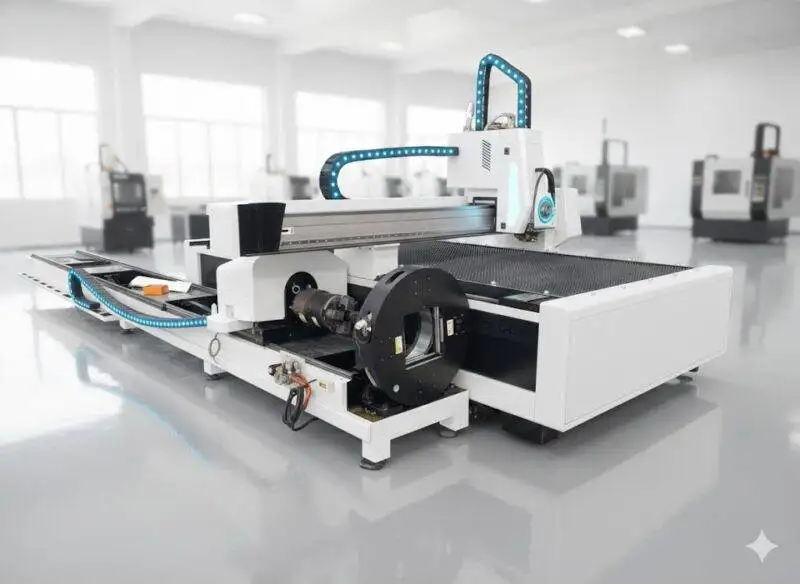
Fiber Laser Cutting Machine with Narrow Gap welding for Wind Tower fabrication
In this article
Technical Integration of Fiber Laser Cutting in Wind Energy
The global demand for larger wind turbine diameters and taller hub heights has forced an evolution in Wind Tower Fabrication techniques. Traditional methods of plate preparation often fall short of the rigorous tolerances required for advanced automated joining processes. The adoption of high-power fiber laser systems represents a fundamental shift toward precision-engineered manufacturing. Unlike legacy thermal cutting, fiber lasers operate at a wavelength of approximately 1.06 microns, allowing for extreme energy density and focusability.
In the context of wind tower production, where steel plate thicknesses typically range from 20mm to 50mm or more, the fiber laser provides a consistent thermal profile. This consistency is critical for maintaining the metallurgical properties of the S355 or S420 structural steels commonly used in these applications. The process ensures that the Heat Affected Zone (HAZ) remains localized, preventing structural brittle zones that could lead to fatigue failure in high-stress offshore environments.
Precision Beveling for Narrow Gap Welding Prep
The primary driver for implementing Fiber Laser Cutting in wind tower facilities is the requirement for flawless joint preparation for Narrow Gap Welding. NGW requires a specific groove geometry—often a deep V or J-prep with an included angle as small as 1 to 5 degrees. Achieving this through mechanical milling is time-consuming, while other thermal methods lack the angular accuracy needed for a successful root pass.
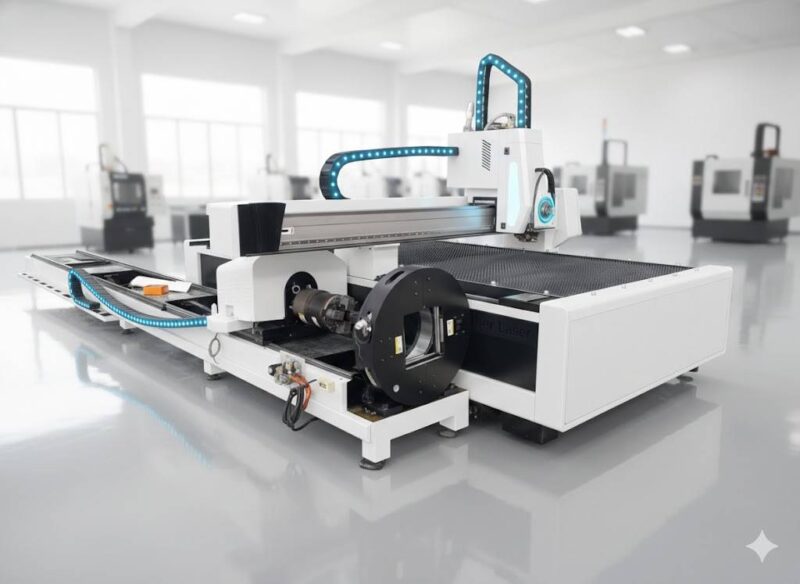
Fiber laser machines equipped with 3D five-axis heads allow for continuous beveling during the primary cut. The precision of the laser ensures that the root face (land) is perfectly uniform across the entire circumference of the tower section. This uniformity is vital because any deviation in the gap width during the welding phase leads to fluctuations in heat input, potentially causing defects like lack of fusion or burn-through. By utilizing fiber technology, the edge quality achieved is “welding-ready,” meaning it meets ISO 9013 Grade 2 or better standards for perpendicularity and surface roughness.
Eliminating the Secondary Grinding Phase
From an industrial engineering perspective, the elimination of non-value-added steps is paramount. In conventional fabrication, thermal cutting is followed by intensive manual or semi-automated grinding to remove dross, oxide layers, and to correct dimensional inaccuracies. Fiber Laser Cutting virtually eliminates these requirements. The high-pressure nitrogen or oxygen assist gas used in the laser process clears the kerf of molten material so efficiently that the resulting edge is smooth and free of slag.
By removing the grinding station from the production flow, a facility can reduce labor costs by 30-40% per section. Furthermore, the absence of grinding dust improves the occupational health environment and reduces the wear on downstream material handling equipment. The “cut-to-weld” workflow enabled by the fiber laser ensures that plates move directly from the cutting table to the rolling station without intermediate handling, directly improving the Overall Equipment Effectiveness (OEE).
Consolidated Punching, Marking, and Cutting Operations
Modern wind tower designs involve complex internal layouts, including brackets for ladders, cable trays, and platforms. Traditionally, these required separate drilling or punching operations. A fiber laser system integrates these into the cutting program. The laser can execute high-speed “stitching” or punching for bolt holes with higher diameter-to-thickness ratios than mechanical punching allows, without the risk of tool breakage or deformation.
Moreover, the laser head can be used for surface marking. This involves low-power etching of part numbers, alignment lines for stiffeners, and weld sequence markers directly onto the plate surface. These marks are permanent enough to survive the rolling and grit-blasting processes but shallow enough not to create stress risers in the steel. This digital integration ensures that the “Digital Twin” of the tower is accurately represented on the physical workpiece, reducing assembly errors in the fit-up stage.
Optimization of Material Utilization and Kerf Control
Material costs account for a significant portion of wind tower CAPEX. The narrow kerf width of a fiber laser (typically 0.2mm to 0.8mm depending on thickness) allows for tighter nesting of components compared to other thermal cutting methods. When fabricating door frames, flanges, and internal reinforcements, the ability to nest parts closer together can result in a 5% to 8% reduction in scrap rates.
In addition to nesting efficiency, the laser’s programmable logic control (PLC) allows for real-time adjustments to compensate for thermal expansion during the cut. In large-format cutting—where plates can be 12 meters long—thermal drift can normally lead to “bowing” of the plate. Fiber lasers utilize sophisticated sensors to monitor the plate position and adjust the cutting path dynamically, ensuring that the longitudinal seams of the tower remain perfectly straight for the subsequent rolling process.
Thermodynamic Efficiency and Operational Costs
The wall-plug efficiency of fiber lasers is approximately 30-40%, which is significantly higher than older laser technologies. When compared to the total energy consumption of a fabrication line—including the massive power draw of heavy-duty welding rotators—the fiber laser offers a leaner profile. Because the cutting speed is significantly higher (often 2x to 3x faster on mid-range thicknesses), the energy consumed per meter of cut is minimized.
Maintenance cycles are also extended. Fiber lasers do not require the internal mirrors or bellows systems associated with CO2 lasers, nor do they require the frequent consumable changes seen in other thermal processes. For a wind tower manufacturer, this translates to higher machine uptime and a more predictable production schedule. The stability of the solid-state laser source ensures that the beam quality does not degrade over thousands of hours of operation, providing consistent NGW preparations from the first tower of a project to the last.
Conclusion of Engineering Strategy
The strategic implementation of Fiber Laser Cutting in Wind Tower Fabrication is not merely an upgrade in cutting speed; it is a holistic improvement in manufacturing precision. By providing the exact tolerances required for Narrow Gap Welding, eliminating the need for manual grinding, and consolidating multi-tool operations into a single workstation, manufacturers can achieve a higher throughput with lower defect rates. This technological synergy is essential for the industry to meet the scaling demands of next-generation wind energy infrastructure while maintaining the structural reliability required for a 25-year operational lifespan.





