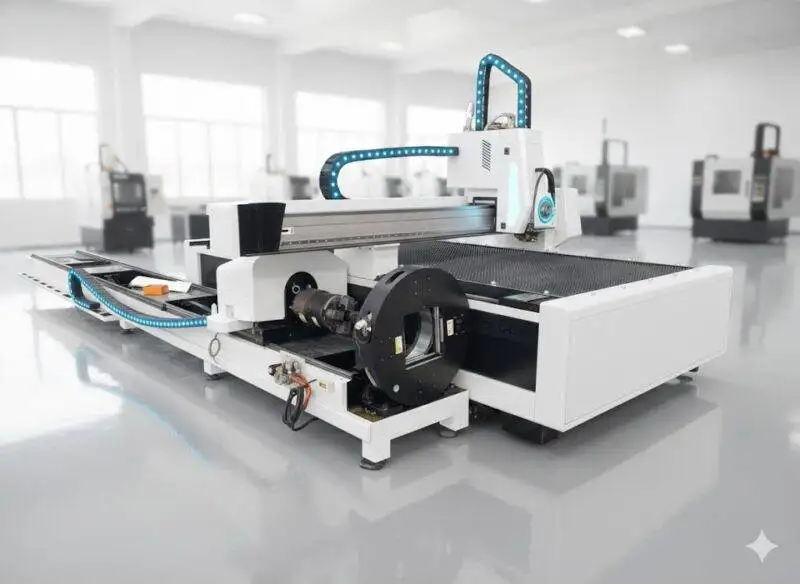
Fiber Laser Cutting Machine with 5-Axis Beveling for Wind Tower fabrication
In this article
Optimization of Wind Tower Component Fabrication via Fiber Laser
In the current landscape of utility-scale renewable energy, the fabrication of wind towers demands a level of geometric precision and structural integrity that traditional methods struggle to maintain at scale. The transition to 5-axis beveling fiber laser technology represents a shift from multi-stage processing to a streamlined, high-throughput model. Industrial engineering principles dictate that minimizing material handling and reducing secondary operations are paramount to lowering the Levelized Cost of Energy (LCOE). Fiber laser systems, particularly those in the 12kW to 30kW range, provide the necessary power density to penetrate the thick carbon steel plates typical of tower sections while maintaining tight tolerances.
Kinematics of 5-Axis Bevel Cutting Heads
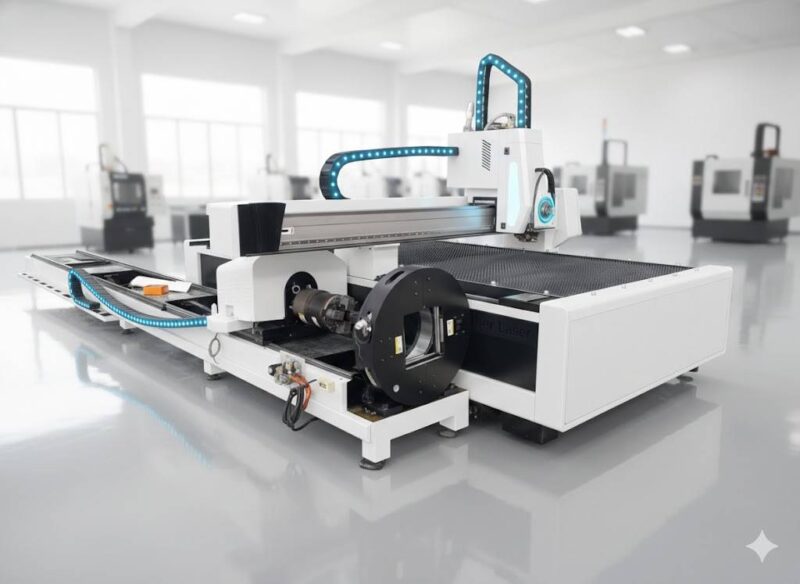
The core of the 5-axis system lies in its ability to manipulate the cutting torch across the X, Y, and Z axes while simultaneously providing rotation (C-axis) and tilt (A/B-axis). In wind tower fabrication, plates are rarely cut with simple 90-degree edges. To prepare for the high-strength submerged arc welding (SAW) processes used in tower assembly, plates require complex bevel profiles, including V, Y, X, and K-cuts.
The high-precision thermal cutting provided by a fiber laser allows for these bevels to be executed with a precision of plus or minus 0.5 degrees. This is achieved through advanced CNC algorithms that compensate for the beam path length and focal point variations as the head tilts. Unlike traditional mechanical beveling, the fiber laser does not exert physical force on the workpiece, preventing plate deformation and ensuring that the final “can” or section circumference remains perfectly within design specifications.
Eliminating Secondary Grinding through Kerf Management
One of the most significant bottlenecks in heavy plate fabrication is the manual labor required for edge cleaning. Fiber Laser Cutting produces a minimal Heat-Affected Zone (HAZ) and an exceptionally smooth surface finish. Because the fiber laser operates at a wavelength of approximately 1.06 microns, the energy absorption rate in carbon steel is highly efficient. This results in a narrow kerf and a dross-free edge.
From an engineering standpoint, the “no grinding” requirement is a result of the high-pressure nitrogen or oxygen assist gas systems that clear the molten material instantly during the cut. The resulting surface roughness (Ra) is low enough to meet the stringent ISO 9013 Grade 2 or 3 standards. By delivering a weld-ready edge directly from the laser bed, the facility eliminates the noise, dust, and labor costs associated with manual grinding stations, significantly improving the safety and cleanliness of the shop floor.
Integrated Punching and Marking Capabilities
Modern automated plate processing involves more than just separation. To facilitate downstream assembly and traceability, wind tower plates require precise markings for alignment, internal component mounting, and identification. The fiber laser system utilizes its high-speed modulation capabilities to switch from high-power cutting to low-power marking in milliseconds.
1. Precision Punching: The laser can “punch” or pierce pilot holes for bolt patterns in flange connections with extreme repeatability. This ensures that when the tower sections are moved to the assembly site, the bolt holes align perfectly without the need for reaming.
2. Traceability Marking: Using the laser to etch part numbers, heat numbers, and QR codes directly onto the plate ensures that material certifications remain linked to the physical part throughout the entire lifecycle of the tower.
3. Layout Marking: The laser can mark the precise locations for internal brackets, ladders, and cable trays. This eliminates the need for manual measurement and chalk-lining, which are prone to human error and consume significant man-hours.
Thermal Stability and Large-Format Processing
Wind tower sections are fabricated from massive plates, often exceeding 3 meters in width and 12 meters in length. Managing thermal expansion during the cutting process is critical. Industrial-grade fiber lasers utilize sophisticated nesting software that calculates optimal cutting paths to distribute heat evenly across the plate.
The stability of the machine bed is equally vital. Most 5-axis systems designed for this sector utilize a heavy-duty gantry structure with dual-drive AC synchronous motors. This ensures that even at high traverse speeds, the momentum of the 5-axis head does not introduce vibration that could compromise the bevel angle or the surface finish. By maintaining high dynamic accuracy, the system ensures that the longitudinal seams of the tower sections fit together with zero gap, which is essential for high-quality automated welding.
Operational Efficiency and Resource Allocation
The transition to fiber laser technology is also a move toward energy efficiency. Fiber lasers have a wall-plug efficiency of approximately 30% to 40%, which is significantly higher than older CO2 technologies. When applied to wind tower fabrication, where machines may run 24/7, the cumulative energy savings are substantial.
Furthermore, the reduction in consumable parts—no electrodes to replace and fewer nozzle changes—increases the Mean Time Between Failures (MTBF). For an industrial engineer, this translates to higher OEE (Overall Equipment Effectiveness) scores. The ability to perform multiple operations (punch, mark, cut, bevel) in a single setup reduces the work-in-progress (WIP) inventory. Instead of a plate moving from a cutting station to a marking station and then to a beveling station, it moves once to the laser bed and then directly to the rolling and welding station.
Conclusion: The Future of Tower Production
The implementation of a 5-axis fiber laser cutting system is not merely an incremental upgrade; it is a fundamental reconfiguration of the wind tower production line. By prioritizing high-precision thermal cutting and integrated marking, manufacturers can achieve a level of consistency that manual processes cannot replicate. The elimination of secondary grinding and the ability to produce weld-ready bevels in a single pass significantly reduces the lead time for tower sections. As wind turbines continue to grow in height and weight, the demand for the precision and efficiency offered by 5-axis beveling fiber laser technology will become the baseline standard for the industry.






