Fiber Laser Cutting Machine with 5-Axis Beveling for Steel Structure
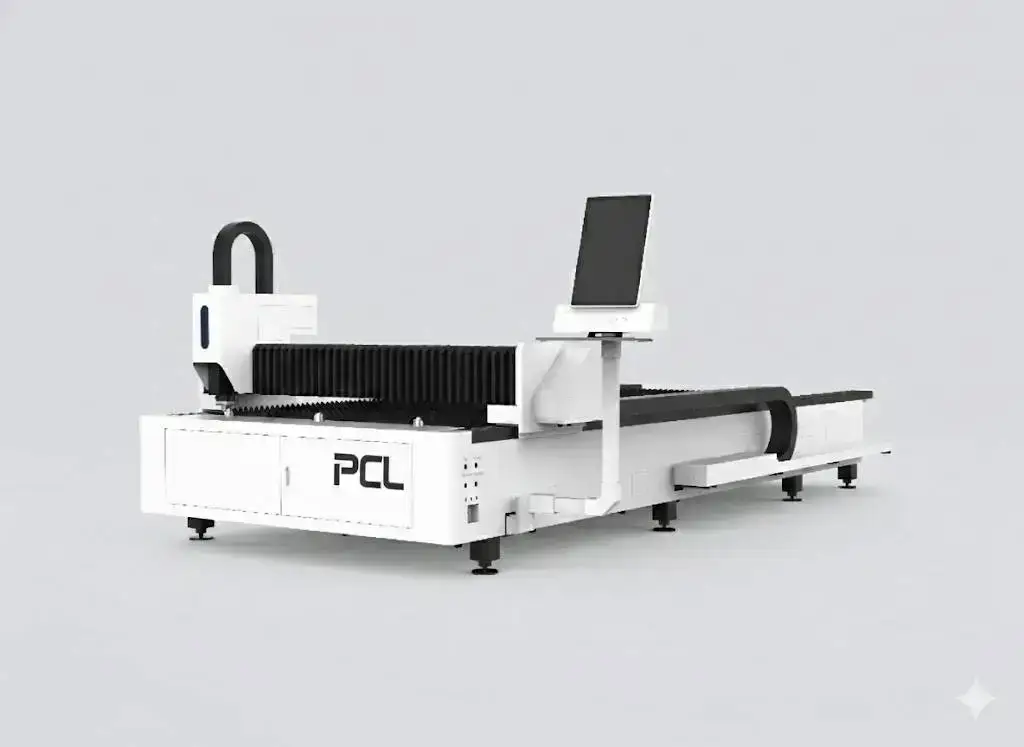
In this article
Advanced Kinematics of 5-Axis Fiber Laser Beveling
In the context of structural steel engineering, the transition from traditional 2D cutting to 5-axis 5-axis fiber laser beveling represents a fundamental improvement in geometric flexibility. A standard 3-axis system operates strictly on X, Y, and Z coordinates, limiting the beam to a perpendicular orientation relative to the workpiece. However, the 5-axis head incorporates two additional rotational axes (typically A and B or C), allowing the laser nozzle to tilt up to ±45 degrees or more. This capability is essential for creating the complex weld preparations required in heavy steel structures.
The precision of this system is governed by high-torque servo motors and sophisticated CNC algorithms that compensate for the “focal point shift” that occurs when the head tilts. Unlike traditional methods, the fiber laser maintains a consistent kerf width even at high angles, ensuring that the root face and bevel angle meet strict tolerances. For industrial engineers, this means that the calculated thermal input remains constant, preventing the structural deformation often seen in slower, high-heat processes.
Eliminating Secondary Operations: The “No-Grinding” Standard
One of the primary bottlenecks in structural steel fabrication is the labor-intensive requirement for edge cleaning. Fiber Laser Cutting operates at a wavelength (typically 1.06 microns) that is highly absorbed by carbon steel, resulting in an extremely narrow heat-affected zone (HAZ). The high-pressure nitrogen or oxygen assist gas used in fiber laser systems ejects molten material so efficiently that the resulting edge is virtually dross-free.
For beveling operations—specifically V, X, Y, and K grooves—the laser produces a surface finish that often exceeds 12.5 microns (Ra). This surface quality allows for immediate assembly. Because there is no carbonization or heavy slag, the need for manual grinding is eliminated. This reduction in post-processing not only lowers labor costs but also significantly improves the health and safety environment of the facility by reducing noise and metallic dust associated with grinding discs.
Integrated Marking, Punching, and Cutting Logic
Modern fiber laser systems for Steel Structures are not merely cutting tools; they are comprehensive material processing centers. The software integration allows for three distinct functions to be executed in a single nesting program: marking, punching (center-point piercing), and cutting.
Precision Marking and Part Identification
Traceability is a critical requirement in large-scale infrastructure projects. The fiber laser can be tuned to a lower power frequency to etch alphanumeric codes, QR codes, or assembly lines directly onto the steel plate. Unlike ink marking or stamping, laser etching is permanent and remains legible after shot blasting or coating. This ensures that every beam, plate, or gusset is correctly identified throughout the supply chain.
Automated Punching and Piercing
In structural engineering, hole alignment is paramount for bolted connections. The automated marking and punching capability of the fiber laser allows for the “dimpling” or center-punching of hole locations where mechanical drilling might be required for thicker sections. Furthermore, for standard bolt holes, the high-speed piercing cycles of a 12kW to 30kW fiber laser allow for the direct cutting of holes with diameters equal to the material thickness, maintaining a circularity that meets AISC and Eurocode standards.
Optimization of Groove Geometry: V/K/X/Y Patterns
The versatility of the 5-axis head enables the creation of specific V/K/X/Y grooves designed for full-penetration or partial-penetration requirements. In heavy steel frames, the K-groove is particularly challenging as it requires a straight cut followed by two distinct beveled angles. A 5-axis fiber laser executes this by modulating the power and feed rate based on the varying thickness the beam must penetrate at an angle.
The precision of the Y-groove, which includes a vertical root face, is critical for automated assembly. If the root face varies by even a millimeter, the fit-up gap becomes inconsistent. The fiber laser’s CNC control ensures that the root face height is uniform across the entire length of the part, regardless of the plate’s inherent waviness, thanks to non-contact capacitive height sensors that adjust the Z-axis in real-time.
Structural Integrity and Thermal Management
A significant advantage of using fiber laser technology over other thermal cutting methods is the minimization of the Heat Affected Zone (HAZ). Structural steels are often sensitive to excessive heat cycles, which can lead to localized hardening or grain growth, potentially compromising the weldability or fatigue life of the joint. The fiber laser’s high power density allows for extremely high cutting speeds, meaning the heat is dissipated almost as quickly as it is introduced. This “cold” cutting characteristic ensures that the base metal’s metallurgical properties remain intact, providing a superior surface for subsequent bonding operations.
Nesting Efficiency and Material Utilization
The implementation of 5-axis fiber lasers is often accompanied by advanced CAD/CAM software tailored for 3D structural shapes. This software accounts for the “swing” of the beveled head during nesting. Because the head requires space to tilt, the software optimizes the distance between parts to maximize material utilization while preventing collisions.
Furthermore, the ability to cut complex bevels on the perimeter of a part while it is still in the nest eliminates the need to move the part to a separate beveling station. This reduces the “work-in-progress” (WIP) inventory and minimizes the risk of material handling damage. In an industrial engineering workflow, this translates to a higher throughput per square foot of factory floor space.
Technical Specifications for High-Output Environments
To achieve the “no-grinding” objective in a 24/7 production environment, certain technical parameters must be met:
- Beam Quality (M2): A value close to 1.1 ensures the tightest focus for clean bevels.
- Dynamic Response: The 5-axis head must have high acceleration (G-force) to maintain constant velocity during complex transitions.
- Gas Control: Proportional valves for oxygen and nitrogen must respond within milliseconds to adjust for the increased material thickness encountered during an angled cut.
Conclusion: The Future of Steel Fabrication
The deployment of 5-axis Fiber Laser Cutting Machines is no longer a luxury but a necessity for competitive structural steel fabrication. By integrating beveling, marking, and high-tolerance cutting into a single automated cycle, manufacturers can achieve a level of precision that eliminates secondary labor and drastically reduces assembly time. The “cut-to-weld” workflow, characterized by the absence of grinding and the presence of perfect groove geometries, represents the pinnacle of modern industrial efficiency.






