Fiber Laser Cutting Machine with 5-Axis Beveling for Construction Machinery
In this article
- Precision Kinematics: The Role of 5-Axis Fiber Laser Systems
- Eliminating Secondary Grinding through High-Density Energy Control
- Integrated Workflow: Punching, Marking, and Beveling
- Operational Efficiency and Material Optimization
- The Technical Advantage of Fiber Laser Over Legacy Systems
- Conclusion for Industrial Strategy
Precision Kinematics: The Role of 5-Axis Fiber Laser Systems
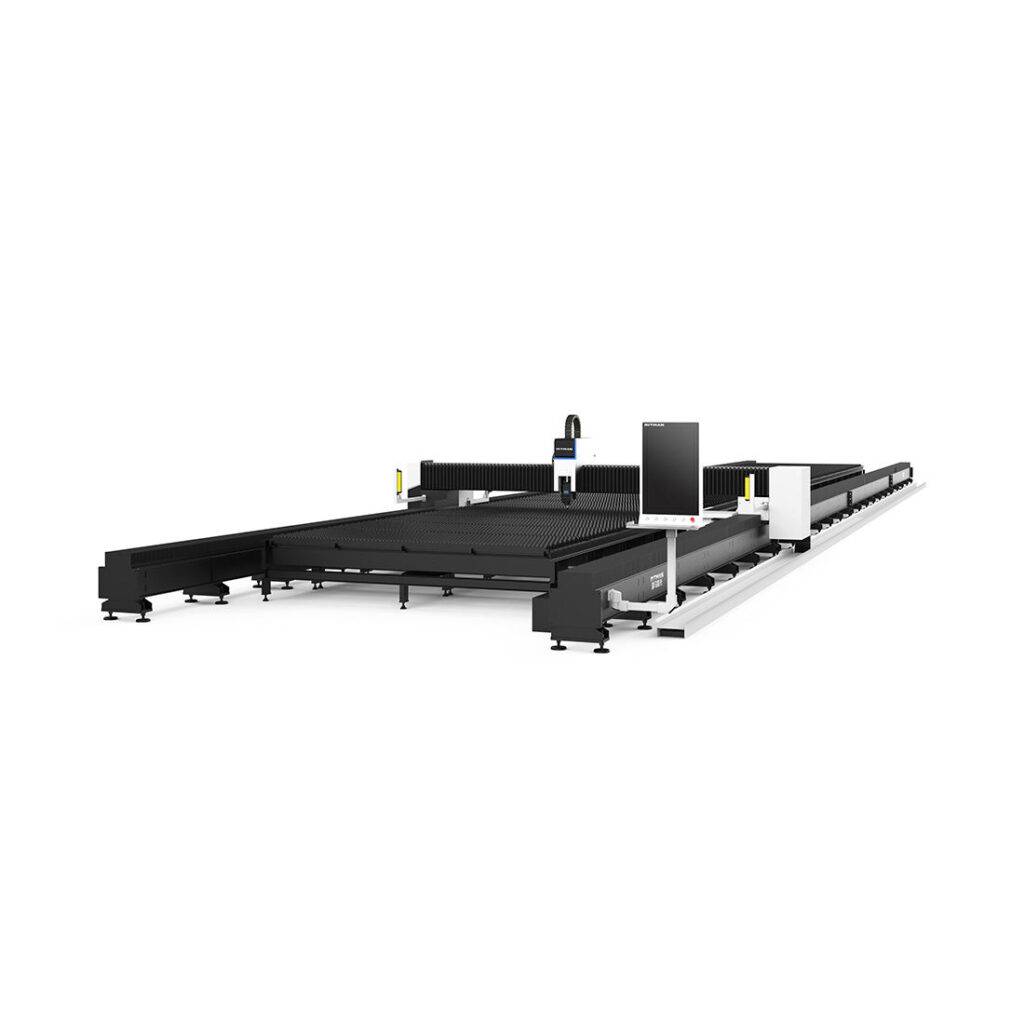
In the production of heavy construction machinery, such as excavators, cranes, and specialized earth-moving equipment, the transition from 2D flatbed cutting to 5-axis fiber laser beveling represents a significant leap in industrial efficiency. The primary challenge in this sector has always been the preparation of thick carbon steel plates—often ranging from 12mm to 30mm—for subsequent assembly. Traditional workflows necessitated a multi-stage process involving 2D cutting followed by manual or mechanical edge grinding to create the required grooves. A 5-axis bevel Laser Cutting system integrates these steps into a single machine cycle.
The core of this technology lies in the specialized cutting head, which utilizes two additional rotational axes (A and B) alongside the standard X, Y, and Z linear movements. This allows the laser beam to maintain a precise angle relative to the plate surface, typically ranging up to +/- 45 degrees. For industrial engineers, the value proposition is found in the repeatability of the cut and the reduction of the heat-affected zone (HAZ), which ensures that the metallurgical properties of high-strength steels remain uncompromised.
Eliminating Secondary Grinding through High-Density Energy Control
One of the most critical metrics in heavy machinery fabrication is the surface finish of the cut edge. Fiber lasers, characterized by their 1.06-micron wavelength, provide an exceptionally high energy density. When paired with high-precision CNC controllers, these machines execute V, X, Y, and K-shaped bevels with a surface roughness that meets or exceeds ISO 9013 standards. This level of precision is paramount because it removes the requirement for secondary grinding.
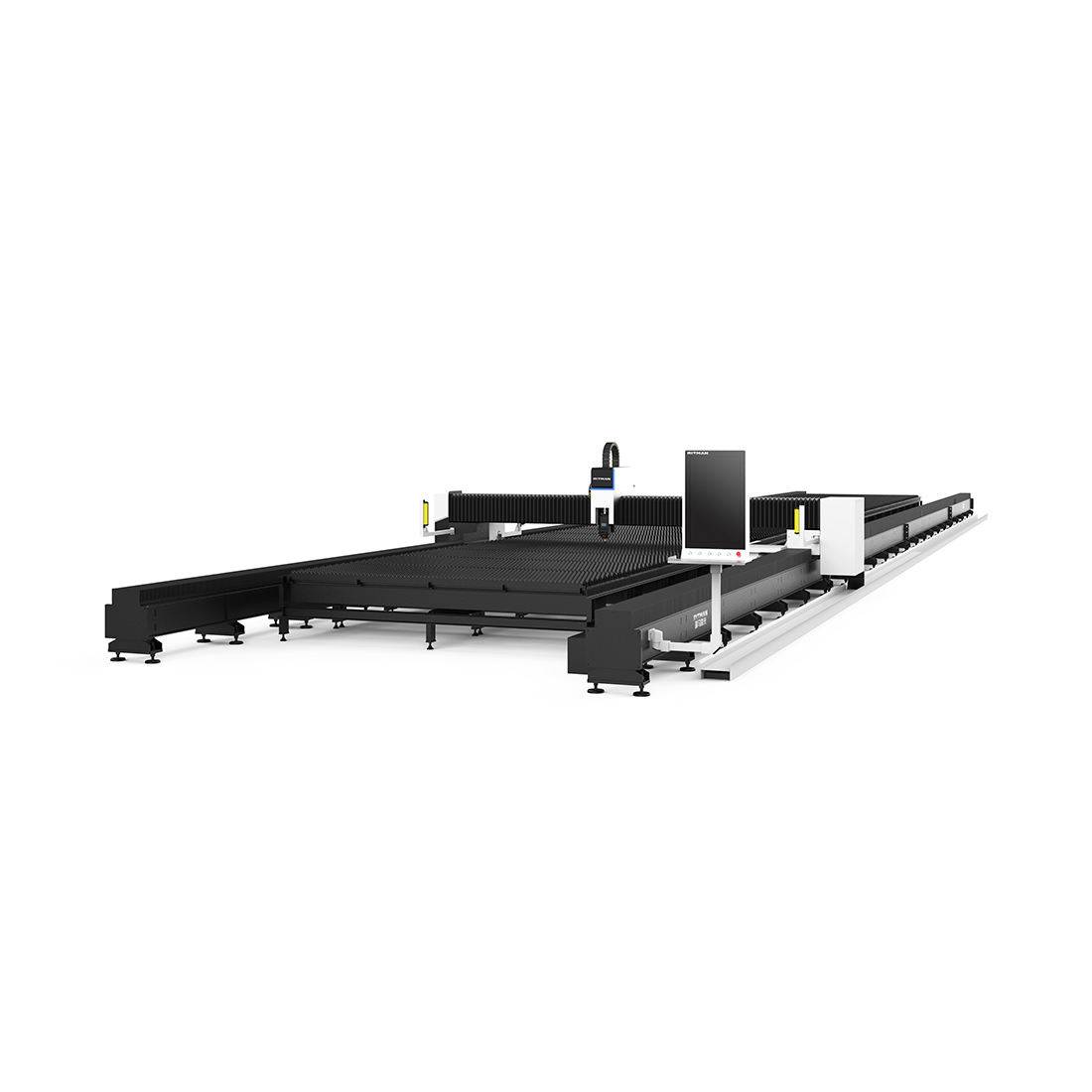
In a standard engineering workflow, grinding is a labor-intensive bottleneck that introduces dimensional variability. By achieving a “cutting-ready” edge directly from the laser bed, the manufacturing cycle time is reduced by approximately 40% to 60%. The elimination of manual grinding also enhances shop floor safety and reduces the environmental impact associated with abrasive dust and noise pollution.
Integrated Workflow: Punching, Marking, and Beveling
The modern fiber laser system is not merely a cutting tool but a multi-functional processing center. for Construction Machinery components like boom sections or chassis plates, the machine performs three distinct operations in a single nesting program: one-pass processing including punching, marking, and bevel cutting.
High-Speed Punching and Hole Accuracy
Fiber lasers excel at creating bolt holes and drainage ports with high circularity. In thick plates, the ability to “punch” or pierce with high-frequency pulses prevents the thermal deformation of the surrounding material. This ensures that holes are perfectly aligned for assembly, maintaining a tolerance of +/- 0.1mm, which is often impossible to achieve with older thermal cutting methods without post-process reaming.
Automated Marking for Traceability
The same laser source can be modulated to perform surface marking. This is used for etching part numbers, assembly guidelines, or QR codes for lifecycle tracking. Since the marking occurs in the same coordinate system as the bevel cutting, the placement accuracy is absolute. This eliminates the need for manual layout and reduces the risk of part identification errors during the high-volume production runs typical of the construction equipment industry.
Advanced Bevel Geometry Execution
The complexity of construction machinery frames requires varied bevel angles to accommodate different joint configurations. The 5-axis head can transition seamlessly from a 45-degree V-cut to a 20-degree Y-cut mid-program. This flexibility is supported by sophisticated CAM software that calculates the dynamic offset of the laser beam as it tilts, compensating for plate thickness and kerf width in real-time. The result is a structural integrity that starts at the component level, ensuring that every joint fits with zero-gap precision.
Operational Efficiency and Material Optimization
From an industrial engineering perspective, the implementation of 5-axis fiber lasers optimizes the “Duty Cycle” of the fabrication department. By utilizing high-power sources (ranging from 12kW to 30kW), the cutting speeds for beveled edges are significantly higher than traditional methods. Furthermore, the narrow kerf of the fiber laser allows for tighter nesting of parts on a single sheet of steel.
Material Yield Improvements
Reducing scrap is a primary goal in heavy-duty manufacturing where material costs constitute a large portion of the total expense. Advanced nesting algorithms for beveling take into account the “swing” of the laser head, allowing for parts to be placed closer together than was previously possible with other thermal cutting technologies. This maximizes the tonnage of parts produced per ton of raw steel purchased.
Reduction in Part Handling
Every time a heavy plate is moved—from a cutting table to a grinding station, and then to a marking station—there is a risk of injury and a cost associated with crane time. Consolidating these processes into the laser cutting envelope minimizes material handling. This streamline approach supports “Just-In-Time” (JIT) manufacturing cycles, allowing construction machinery OEMs to respond more quickly to market demand fluctuations.
The Technical Advantage of Fiber Laser Over Legacy Systems
The stability of the fiber laser beam is a critical factor in beveling. Unlike CO2 lasers, which require complex mirror paths that can become misaligned during high-speed 5-axis movement, the fiber laser is delivered via a flexible optical cable. This allows the cutting head to move with high acceleration (G-force) without losing beam quality or focus. For the thick plates used in excavator buckets or crane stabilizers, this consistent fiber laser efficiency translates to uniform cut quality from the first millimeter to the last.
Furthermore, the maintenance requirements for fiber systems are significantly lower. With no mirrors to clean and a much higher wall-plug efficiency (approx. 30-40%), the operational cost per hour is lower, providing a faster Return on Investment (ROI) for the machinery. The lack of moving parts within the laser generator itself ensures that the system can withstand the harsh environments of a heavy industrial fabrication shop.
Conclusion for Industrial Strategy
For construction machinery manufacturers, the adoption of 5-axis fiber laser beveling is no longer an optional upgrade but a strategic necessity. The ability to produce high-precision, beveled components that require no secondary processing allows for a level of manufacturing throughput that was previously unattainable. By focusing on the integration of punching, marking, and cutting, facilities can achieve a higher standard of dimensional accuracy and structural reliability, ultimately leading to a more competitive position in the global infrastructure market. The emphasis remains on the data-driven optimization of the cutting process, ensuring that every kilowatt of laser power is converted into high-value, assembly-ready components.






