Engineering Review: 2000W 6-Axis Collaborative Welder – Lyon, France
In this article
- Field Engineering Report: Implementation of 2000W 6-Axis Collaborative Welder
- Site Location: Lyon, France – Industrial Fabrication Sector
- The Synergy Between Collaborative Robotics and Automated Welding
- Performance Metrics in Mild Steel Welding
- Lessons Learned and Field Adjustments
- Conclusions and Recommendations
Field Engineering Report: Implementation of 2000W 6-Axis Collaborative Welder
Site Location: Lyon, France – Industrial Fabrication Sector
1. Executive Summary of Field Operations
This report details the technical deployment and process optimization of a 2000W 6-Axis Collaborative Welder within a mid-sized production facility in Lyon. The primary objective was the transition from manual metal arc processes to a high-efficiency Automated Welding workflow for Mild Steel welding. Over a fourteen-day commissioning period, we evaluated the kinematics of the 6-axis system, the stability of the 2000W fiber source, and the integration of collaborative safety protocols within a high-traffic shop floor environment.
2. Technical Specifications and System Kinematics
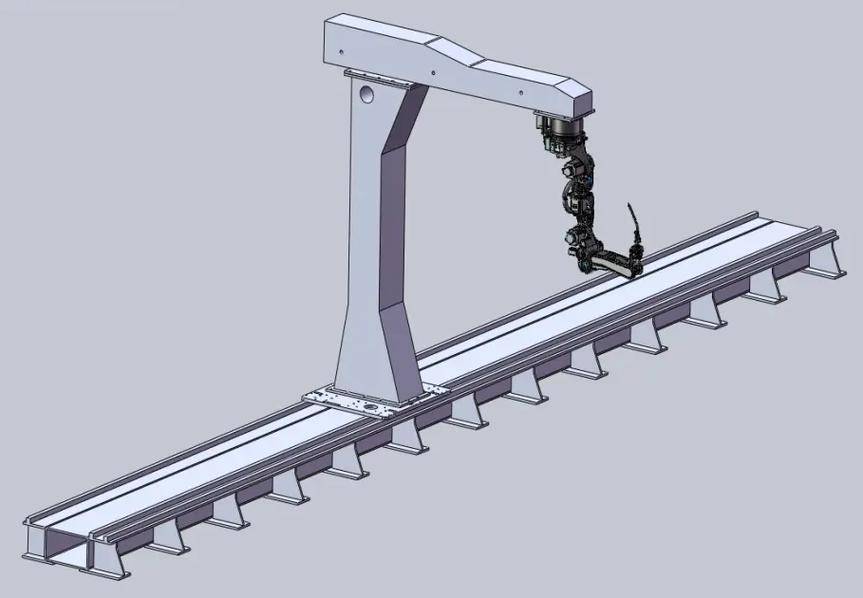
The core of the installation is the 6-Axis Collaborative Welder, a system designed to bridge the gap between fixed-cell industrial robots and manual operators. Unlike 3- or 4-axis Cartesian systems, the 6-axis articulation allows for complex torch orientations—essential for the multi-pass fillets and circumferential welds required on the Lyon site’s pressure vessel components.
The 2000W power rating refers to the continuous-wave fiber laser source integrated into the cobot head. For Mild Steel welding, this power density allows for deep penetration with a significantly reduced Heat Affected Zone (HAZ) compared to traditional MIG/MAG. The 6-axis movement provides the necessary “Work Angle” and “Travel Angle” adjustments in real-time, simulating the wrist flick of a veteran welder to manage the molten pool against gravity.
The Synergy Between Collaborative Robotics and Automated Welding
3. Workflow Integration in the Lyon Workshop
In the context of the Lyon facility, Automated Welding was previously seen as an “all-or-nothing” investment. Traditional automation required expensive light curtains and rigid safety cage infrastructure. The introduction of the 6-Axis Collaborative Welder changed this dynamic. By utilizing torque sensors in each joint, the system operates alongside human fitters.
During the field test, we established a “tandem workflow”:
1. Manual Fit-up: A technician tacks the mild steel assemblies using a standard MIG set.
2. Lead-through Programming: The technician moves the 6-axis arm manually to the start and end points of the seam.
3. Automated Execution: The cobot executes the 2000W laser weld with a repeatability of ±0.05mm.
This synergy reduces the non-arc time significantly. The “Collaborative” aspect isn’t just about safety; it’s about the interface. We found that the time to program a new Mild Steel welding path was reduced by 70% compared to traditional G-code-based industrial robots.
4. Advanced Path Calibration for 6-Axis Movement
One of the “lessons learned” during the Lyon deployment involves the singularity points of the 6-axis arm. While Automated Welding suggests a “set it and forget it” mentality, the 6th axis (the wrist) can struggle when the torch needs to rotate nearly 360 degrees on small diameter mild steel piping.
We optimized the pathing by implementing a “Constant Linear Velocity” algorithm. This ensures that even as the 6-Axis Collaborative Welder reaches its joint limits, the 2000W output is modulated to match the actual ground speed of the laser head. Without this, we observed localized burn-through on S235 mild steel corners where the arm momentarily slowed down to re-orient its joints.
Performance Metrics in Mild Steel Welding
5. Metallurgical Observations on S355 Grade Steel
The Lyon site predominantly uses S355 mild steel. Mild Steel welding at 2000W requires precise shielding gas management—typically a high-purity Argon/CO2 mix or pure Nitrogen depending on the required finish.
Data from the first 500 cycles showed:
* Penetration Depth: 4.5mm at a travel speed of 1.2 meters per minute.
* Tensile Strength: Consistently met 490-630 MPa requirements.
* Porosity: Minimal, provided the mill scale was mechanically removed prior to the Automated Welding cycle.
6. Thermal Management and Distortion Control
A major advantage of the 2000W 6-axis system over manual welding is the control over “Heat Input per Unit Length.” In Mild Steel welding, excessive heat leads to warping, especially in the 3mm to 6mm gauge range used in Lyon’s HVAC ducting contracts. By leveraging the Automated Welding precision, we maintained a consistent travel speed that reduced total heat input by 40%. This eliminated the need for post-weld straightening, saving the client approximately 12 man-hours per week.
Lessons Learned and Field Adjustments
7. The Criticality of Fixturing and Tolerances
The most significant hurdle encountered was the “Automation Gap.” While the 6-Axis Collaborative Welder is highly accurate, it lacks the human eye’s ability to compensate for poor fit-up. If the gap in the mild steel joint exceeded 0.5mm, the 2000W laser tended to “drop through” rather than bridge the gap.
Lesson Learned: Automated welding is only as good as the upstream fabrication. We had to implement more rigorous jigging standards in the Lyon shop. We moved from “loose clamping” to “precision pneumatic fixturing.” Once the fit-up was standardized to a 0.2mm tolerance, the scrap rate dropped to near zero.
8. Safety and Human Factors in a Collaborative Environment
In France, Labor regulations (specifically those overseen by INRS) are stringent regarding cobot safety. We had to define “Collaborative Zones” where the robot speed is capped at 250mm/s when a human is detected via laser scanners.
We found that the psychological transition for the Lyon welders was the biggest variable. Initially, there was skepticism that a 2000W system could be “safe.” By demonstrating the sensitive force-feedback—where the 6-Axis Collaborative Welder stops at the touch of a finger—we gained operator trust. The welder’s role shifted from “torch burner” to “process technician.”
9. Maintenance of the 2000W Optical Path
The industrial atmosphere in a Lyon fabrication shop is often heavy with grinding dust. For a 6-Axis Collaborative Welder using a 2kW fiber source, the cover slide (protective window) is the Achilles’ heel.
Lesson Learned: We implemented a pressurized “air knife” on the torch head. This creates a positive pressure barrier that prevents mild steel spatter and dust from settling on the optics. We also established a mandatory “100-weld check” for the optical lens, ensuring that the Automated Welding quality did not degrade due to beam scattering.
Conclusions and Recommendations
10. Summary of ROI and Efficiency
The deployment of the 6-Axis Collaborative Welder in Lyon has proven that Automated Welding is viable for high-mix, low-volume mild steel production. The 2000W system provides the necessary power to handle structural Mild Steel welding while maintaining the agility of a collaborative system.
Key Recommendations for Future Sites:
* Pre-process Cleaning: Ensure mild steel is free of oil and mill scale to prevent laser reflection and porosity.
* Precision Jigs: Invest in CNC-machined fixtures; the 6-axis arm cannot “hunt” for a seam without expensive vision sensors.
* Operator Training: Focus training on “Path Optimization” rather than just “Button Pushing.” The ability to manipulate the 6th axis for optimal gas coverage is what separates a good weld from a failing one.
The Lyon project concludes that the synergy between a high-power fiber source and a 6-axis cobot is the current “Gold Standard” for modernizing European fabrication shops. The technical throughput is undisputed, provided the mechanical tolerances of the workpieces are strictly controlled.
***
End of Report
Senior Welding Engineer, Field Operations Division







