Engineering Review: Double Pulse MIG/MAG Welding Robot – Chonburi, Thailand
In this article
Field Commissioning Report: Double Pulse MIG/MAG Welding Robot Integration
Location: Pinthong Industrial Estate, Chonburi, Thailand
1. Executive Summary and Site Overview
This report details the implementation and optimization of a high-speed MIG/MAG Welding Robot system at a Tier-1 automotive component facility in Chonburi. The project objective was to transition a critical Aluminum Alloy welding line from manual GTAW (TIG) to an automated robotic cell to meet increased production volumes for EV battery housings. In the tropical climate of Chonburi, where ambient humidity often exceeds 80%, the technical challenges of Arc Welding Solutions are magnified, particularly regarding hydrogen porosity and oxide formation on 6000-series aluminum. The successful deployment hinged on the synergy between advanced double-pulse waveforms and robotic path precision.
2. The Synergy: MIG/MAG Welding Robot and Integrated Arc Welding Solutions
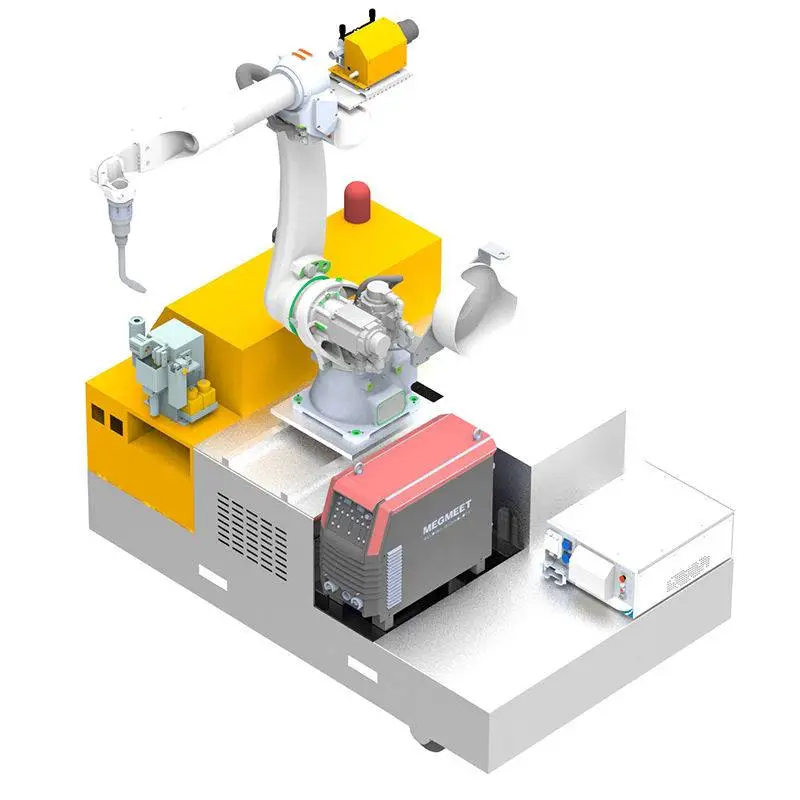
In the context of this Chonburi plant, a MIG/MAG Welding Robot is not a standalone tool but the centerpiece of a complex ecosystem. Our approach to Arc Welding Solutions involves a holistic integration of the power source, the robotic manipulator, the push-pull torch system, and the gas delivery network.
The synergy is realized through the communication speed between the robot controller and the power source. During Aluminum Alloy welding, the double-pulse function requires the robot to modulate its travel speed in micro-sync with the current fluctuations. If the “Solution” doesn’t account for the thermal conductivity of aluminum, the robot will simply blow through the start of the joint or leave cold laps at the end. In this installation, we utilized a high-speed fieldbus interface to ensure that the MIG/MAG Welding Robot adjusted its weave frequency dynamically based on real-time feedback from the arc sensor, a critical component of our modern Arc Welding Solutions.
3. Technical Deep Dive: Aluminum Alloy Welding Challenges
Aluminum Alloy welding, specifically with 6061 and 5052 grades used on-site, presents unique metallurgical hurdles. Unlike steel, aluminum has a high thermal conductivity and a low melting point, coupled with a refractory oxide layer that melts at three times the temperature of the base metal.
Our technical strategy focused on three primary areas:
- Oxide Cleaning: Utilizing the “cleaning action” of the DCEP (Direct Current Electrode Positive) phase within the pulse cycle.
- Porosity Mitigation: Given the Chonburi humidity, hydrogen solubility is our greatest enemy. We implemented heated wire storage and a triple-stage gas filtration system as part of our Arc Welding Solutions to ensure the 1.2mm ER5356 wire remained contaminant-free.
- Thermal Management: Aluminum dissipates heat rapidly. The MIG/MAG Welding Robot was programmed with a “Hot Start” routine to overcome the initial heat sink effect, transitioning into a stabilized double-pulse mode to manage the weld pool volume.
4. Practical Application of Double Pulse Technology
The core of this field deployment was the “Double Pulse” or “Pulse-on-Pulse” technique. This process modulates the high-frequency pulse current with a secondary low-frequency pulse. For the MIG/MAG Welding Robot, this results in a visual bead aesthetic that mimics manual TIG welding—often called “stacked dimes”—but at four times the travel speed.
In the Chonburi workshop, we set the low-frequency pulse between 1.5 Hz and 3 Hz. This agitation of the weld pool is crucial for Aluminum Alloy welding as it helps release entrapped gases (reducing porosity) and refines the grain structure of the weld metal. The technical advantage here is significant: we achieved high-quality structural integrity without the excessive heat input that leads to workpiece distortion in thin-gauge automotive frames.
5. Site-Specific Lessons Learned: The “Chonburi Factor”
Engineering in the Eastern Economic Corridor (EEC) of Thailand requires adjustments that aren’t always found in the manual. Over the 14-day commissioning period, we identified several “lessons learned” regarding the MIG/MAG Welding Robot performance:
4.1 Environmental Control and Wire Feeding
The high salt content and humidity near the Chonburi coast lead to rapid oxidation of aluminum wire surfaces. Even with a high-end MIG/MAG Welding Robot, if the wire surface is compromised, the arc will wander. We learned that standard plastic liners were insufficient; we shifted to specialized graphite-teflon liners and ensured the push-pull motor torque was calibrated every shift. Our Arc Welding Solutions must include a climate-controlled “dry room” for all filler metal consumables.
4.2 Power Stability
Industrial estates in Chonburi can experience voltage sags during peak afternoon loads (when air conditioning units across the estate are at maximum). We observed intermittent arc instability in the MIG/MAG Welding Robot during these windows. The lesson: Always install a dedicated voltage stabilizer and high-quality grounding for the robot controller to prevent logic errors and “arc-out” conditions during sensitive Aluminum Alloy welding cycles.
6. Parameter Optimization and Results
To achieve the target cycle time of 110 seconds per unit, we optimized the following parameters for the 6mm lap joints:
- Peak Current: 240A
- Base Current: 80A
- Travel Speed: 65 cm/min
- Shielding Gas: 100% Argon (High Purity 5.0) at 22 L/min
By integrating these parameters into the MIG/MAG Welding Robot, we reduced the scrap rate from 12% (manual) to less than 0.5% (robotic). The Arc Welding Solutions package also included an automated torch cleaning station, which uses a reamer and anti-spatter injection. For Aluminum Alloy welding, spatter is minimal, but “fine dust” or “smut” buildup in the gas nozzle can disrupt the laminar flow, leading to oxidation. We programmed a cleaning cycle every 5 workpieces to maintain optimal gas coverage.
7. Structural Integrity and Quality Assurance
Post-weld inspections involved both macro-etching and X-ray diffraction. The MIG/MAG Welding Robot consistently produced penetration depths of 2.5mm on 4mm base material, meeting the client’s safety specifications. The double-pulse agitation successfully reduced the average pore size to under 0.1mm, well within the ISO 10042 Quality Level B for aluminum. This confirms that the synergy between the hardware and the specialized Arc Welding Solutions is sufficient for high-stress automotive applications.
8. Conclusion
The deployment in Chonburi serves as a benchmark for Aluminum Alloy welding automation in Southeast Asia. The success of a MIG/MAG Welding Robot depends less on the brand of the arm and more on the comprehensive Arc Welding Solutions tailored to the local environment and material metallurgy. Senior engineers must prioritize wire cleanliness and power consistency when operating in tropical industrial zones. As the Thai automotive sector shifts toward electrification, the demand for high-precision robotic aluminum joining will only increase; the lessons learned here regarding humidity control and double-pulse tuning will be foundational for future regional rollouts.
Signed,
Senior Welding Engineer
Field Operations – Chonburi Division







