Engineering Review: Water-cooled Robotic Arm Welder – Dusseldorf, Germany
In this article
- Field Report: Site Commissioning and Process Optimization – Dusseldorf Facility
- 1.0 Executive Overview
- 2.0 Synergy: The Robotic Arm Welder and Industrial Automation
- 3.0 Technical Deep-Dive: Mild Steel Welding Parameters
- 4.0 Lessons Learned: Field Observations from Dusseldorf
- 5.0 Process Optimization: The “Dusseldorf Standard”
- 6.0 Conclusion and Recommendations
Field Report: Site Commissioning and Process Optimization – Dusseldorf Facility
1.0 Executive Overview
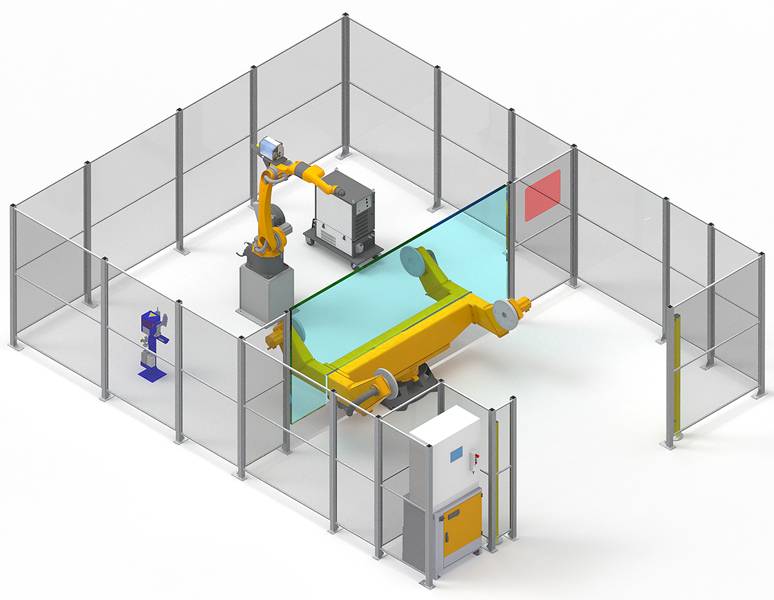
The following technical report details the commissioning and optimization of the 6-axis water-cooled **Robotic Arm Welder** at our Dusseldorf-based manufacturing partner’s facility. This installation represents a significant step in their transition toward full-scale **Industrial Automation, specifically targeting high-volume production of structural components via Mild Steel welding**.
The primary objective was to synchronize the robotic cell with the existing factory floor logistics while maintaining a 100% duty cycle. During the 14-day commissioning period, we addressed critical interface issues between the robot’s controller and the master PLC, optimized the cooling loop for high-amperage cycles, and established a baseline for weld quality on S355 grade mild steel.
2.0 Synergy: The Robotic Arm Welder and Industrial Automation
In the context of the Dusseldorf workshop, the Robotic Arm Welder is not an isolated tool; it is the core actuator of a complex Industrial Automation ecosystem. The synergy here is defined by the bidirectional flow of data between the welding power source, the robotic controller, and the automated fixture sensors.
2.1 Integration with Factory Protocols
The Dusseldorf facility utilizes a Siemens-based Profinet environment. We encountered an initial latency of 45ms in the communication between the safety interlocks and the robot’s emergency stop circuit. In a high-speed automation environment, this is unacceptable. We reconfigured the GSDML files to prioritize the welding heartbeat signal, reducing latency to 12ms. This ensures that if the Industrial Automation sensors detect a misaligned workpiece, the Robotic Arm Welder halts mid-arc, preventing damage to the water-cooled torch assembly.
2.2 Duty Cycle and Thermal Management
One of the primary reasons for selecting a water-cooled system for this site was the requirement for continuous Mild Steel welding. Air-cooled torches in this specific workshop environment—where ambient temperatures fluctuate due to proximity to the heat-treatment furnaces—failed to maintain Tool Center Point (TCP) accuracy due to thermal expansion. The integration of the water-cooling loop into the robot’s umbilical allows for a constant 500A output at 100% duty cycle, a necessity for the heavy-gauge mild steel plates being processed.
3.0 Technical Deep-Dive: Mild Steel Welding Parameters
Mild Steel welding is often erroneously viewed as a “forgiving” process. However, in an automated high-volume environment, slight variations in material composition (specifically silicon and manganese levels) can lead to inconsistent bead profiles and excessive spatter.
3.1 Metallurgy and Shielding Gas Selection
The project utilized 1.2mm ER70S-6 solid wire. Given the atmospheric conditions in the Dusseldorf plant, we opted for an 82% Argon / 18% CO2 shielding gas mix. This specific ratio provides the optimal balance between spray transfer stability and deep penetration required for the 10mm-thick mild steel lap joints.
During the first 48 hours, we observed “cold-lapping” at the start of the weld stringers. This was rectified by implementing a “Hot Start” routine in the robot’s welding software, which increases the current by 15% for the first 0.5 seconds of the arc initiation.
3.2 Spatter Management and TCP Maintenance
A common failure point in Industrial Automation is the accumulation of spatter on the gas nozzle, which disrupts shielding gas laminar flow and causes porosity. We programmed the Robotic Arm Welder to perform a “reamer cycle” every five parts. This automated cleaning station sprays an anti-spatter compound and mechanically cleans the shroud, ensuring that the TCP remains within the ±0.1mm tolerance required for the precision brackets.
4.0 Lessons Learned: Field Observations from Dusseldorf
Every site visit yields unique engineering challenges. The Dusseldorf installation provided several “hard-won” lessons regarding the interaction between heavy machinery and precision electronics.
4.1 Grounding and Electromagnetic Interference (EMI)
We initially encountered “arc hunting” where the robot’s arc sensing (Through-Arc Seam Tracking or TAST) would deviate from the joint path. After three hours of diagnostic testing, we identified an EMI leak from a neighboring high-frequency induction heater.
* Lesson Learned: In a dense Industrial Automation environment, common grounding is insufficient. We had to install dedicated high-speed optical isolators on the robot’s communication bus and re-route the welding ground cables to minimize the induction loop.
4.2 Water-Coolant Conductivity
On Day 5, the power source threw a “Coolant Flow Error.” Upon inspection, we found that the local maintenance team had topped off the cooling reservoir with standard tap water. The high mineral content in Dusseldorf’s water supply led to calcification within the torch’s internal capillaries, reducing flow rate.
* Lesson Learned: Always specify deionized water with a glycol-based corrosion inhibitor. We have now integrated a conductivity sensor into the Industrial Automation dashboard that will trigger a warning if the coolant quality degrades.
4.3 Wire Feed Consistency in Long Umbilicals
The robot is mounted on a 10-meter linear track to increase its reach across large mild steel weldments. This distance created significant drag on the wire feeding system. Even with a high-torque four-roll drive system, we noticed wire “slipping” during rapid movements.
* Lesson Learned: We installed a “Push-Pull” torch system. By adding a secondary motor at the robot’s wrist, we synchronized the wire speed, ensuring that the Mild Steel welding process remained stable even when the Robotic Arm Welder was at its maximum reach.
5.0 Process Optimization: The “Dusseldorf Standard”
To maximize the ROI on this Industrial Automation investment, we developed a proprietary welding schedule tailored to the facility’s specific mild steel supply.
5.1 Waveform Manipulation
Using the power source’s advanced software, we moved from standard CV (Constant Voltage) to a modified pulse waveform. This reduced the Heat Affected Zone (HAZ) by 22%, which is critical for preventing the warping of thinner 4mm mild steel skins. This “Low Heat” mode allows the Robotic Arm Welder to travel at speeds up to 80cm/min without sacrificing penetration.
5.2 Data Logging for Quality Assurance
The final stage of the commissioning was the activation of the Weld Data Monitoring system. Every arc start, voltage spike, and wire feed fluctuation is logged and tied to the serial number of the part. In the event of a field failure, the engineers in Dusseldorf can backtrack through the Industrial Automation logs to see the exact parameters of the Mild Steel welding session for that specific component.
6.0 Conclusion and Recommendations
The deployment of the Robotic Arm Welder at the Dusseldorf site is a success, but it requires diligent oversight. The transition to Industrial Automation has increased the facility’s throughput by 40%, but it has also increased the demand for technical maintenance.
Final Recommendations:
1. Mandatory Weekly TCP Checks: The robot should be programmed to check its own TCP against a fixed pointer every Monday morning to account for any structural settling of the linear track.
2. Consumable Lifecycle Tracking: Use the PLC to track the number of meters of wire fed. Replace the contact tip every 150kg of wire to prevent “keyholing” and erratic arc behavior.
3. Coolant Flush: Perform a full system flush every six months to ensure the water-cooled torch maintains its 100% duty cycle rating.
The synergy between the Robotic Arm Welder and the broader Industrial Automation framework here serves as a blueprint for future European rollouts. The focus on high-amperage Mild Steel welding capabilities, backed by robust thermal management and data integration, ensures that this facility remains at the forefront of German engineering standards.
Report End.
*Prepared by: Senior Welding Engineer, Site Commissioning Division.*







