Beam Processing Center with Narrow Gap welding for for Shipbuilding
In this article
Optimizing Shipbuilding Workflow via Plasma-Centric Beam Processing
In modern naval architecture, the demand for structural efficiency and rapid assembly drives the evolution of the Beam Processing Center (BPC). For shipyards, the transition toward automated Narrow Gap Welding (NGW) requires a fundamental shift in how structural profiles, such as H-beams, bulb flats, and inverted angles, are prepared. The primary bottleneck in large-scale vessel construction is often the fit-up phase. If the intersection of a longitudinal stiffener and a transverse bulkhead is not exact, the subsequent welding process encounters gaps that demand excessive filler material, leading to thermal distortion and increased labor costs.
Industrial engineers must prioritize Plasma Cutting systems that offer high-definition tolerances and multi-axis flexibility. Unlike traditional mechanical sawing or manual oxy-fuel cutting, an automated plasma-based BPC provides the geometric precision necessary to facilitate the tight tolerances required for NGW. This analysis focuses on the mechanical and operational parameters of plasma cutting that ensure seamless integration into the shipbuilding value chain.
Achieving Millimeter-Scale Intersection Accuracy
The complexity of a ship’s hull requires beams to be cut at varied angles and intersected with curved surfaces. Intersection Accuracy is not merely a measure of the cut’s cleanliness but a function of the machine’s ability to synchronize its 6-axis robotic or gantry movements with the actual physical dimensions of the beam.
Coordinate Transformation and Real-Time Measurement
Raw H-beams and structural profiles often arrive from the mill with slight deviations in web height, flange width, or camber. A high-performance BPC utilizes laser or mechanical probing to map these variances before the plasma torch is engaged. By applying real-time coordinate transformation, the system adjusts the cutting path to match the “as-built” profile rather than the “as-designed” CAD model.
This level of precision is critical for NGW. In narrow gap configurations, the joint preparation usually involves a total gap of less than 10-15mm for plates exceeding 40mm in thickness. If the intersection cut on an H-beam flange is off by even 2mm, the automated welding head may lose the arc or fail to achieve full penetration. Therefore, the plasma system’s motion controller must maintain dynamic kerf compensation to ensure that the final part geometry allows for a friction-fit or near-zero-gap assembly.
H-Beam Handling and Low-Maintenance Engineering
Shipyards are high-debris environments where metallic dust, slag, and industrial pollutants can compromise precision machinery. Designing a BPC for H-beam Low Maintenance is a prerequisite for achieving the high Duty Cycle (DC) required in 24/7 fabrication schedules.
Slag Management and Rack-and-Pinion Longevity
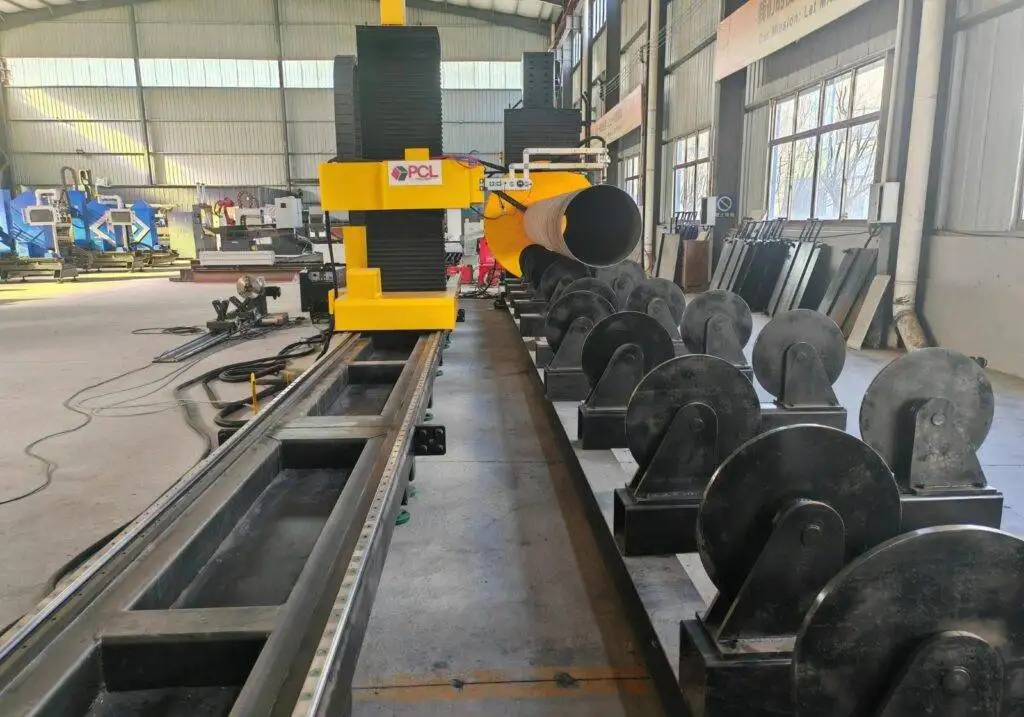
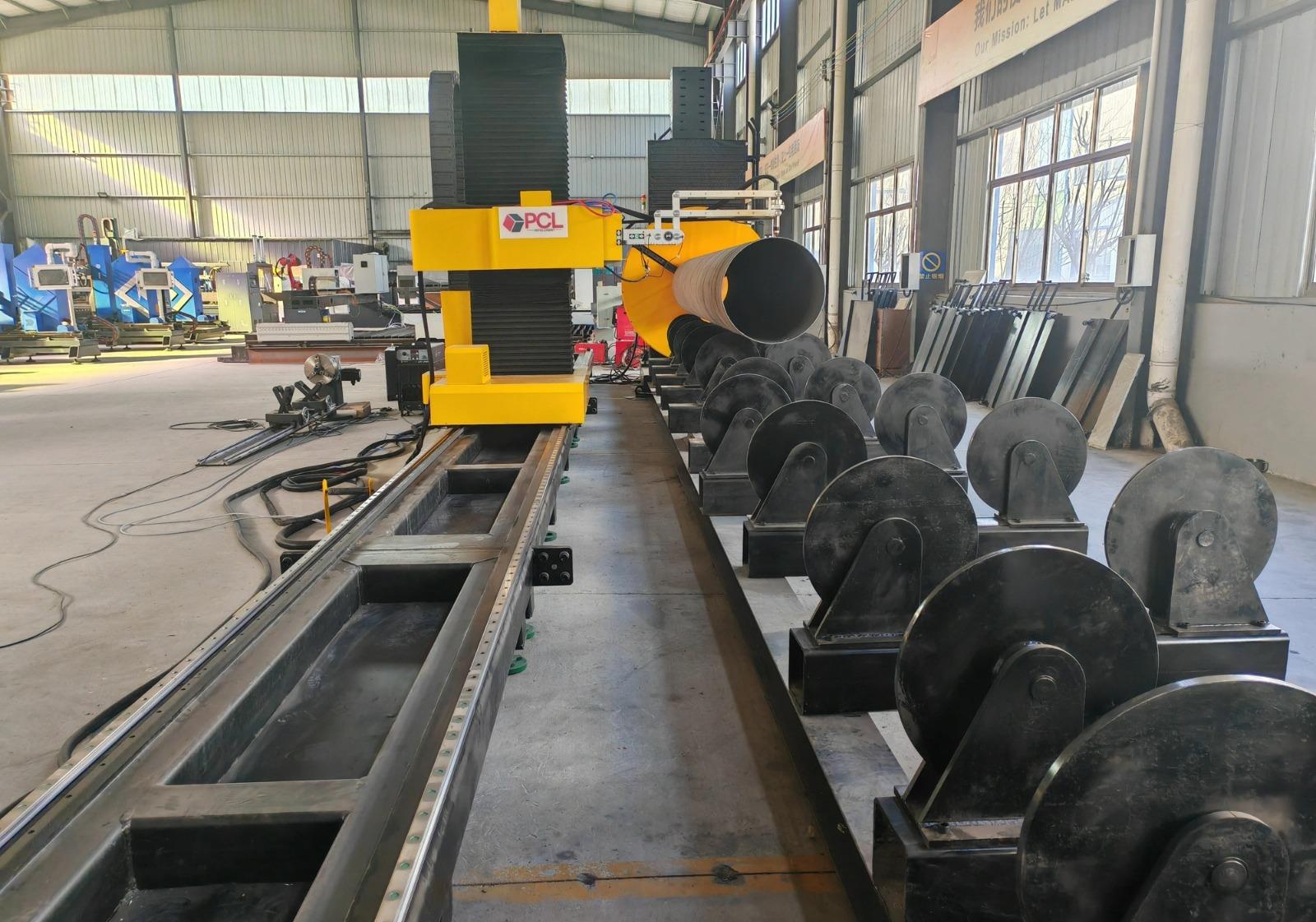
The plasma cutting process generates significant amounts of molten dross and fine particulate matter. To minimize downtime, the beam transport system—typically a heavy-duty roller conveyor or a drag-chain feeder—must be engineered with shielded guideways. Industrial engineers should specify systems with centralized lubrication and pressurized bellows for the linear rails.
Furthermore, the H-beam support bed should utilize sacrificial copper or cast-iron slats that are easily replaceable. By implementing a downward-draft smoke extraction system integrated directly into the cutting zone, the machine prevents the accumulation of dust on sensitive optical sensors and encoders. This proactive approach to maintenance ensures that the machine’s MTBF (Mean Time Between Failure) remains high, preventing costly stoppages in the shipyard’s assembly line.
Advanced Plasma Beveling for Narrow Gap Welding
The core advantage of using plasma in a BPC for Shipbuilding is its ability to perform Plasma Beveling on heavy-walled profiles. Conventional welding joints often require a 60-degree V-groove, which consumes vast amounts of time and consumables. NGW, however, utilizes a steep-angle preparation (typically 5 to 20 degrees), which significantly reduces the weld metal volume.
Multi-Pass Preparation and Edge Quality
High-definition plasma power sources are now capable of producing weld-ready edges with minimal Heat Affected Zones (HAZ). For shipbuilding, the BPC must be capable of executing complex bevels, including K, Y, and X-cuts, in a single pass or through a sequence of coordinated movements. The plasma torch head must feature a +/- 45-degree tilt capability and a high-speed rotation axis to navigate the corners of H-beam flanges.
The metallurgical quality of the cut edge is paramount. Modern oxygen-plasma systems minimize the formation of nitrogen nitrides on the cut surface, which can cause porosity in the final NGW bead. By maintaining a constant torch-to-workpiece distance via high-speed Voltage Height Control (VHC), the BPC ensures that the bevel angle remains consistent across the entire length of the structural member. This consistency is the primary factor in reducing secondary grinding operations, allowing the beam to move directly from the cutting station to the welding station.
Workflow Integration and Data-Driven Manufacturing
A BPC is not a standalone tool but a node in a digitally integrated shipyard. The transition from the plasma cutting stage to the NGW stage is managed through sophisticated nesting software that tracks the unique ID of every structural component.
Material Flow Optimization
The integration of the BPC into the production line allows for “just-in-time” delivery of processed beams to the sub-assembly area. By automating the marking of weld lines and part numbers using the plasma torch in a low-power marking mode, the shipyard eliminates manual layout errors. This creates a cohesive Structural Integrity loop where every cut, bevel, and mark is verified against the digital twin of the vessel.
For the industrial engineer, the focus remains on the throughput per square meter of shop floor. By consolidating cutting, beveling, and marking into a single plasma-based BPC, the shipyard reduces material handling by up to 40%. The elimination of separate beveling stations and the reduction in manual rework due to high intersection accuracy directly translate to a shorter hull-construction cycle.
Conclusion
The adoption of a Beam Processing Center equipped with high-definition plasma technology is a strategic necessity for shipyards implementing Narrow Gap Welding. By focusing on the mechanical precision of 3D intersections and the reliability of low-maintenance transport systems, manufacturers can achieve the tolerances required for advanced automated welding. The ability to produce complex bevel geometries without secondary processing ensures that the structural integrity of the vessel is maintained while operational costs are drastically reduced. In the competitive landscape of global shipbuilding, the plasma-based BPC stands as a cornerstone of efficient, high-quality structural fabrication.






