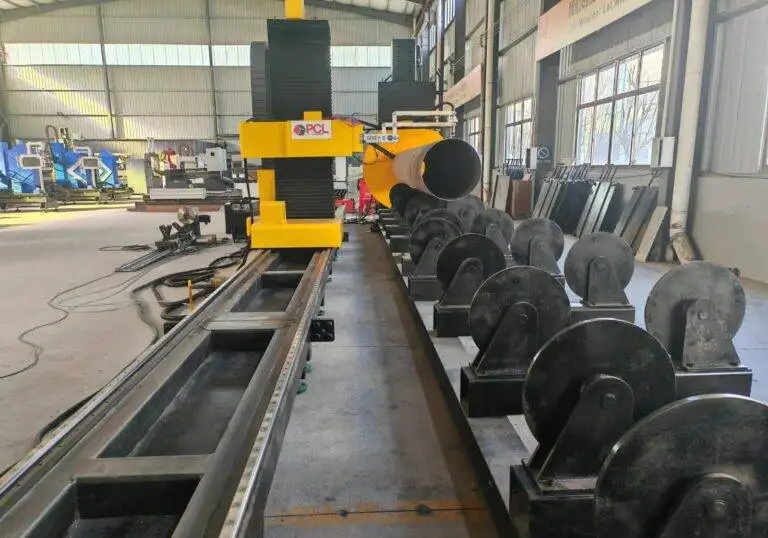
Beam Processing Center with Narrow Gap welding for for Steel Structure

In this article
Advanced Beam Processing: The Industrial Shift to Robotic Plasma Systems
In the contemporary landscape of structural steel fabrication, the efficiency of a Beam Processing Center is measured by its ability to facilitate complex joinery while minimizing downstream labor costs. For heavy-duty steel structures, particularly those utilizing large H-beams and I-sections, the adoption of 3D Plasma Cutting technology has become a non-negotiable standard. This shift is primarily driven by the transition toward Narrow Gap Welding (NGW) techniques, which require geometric tolerances far stricter than those achievable through traditional manual thermal cutting or mechanical sawing.
The industrial engineering perspective focuses on the total lifecycle of the beam—from raw mill delivery to the final erected joint. By integrating multi-axis robotic arms with high-definition plasma power sources, fabricators can execute cutting, marking, and beveling in a single pass. This integration eliminates the cumulative errors inherent in multi-stage processing, ensuring that every H-beam is prepared for optimal weld penetration and structural alignment.
Precision Intersection Accuracy in Heavy Profiles
One of the most significant challenges in steel structure fabrication is the “intersection”—the point where various structural members meet at complex angles. Traditional methods often result in gaps or overlaps that require extensive on-site “fitting” or excessive weld filler to bridge. A dedicated Beam Processing Center utilizes sophisticated sensing technologies, such as laser mapping or touch-probing, to compensate for mill tolerances. Even high-quality H-beams exhibit slight variances in flange thickness, web centering, or overall twist.

The robotic plasma system calculates these variances in real-time, adjusting the cutting path to ensure that the intersection geometry is perfect. This level of accuracy is critical for NGW. Because Narrow Gap Welding relies on a very tight root opening and a specific groove angle, any deviation in the cut face will lead to inconsistent bead profiles or lack of fusion. By maintaining sub-millimeter accuracy at the intersection, the system ensures that the structural load paths are precisely aligned, maximizing the structural integrity of the entire frame.
Mechanical Robustness and H-Beam Low Maintenance
From an operational efficiency standpoint, the maintenance profile of a Beam Processing Center determines its long-term ROI. Plasma systems are inherently suited for the harsh environments of steel mills and fabrication shops. Unlike more delicate thermal processes, plasma torches are rugged, designed to withstand the high-vibration and dust-heavy conditions typical of heavy H-beam handling.
The low maintenance requirements of plasma-based centers stem from several engineering factors:
- Consumable Longevity: Modern high-definition plasma systems feature electrode and nozzle cooling circuits that significantly extend the life of wear parts, even during long-duration cuts on thick-walled sections.
- Tolerance to Surface Impurities: Plasma cutting is less sensitive to surface rust, mill scale, or primers. This reduces the need for intensive pre-cut cleaning, which is a significant bottleneck in traditional workflows.
- Simplified Motion Systems: Because the plasma torch is a non-contact tool with a forgiving standoff distance, the risk of mechanical crashes is minimized, and the robotic kinematics remain focused on precision rather than force-resistance.
For the plant manager, this translates to higher uptime and a predictable maintenance schedule, ensuring that the production line remains fluid and bottle-neck free.
The Critical Role of Precision Beveling for Narrow Gap Welding
The primary advantage of Narrow Gap Welding is the drastic reduction in weld metal volume—often up to 50-70% compared to standard V-groove preparations. However, this advantage is entirely dependent on the quality of the precision beveling performed during the cutting stage. A Beam Processing Center equipped with a 5-axis or 6-axis robotic plasma head can execute complex bevel profiles—including V, Y, X, and K cuts—directly onto the flanges and webs of H-beams.
The physics of NGW requires a narrow, nearly parallel groove. If the bevel angle is too wide, the filler metal requirement increases, leading to higher heat input and potential distortion of the beam. If the angle is too narrow, the welding arc may fail to penetrate the side walls. Plasma technology allows for “Variable Beveling,” where the angle of the cut can change dynamically along the length of a contour. This is particularly useful in seismic zones or for high-load bridge components where the stress distribution requires varied weld depths and profiles across a single joint.
Optimizing Heat-Affected Zones (HAZ) and Kerf Compensation
Critics of thermal cutting often point to the Heat-Affected Zone (HAZ). However, modern high-definition plasma systems operate at extremely high speeds, which actually minimizes the total heat input into the base material. By concentrating the energy of the plasma arc, the system creates a narrow kerf with a minimal HAZ, preserving the metallurgical properties of the high-strength steel used in H-beams.
Furthermore, the software controlling the Beam Processing Center incorporates sophisticated kerf compensation algorithms. As the plasma nozzle wears, the kerf width can change slightly. The system monitors the arc voltage and adjusts the torch height and path offset to maintain the desired dimensions. This ensures that the final “fit-up” for the Narrow Gap Welding process is consistent across every beam in the project, regardless of whether it was the first or the hundredth cut of the day.
Streamlining the Fabrication Workflow
Beyond the technical specifics of the cut, the integration of plasma technology into an automated center streamlines the entire shop floor logistics. When a beam enters the center, it is measured, cut to length, mitered, and beveled in one continuous sequence. The elimination of manual layout—where workers use chalk lines and tape measures—removes the single largest source of error in structural steel work.
In the context of NGW, the “prep work” is often the most time-consuming phase. By automating this prep through a robotic plasma interface, the industrial engineer can shift the labor focus from manual grinding and fitting to high-value welding and assembly. This transition not only increases the throughput of the facility but also improves the safety profile by reducing the amount of manual torch handling and heavy material flipping required.
Conclusion: The Engineering Imperative
The synergy between 3D plasma cutting and Narrow Gap Welding represents the pinnacle of modern structural engineering efficiency. By focusing on intersection accuracy, leveraging the low-maintenance nature of plasma hardware, and mastering the art of precision beveling, fabricators can produce steel structures that are stronger, more accurate, and more cost-effective. As building codes become more stringent and architectural designs more complex, the ability of a Beam Processing Center to deliver flawless, NGW-ready components will be the primary differentiator for successful fabrication enterprises.