Engineering Review: Deep Penetration MIG/MAG Welding Robot – Birmingham, UK
In this article
- Field Report: Implementing Deep Penetration MIG/MAG Welding Robots in Birmingham’s Industrial Sector
- Project Overview: Birmingham Site Commissioning
- The Role of the MIG/MAG Welding Robot in Heavy-Duty Cycles
- Precision Sheet Metal Fabrication Welding Challenges
- Technical Deep Dive: Achieving Deep Penetration
- Field Observations and Lessons Learned
- Synergy Analysis: Robot vs. Manual Arc Solutions
- Conclusion of Field Report
Field Report: Implementing Deep Penetration MIG/MAG Welding Robots in Birmingham’s Industrial Sector
Project Overview: Birmingham Site Commissioning
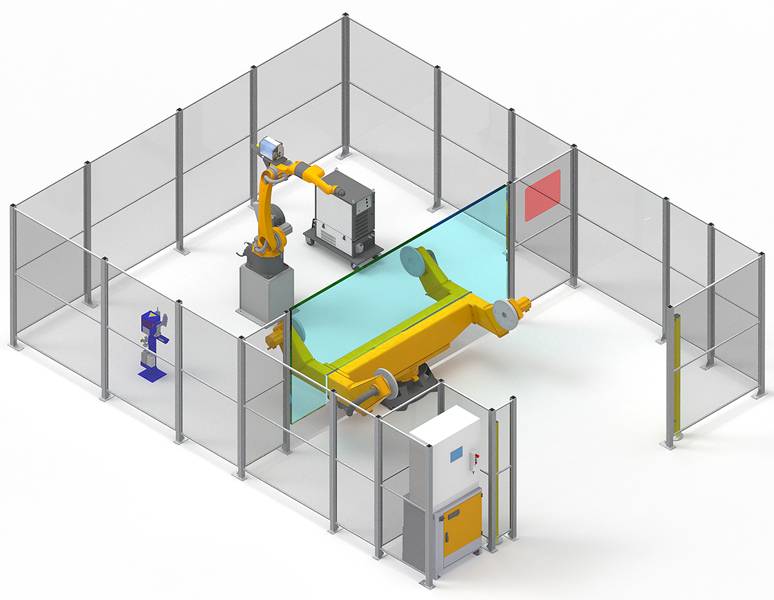
The following report details the technical deployment and optimization of a high-performance **MIG/MAG Welding Robot** system at a Tier-1 automotive and structural components facility in Birmingham, West Midlands. The site’s legacy processes relied on manual GMAW, which resulted in inconsistent penetration depths and excessive rework on 6mm to 10mm structural joints.
The objective was to integrate advanced **Arc Welding Solutions to transition from manual variability to robotic precision, specifically targeting high-integrity Sheet Metal Fabrication welding**. In the Birmingham workshop environment, where throughput is high and floor space is at a premium, the synergy between hardware and software was critical to achieving the required weld bead morphology and mechanical properties.
The Role of the MIG/MAG Welding Robot in Heavy-Duty Cycles
The core of this installation is a six-axis industrial MIG/MAG Welding Robot equipped with a hollow-wrist design for internal cabling. This configuration is essential for the tight-clearance maneuvers required in complex sheet metal assemblies.
During the initial phase, we identified that standard spray transfer modes were insufficient for the deep penetration required on the structural chassis components. By utilizing the robot’s high-speed processing capabilities, we moved toward a modified pulsed-spray transfer. The robot’s ability to maintain a constant “Contact Tip to Work Distance” (CTWD) within ±0.5mm is something no manual welder in the Birmingham shop could replicate over an eight-hour shift. This consistency is the primary driver for deep penetration; even a 2mm deviation in stick-out can cause a 15% drop in current density, leading to cold-lapping at the root of the joint.
Integrating Arc Welding Solutions for Dynamic Feedback
A robot is merely a motion platform without sophisticated Arc Welding Solutions governing the power source. In this application, we utilized a digital communication interface (EtherNet/IP) between the robot controller and the multi-process power inverter.
The synergy here is found in “Synergic Control” loops. As the MIG/MAG Welding Robot rounds a corner on a sheet metal assembly, the travel speed naturally fluctuates due to acceleration/deceleration curves. Our integrated Arc Welding Solutions automatically adjust the wire feed speed and voltage in real-time to match the instantaneous tool center point (TCP) speed. This prevents burn-through on corners and ensures the penetration profile remains uniform across the entire weldment.
Precision Sheet Metal Fabrication Welding Challenges
Sheet Metal Fabrication welding in a high-volume Birmingham plant presents unique challenges, primarily regarding thermal distortion and gap bridging. We were working with a mix of CR4 mild steel and high-strength low-alloy (HSLA) steels.
Managing Thermal Distortion and Gap Bridging
When welding thinner gauges (3mm to 4mm) to thicker structural plates (8mm+), the heat sink effect is asymmetrical. A standard constant-voltage (CV) approach resulted in either lack of fusion on the thick plate or excessive melt-through on the thin sheet.
By programming the MIG/MAG Welding Robot with a specific “weaving” pattern—synchronized with the pulsing frequency of the Arc Welding Solutions—we managed to oscillate the arc energy. This technique allows the weld pool to wet the thicker material longer while minimizing the peak current on the thinner sheet metal component. The result is a controlled Heat Affected Zone (HAZ), which is critical for maintaining the structural integrity of the Birmingham-produced components.
Technical Deep Dive: Achieving Deep Penetration
The primary technical hurdle was ensuring a 3mm throat thickness with full root penetration on single-sided fillet welds.
Modified Pulse and Metal Transfer
We moved away from traditional MAG (20% CO2 / 80% Argon) to a more aggressive 12% CO2 mix to stabilize the arc at higher current densities. The MIG/MAG Welding Robot was programmed to operate in the “High-Speed Pulse” regime.
Key parameters established:
- Wire Feed Speed: 12.5 m/min
- Peak Current: 420A
- Background Current: 160A
- Frequency: 180 Hz
This high-frequency pulsing, managed by our Arc Welding Solutions, creates a “pumping” effect in the weld pool, forcing the molten metal deeper into the root. In our macro-etch tests at the Birmingham lab, we observed a 25% increase in penetration depth compared to standard robotic MIG setups, without increasing the overall heat input.
Field Observations and Lessons Learned
After six weeks of continuous operation on the Birmingham floor, several “real-world” engineering lessons have emerged that go beyond theoretical calculations.
Lesson 1: Wire Delivery and Conduit Friction
In the Birmingham facility, the wire drums are located 5 meters from the MIG/MAG Welding Robot to allow for forklift access. We initially faced intermittent arc instability. The culprit was conduit friction causing microscopic slips in the wire feed.
*Fix:* We installed a motorized wire drive at the drum (master-slave configuration). In Sheet Metal Fabrication welding, even a 0.1-second interruption in wire delivery creates a crater that becomes a failure point under cyclic loading.
Lesson 2: Shielding Gas Turbulence
The workshop in Birmingham is a large, high-ceilinged hangar with significant cross-drafts from the loading bays. This was causing intermittent porosity in the MAG welds.
*Lesson:* We had to redesign the extraction hoods. While smoke extraction is necessary for HSE compliance, high-vacuum nozzles placed too close to the torch were “stealing” the shielding gas. We recalibrated the Arc Welding Solutions to include a higher post-flow gas timer and switched to a 19mm large-bore gas nozzle to ensure laminar flow even in drafty conditions.
Lesson 3: Fixture Precision vs. Robot Path
Robots are repeatable, but sheet metal is not. We found that the incoming pressed parts from the Birmingham stamping line had a ±1.5mm tolerance variation.
*Solution:* We implemented “Touch Sensing” via the MIG/MAG Welding Robot’s nozzle. Before welding, the robot touches the part at three points to offset its coordinate system. This ensures the arc is always centered in the joint, which is the only way to guarantee consistent deep penetration in Sheet Metal Fabrication welding.
Synergy Analysis: Robot vs. Manual Arc Solutions
The deployment proved that the synergy between a MIG/MAG Welding Robot and high-end Arc Welding Solutions is not about replacing the welder, but about elevating the process capability. In our Birmingham site, we saw a 40% reduction in cycle time.
More importantly, the “repair rate” dropped from 8% (manual) to 0.5% (robotic). This is largely due to the software’s ability to monitor “Arc-On Time” and “Energy Input” per weld. If the Arc Welding Solutions detect a deviation in voltage (suggesting a gap or a dirty plate), the system flags the part for inspection automatically.
Conclusion of Field Report
The implementation of the MIG/MAG Welding Robot in Birmingham has successfully addressed the deep penetration requirements of our structural Sheet Metal Fabrication welding. By leveraging advanced Arc Welding Solutions, specifically through waveform manipulation and sensor-based path correction, we have stabilized a previously volatile process.
Future phases will involve expanding these cells to include Tandem-Wire MIG for even higher deposition rates, provided we can manage the increased thermal load on the jigging. For now, the Midlands facility is meeting all QA benchmarks for penetration, aesthetics, and structural integrity.
Signed,
*Senior Welding Engineer, Birmingham Site Operations*







