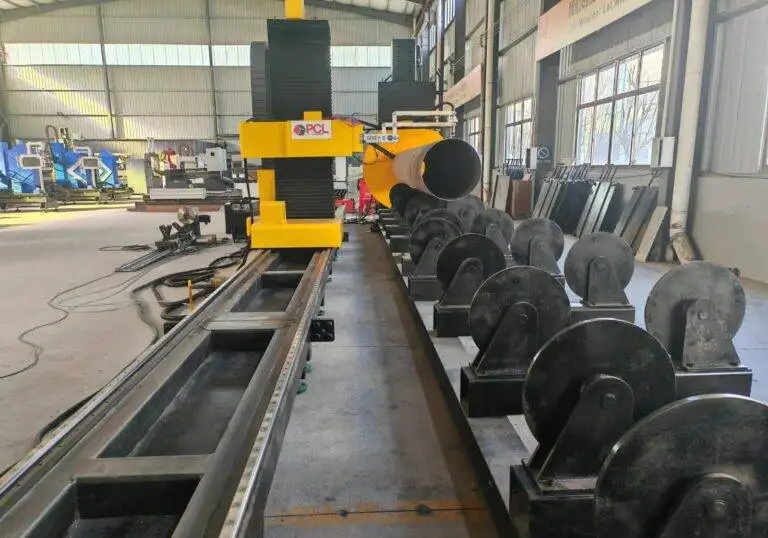
Beam Processing Center with Narrow Gap welding for for Shipbuilding

In this article
Optimizing Structural Integrity through Advanced Plasma Cutting
In the high-stakes environment of naval architecture and commercial shipbuilding, the transition from raw structural steel to a finished hull assembly demands rigorous precision. A Beam Processing Center (BPC) serves as the primary node for transforming H-beams, bulbs, and angles into modular components. For projects utilizing Narrow Gap Welding (NGW), the efficiency of the entire fabrication chain is dictated by the quality of the initial plasma cut. Unlike traditional welding methods that allow for wider tolerances, NGW requires microscopic consistency in joint preparation to ensure deep penetration with minimal heat input.
The implementation of a 3D plasma cutting head within these centers allows for the execution of complex geometries in a single pass. This capability is critical when dealing with the heavy-gauge H-beams common in mid-ship sections and bulkheads. By focusing on the intersection of plasma dynamics and robotic motion control, engineers can achieve the specific edge profiles necessary for high-integrity maritime structures.
Intersection Accuracy and Geometric Precision
Shipbuilding involves the convergence of multiple structural members at non-orthogonal angles. The intersection accuracy of these beams determines the gap variability, which directly impacts the volumetric efficiency of the weld metal. In a modern BPC, 6-axis or 8-axis robotic plasma systems utilize sophisticated sensing technologies—such as laser scanning or tactile probing—to map the actual dimensions of the H-beam before the first arc is struck.

Structural steel, particularly large H-beams, often arrives with inherent manufacturing deviations, including camber, sweep, and flange tilt. If a cutting system relies solely on nominal CAD data, the resulting intersections will inevitably suffer from fit-up gaps. High-precision plasma systems compensate for these variances in real-time. By adjusting the cutting path to the actual profile of the beam, the system ensures that the intersection point between a longitudinal stiffener and a transverse bulkhead is tight. This minimizes the reliance on bridge-welding and reduces the total man-hours spent on manual fit-up.
H-Beam Processing: Robustness and Low Maintenance
The shipyard environment is notoriously harsh, characterized by metallic dust, fluctuating temperatures, and heavy vibrations. In this context, the mechanical robustness of the cutting medium is paramount. Plasma cutting systems are engineered for the high-duty cycles required in continuous production shifts. For H-beam processing, the primary advantage lies in the low maintenance profile of the plasma torch and power supply compared to more sensitive thermal cutting technologies.
A plasma system’s consumable components—nozzles, electrodes, and swirl rings—are designed for rapid replacement and are relatively inexpensive. This allows for a predictable maintenance schedule that does not require specialized clean-room environments or highly delicate handling. Furthermore, the modern high-definition plasma power source is capable of maintaining arc stability even during the rapid direction changes required when cutting around the flanges and webs of an H-beam. This reliability ensures that the Beam Processing Center remains operational with minimal unplanned downtime, a critical factor when meeting tight dry-dock schedules.
Advanced Beveling for Narrow Gap Welding Prep
The move toward Narrow Gap Welding in shipbuilding is driven by the need to reduce filler material consumption and total heat-affected zones (HAZ). However, NGW is unforgiving regarding edge preparation. Conventional oxy-fuel cutting often leaves a heavy slag layer and a wide HAZ, which requires secondary grinding. In contrast, plasma beveling provides a cleaner, more precise edge profile that is ready for the welding robot with little to no post-processing.
The BPC must be capable of producing varied bevel types—including V, Y, and X-cuts—on the fly. When preparing an H-beam for NGW, the plasma head must maintain a constant torch-to-workpiece distance while articulating through steep angles. Advanced plasma systems use sophisticated torch height control (THC) that responds to the voltage fluctuations of the arc, ensuring that the bevel angle remains consistent even if the beam surface is uneven. This consistency is the foundational requirement for the subsequent Narrow Gap Welding process, where even a one-degree deviation in the bevel can lead to lack of fusion or slag entrapment.
Thermal Management and Material Distortion
Controlling the thermal input during the cutting phase is essential for maintaining the metallurgical properties of high-tensile shipbuilding steel. Plasma cutting, characterized by its high energy density and high cutting speeds, limits the time the heat source is in contact with the material. This rapid processing significantly reduces the zone of thermal influence. For H-beams, which are prone to warping when subjected to uneven heating, the speed of plasma cutting helps maintain the structural straightness of the component.
By optimizing the nesting and cutting sequence within the BPC software, engineers can further mitigate distortion. This integrated approach ensures that when the beams reach the assembly platen, they retain their engineered dimensions, facilitating a faster and more accurate Narrow Gap Welding cycle. The reduction in distortion also means that the internal stresses within the hull structure are minimized, leading to a longer fatigue life for the vessel.
Digital Integration and Workflow Efficiency
The final pillar of efficiency in a plasma-based Beam Processing Center is the digital workflow. Modern centers utilize structural integrity data directly from the ship’s PLM (Product Lifecycle Management) system. The software translates complex 3D models into machine code that includes specific instructions for beveling and marking. This end-to-end digital integration eliminates manual layout errors and ensures that every beam is cut to the exact requirements of the NGW specifications.
The ability to mark part numbers, alignment lines, and welding instructions directly onto the H-beam using the plasma torch (in a low-amperage marking mode) further streamlines the downstream assembly. This ensures that the NGW robots or manual operators have clear visual cues for alignment, further enhancing the precision of the final structural assembly. By focusing on the synergy between precise plasma cutting and the requirements of narrow-gap joints, shipyards can achieve a level of productivity and quality that was previously unattainable with traditional fabrication methods.
Conclusion: The Strategic Advantage of Plasma in NGW Workflows
The selection of plasma technology for a Beam Processing Center is a strategic decision based on the balance of precision, speed, and durability. for Shipbuilding applications where H-beams form the backbone of the vessel, the ability to achieve high intersection accuracy and specialized beveling profiles is indispensable. By minimizing maintenance requirements and maximizing the quality of the weld preparation, plasma cutting serves as the critical enabler for Narrow Gap Welding, ultimately leading to lighter, stronger, and more cost-effectively produced ships.