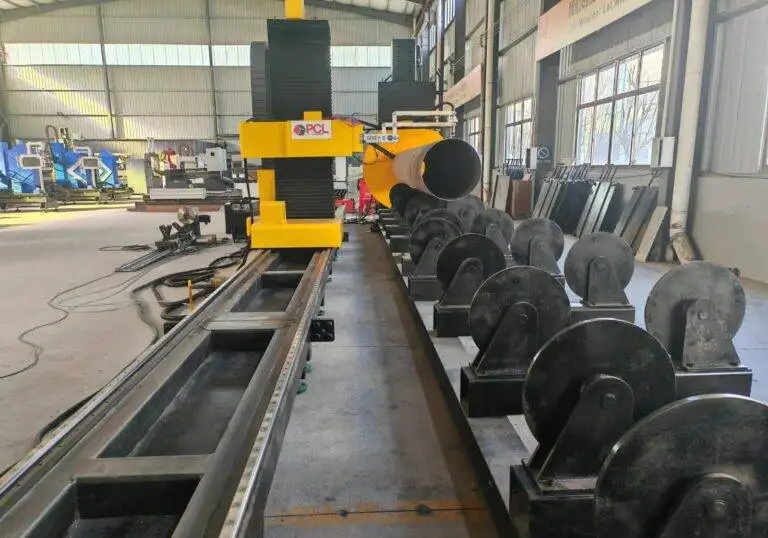
Beam Processing Center with Narrow Gap welding for for Shipbuilding

In this article
- Engineering Efficiency in Shipbuilding: The Role of the Beam Processing Center
- The Technical Supremacy of 3D Plasma Cutting in Profile Management
- Achieving Critical Intersection Accuracy for Structural Integrity
- Maintenance Cycles and Reliability of H-Beam Handling Systems
- Advanced Beveling for Narrow Gap Welding Preparation
Engineering Efficiency in Shipbuilding: The Role of the Beam Processing Center
In the heavy industry landscape of shipbuilding, the transition from manual profile processing to automated Beam Processing Centers (BPC) marks a critical shift toward lean manufacturing. The primary objective is the preparation of structural members—H-beams, bulbs, and angles—with such high precision that subsequent assembly stages require minimal intervention. For shipyards employing Narrow Gap Welding, the margin for error in edge preparation is virtually non-existent. The BPC serves as the foundational stage where structural integrity begins, utilizing high-definition plasma systems to execute complex geometries across three dimensions.
The Technical Supremacy of 3D Plasma Cutting in Profile Management
Unlike traditional plate processing, beam processing involves multi-surface engagement. A plasma cutting robot within a BPC must navigate the flanges and webs of an H-beam simultaneously. The engineering challenge lies in maintaining a consistent torch-to-workpiece distance while moving across varying material thicknesses. Modern centers utilize high-speed sensing and 7-axis robotic arms to ensure that the plasma arc remains stable, minimizing the dross and slag that typically accumulate on the underside of thick-walled profiles.
From an industrial engineering perspective, the choice of plasma over other thermal cutting methods is driven by its ability to handle high-tensile marine-grade steels with significant speed-to-thickness ratios. In shipbuilding, where sections often exceed 25mm in thickness, the plasma arc provides the necessary energy density to achieve clean cuts without the excessive thermal warping associated with oxy-fuel processes.
Achieving Critical Intersection Accuracy for Structural Integrity
The complexity of a ship’s hull and internal skeleton requires hundreds of thousands of intersections where longitudinal stiffeners meet transverse frames. Intersection accuracy is the metric that determines the success of the fit-up phase. If a coping cut or a mouse hole is off by even 2mm, the resulting gap forces the welding team to compensate with excessive filler metal, increasing the risk of hydrogen cracking and thermal distortion.
Automated BPCs solve this through advanced CAD/CAM integration. The software translates 3D hull models directly into robotic tool paths, accounting for the kerf width of the plasma arc. By executing precise scallops, chamfers, and bolt holes in a single pass, the system ensures that when the beams reach the assembly block, they lock into place with mechanical precision. This accuracy is paramount when preparing for NGW, as the narrow groove requires perfectly parallel or slightly tapered side walls to ensure deep penetration and consistent fusion.
Maintenance Cycles and Reliability of H-Beam Handling Systems
Industrial environments are notoriously harsh on sensitive machinery. However, the design of modern H-beam processing centers emphasizes mechanical ruggedness and low maintenance. Unlike systems that rely on delicate optical components, plasma-based BPCs are engineered to withstand the dust, vibration, and temperature fluctuations of a shipyard.
Key maintenance-friendly features include:
- Self-cleaning slat tables and scrap conveyors that prevent heavy slag buildup.
- Hardened roller feeds and rack-and-pinion drives designed for multi-ton beam loads.
- Robust torch head designs with quick-change consumables that reduce downtime during high-volume shifts.
- Integrated fume extraction systems that protect the robotic components from metallic dust ingestion.
By focusing on a low maintenance architecture, shipyards can achieve a higher OEE (Overall Equipment Effectiveness). The reliability of the plasma power source, often rated for 100% duty cycles, ensures that the beam line remains the heartbeat of the fabrication shop, feeding the assembly blocks without bottlenecking.
Advanced Beveling for Narrow Gap Welding Preparation
Narrow Gap Welding is a high-efficiency joinery technique that reduces the volume of the weld metal by utilizing a tight, nearly parallel groove. The success of this process is entirely dependent on the quality of the bevel. The BPC’s plasma torch must be capable of executing compound bevels—V, Y, K, and X-cuts—with extreme angular consistency.
High-definition plasma systems now offer “true hole” and “true bevel” technologies that compensate for the natural taper of the plasma arc. When preparing an H-beam for an NGW joint, the BPC produces a smooth surface finish that mimics machined quality. This surface preparation is vital; any irregularities in the bevel face can cause arc instability or slag inclusions during the welding process. By automating this beveling within the cutting cycle, the shipyard eliminates the need for secondary grinding, which is both labor-intensive and inconsistent.
Thermal Management and the Heat Affected Zone (HAZ)
A common concern in thermal cutting is the Heat Affected Zone. In shipbuilding, excessive heat can alter the grain structure of the steel, leading to brittleness in the joint. Modern plasma units in BPCs utilize sophisticated gas mixtures—such as Oxygen-Air or Argon-Hydrogen—to constrict the arc. This constriction increases energy density, allowing for faster travel speeds. The result is a narrower HAZ compared to conventional methods.
For NGW preparation, a minimal HAZ ensures that the subsequent welding pass interacts with the base metal’s original metallurgical properties. This is especially critical for ice-class vessels and high-pressure tankers where weld toughness is a non-negotiable safety parameter.
Integration with Automated Material Handling
The throughput of a Beam Processing Center is not only determined by the cutting speed but by the logistics of moving H-beams through the system. Industrial engineers prioritize the “in-feed” and “out-feed” synchronization. Cross-transfers, buffer zones, and automated measurement probes ensure that the plasma torch is always engaged.
Before the first cut is made, the BPC uses laser or mechanical probing to detect any deviations in the beam’s profile—such as camber or sweep. The software then dynamically adjusts the cutting program to match the actual physical dimensions of the steel. This “measure-to-cut” workflow is the secret behind the intersection accuracy required for complex naval architecture.
Optimizing Consumable Life and Operational Costs
From a cost-control perspective, the BPC’s plasma system is monitored via IoT sensors to track consumable wear. Predictive maintenance algorithms alert operators before a nozzle or electrode failure occurs, preventing ruined cuts on expensive structural profiles. This level of data-driven management allows for precise budgeting of “cost-per-meter” in the cutting process.
Conclusion: The Strategic Advantage of Plasma-Based BPCs
The integration of a Beam Processing Center into a shipyard’s workflow is a strategic move toward high-precision engineering. By mastering plasma cutting for 3D profiles, shipyards can achieve the intersection accuracy necessary for the most demanding Narrow Gap Welding applications. The result is a significant reduction in man-hours, a decrease in material waste, and a structural end-product that meets the highest standards of maritime safety. Focusing on H-beam reliability and low maintenance systems ensures that the shipyard remains competitive in a global market that increasingly demands faster delivery cycles and higher structural integrity.