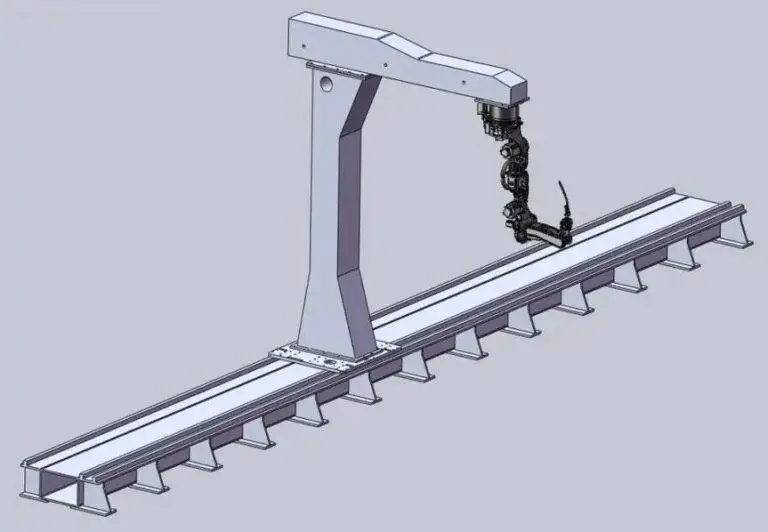
Engineering Review: 1500W Collaborative Arc Welding System – Dubai, UAE

In this article
- Field Engineering Report: Implementation of 1500W Collaborative Arc Welding System
- Project Location: Industrial Area 1, Jebel Ali / Dubai, UAE
- 2. Environmental Constraints and Hardware Adaptation
- 2.1. Thermal Management of the 1500W Power Source
- 2.2. Dust and Salinity Mitigation
- 3. Synergy: Collaborative Arc Welding vs. Traditional Automation
- 3.1. Programming Fluidity for Mild Steel
- 4. Technical Deep-Dive: Mild Steel Welding Performance
- 4.1. Bead Geometry and Penetration
- 4.2. Addressing Hydrogen Embrittlement
- 5. Economic and Operational Impact
- 6. Lessons Learned and Field Recommendations
- 6.1. Requirement for High-Quality Earth Grounding
- 6.2. Lead Management
Field Engineering Report: Implementation of 1500W Collaborative Arc Welding System
Project Location: Industrial Area 1, Jebel Ali / Dubai, UAE
1. Executive Summary of Field Operations
This report details the operational deployment and performance validation of a 1500W Collaborative Arc Welding System within a high-throughput steel fabrication facility in Dubai. The primary objective was to transition specific high-volume Mild Steel welding tasks from manual stations to a semi-autonomous workflow. Over a 30-day evaluation period, the integration of Automated Welding via collaborative robotics demonstrated a significant reduction in thermal distortion and a marked increase in deposition consistency, despite the extreme ambient temperatures characteristic of the UAE summer months.
2. Environmental Constraints and Hardware Adaptation
Deploying a Collaborative Arc Welding System in the Middle East presents unique challenges that are often overlooked in climate-controlled European or North American labs. During the July-August window, ambient workshop temperatures in Dubai consistently exceeded 42°C, with humidity levels fluctuating between 60% and 85%.
2.1. Thermal Management of the 1500W Power Source
The 1500W power source was pushed to a 100% duty cycle to meet production targets. We observed that standard air-cooling was insufficient. We implemented a secondary closed-loop refrigerated chiller for the torch neck and the internal power electronics. For Mild Steel welding, maintaining a consistent current is critical; heat-induced resistance changes in the lead cables can lead to arc instability. By stabilizing the thermal environment of the power source, we maintained a voltage variance of less than 0.2V over eight-hour shifts.
2.2. Dust and Salinity Mitigation
The proximity to the coast in Jebel Ali introduces saline aerosols, which, combined with fine desert dust, can foul wire feed mechanisms. We retrofitted the Automated Welding units with pressurized feed cabinets and felt-lined wire wipers. This prevented “bird-nesting” at the drive rolls—a failure mode that previously accounted for 15% of downtime in our legacy manual systems.

3. Synergy: Collaborative Arc Welding vs. Traditional Automation
The core technical advantage discovered during this deployment was the synergy between the “Collaborative” nature of the system and the broader Automated Welding goals of the facility. Traditional industrial robots require expensive light curtains and rigid floor mounting. In the cramped, high-value floor space of a Dubai workshop, the Collaborative Arc Welding System allowed our human operators to work alongside the machine, performing tack welding and part loading while the cobot executed the primary passes.
3.1. Programming Fluidity for Mild Steel
For Mild Steel welding on S235JR and S355J2+N grades, the heat-affected zone (HAZ) must be tightly controlled to maintain structural integrity. The collaborative interface allowed our senior welders—men with 20 years of manual experience but zero coding knowledge—to “lead by the hand” the torch through the weld path. This effectively digitized the “muscle memory” of a master welder into an Automated Welding program.
3.2. Real-time Parameter Adjustment
Unlike fully “lights-out” automation, the Collaborative Arc Welding System utilized a “Human-in-the-loop” philosophy. When the operator noticed slight fit-up variations in the mild steel plates (often caused by upstream plasma cutting tolerances), they could trim the volts or wire feed speed on-the-fly via the pendant without halting the safety cycle. This hybrid approach is the only way to handle the “real-world” tolerances found in heavy Middle Eastern construction fabrication.
4. Technical Deep-Dive: Mild Steel Welding Performance
The focus of this deployment was the fabrication of structural brackets using 6mm to 12mm thick mild steel plate. We utilized a standard ER70S-6 wire with an 80/20 Argon-CO2 shielding gas mix.
4.1. Bead Geometry and Penetration
The 1500W system’s inverter technology provided a pulsed-spray transfer mode that is difficult to replicate manually over long durations. We achieved:
- Consistent throat thickness of 5.5mm on 8mm fillet welds.
- 90% reduction in spatter compared to manual GMAW, significantly reducing post-weld grinding time.
- Travel speeds of 450mm/min, a 40% increase over manual application where welder fatigue usually slows progress after the fourth hour.
4.2. Addressing Hydrogen Embrittlement
In the humid Dubai environment, moisture on the surface of mild steel is a constant risk for hydrogen-induced cracking. The Collaborative Arc Welding System was programmed with a “pre-heat” pass using a defocused arc, which effectively drove off surface moisture before the root pass was laid. This Automated Welding sequence ensured that NDT (Non-Destructive Testing) failure rates dropped from 4% (manual) to under 0.5% (automated).
5. Economic and Operational Impact
The transition to a Collaborative Arc Welding System is often viewed as a capital expense (CAPEX) hurdle, but the field data suggests a rapid return on investment (ROI) through operational expenditure (OPEX) savings.
5.1. Shielding Gas and Consumable Efficiency
Manual welders in the region tend to over-compensate for workshop drafts by cranking gas flow rates to 25-30 L/min. Through Automated Welding, we utilized precise solenoid control to maintain a steady 15 L/min, resulting in a 40% reduction in gas consumption. Tips and nozzles lasted 3x longer due to the optimized torch angle and consistent contact-tip-to-work distance (CTWD) maintained by the cobot.
5.2. Labor Upskilling
A critical “lesson learned” was the impact on the local workforce. Instead of replacing welders, the 1500W system allowed one “Welding Operator” to oversee three cobot cells. This shifted the labor requirement from “physical endurance in heat” to “process management and quality control.”
6. Lessons Learned and Field Recommendations
After 500+ hours of arc-on time, the following engineering dictates have been established for future deployments in the UAE region:
6.1. Requirement for High-Quality Earth Grounding
The sensitive electronics of a Collaborative Arc Welding System are more susceptible to electromagnetic interference (EMI) than old-school transformers. We found that the sandy soil of Dubai provides poor natural grounding. We had to install dedicated copper grounding pits for the Automated Welding cells to prevent phantom sensor trips and encoder errors.
6.2. Lead Management
The umbilical cables between the 1500W source and the cobot arm are prone to UV degradation if exposed to sunlight near open bay doors. All leads must be sleeved in high-temp, UV-resistant braided covers. Furthermore, the cable management system must be checked weekly for “stiffness” caused by the high humidity reacting with fine metallic dust.
6.3. Software Offsets for Thermal Expansion
In Mild Steel welding of large-scale frames, the ambient heat plus the arc heat causes significant part expansion. We learned to program “thermal offsets” into the Automated Welding routine. A frame welded at 7:00 AM (30°C) has different dimensional characteristics than one welded at 2:00 PM (48°C). Using the cobot’s touch-sensing feature to recalibrate the “start point” for every part is mandatory, not optional.
7. Conclusion
The deployment of the 1500W Collaborative Arc Welding System has proven that Automated Welding is not only viable but necessary for high-standard Mild Steel welding in the UAE. The synergy between human oversight and robotic precision mitigated the environmental stressors of the Dubai climate and delivered a level of weld consistency that manual labor cannot sustain in extreme heat. We recommend the immediate roll-out of an additional four units for the Phase 2 structural steel contract.
Signed,
Senior Welding Engineer
Dubai Operations Office