Engineering Review: Low-spatter MAG 6-Axis Collaborative Welder – Barcelona, Spain

In this article
- Field Report: Implementing Low-Spatter MAG via 6-Axis Collaborative Welder
- 1. Project Overview and Site Context: Barcelona Industrial District
- 2. Technical Synergy: 6-Axis Collaborative Welder and Automated Welding
- 3. Metallurgical Focus: Tool Steel Welding Challenges
- 4. Lessons Learned: Field Observations from the Barcelona Workshop
- 5. Productivity and Quality Analysis
- 6. Strategic Integration for the Spanish Market
- 7. Final Engineering Conclusion
Field Report: Implementing Low-Spatter MAG via 6-Axis Collaborative Welder
1. Project Overview and Site Context: Barcelona Industrial District
This report details the technical deployment and optimization of a 6-Axis Collaborative Welder within a high-precision tool and die facility located in the Zona Franca industrial sector of Barcelona, Spain. The facility specializes in the refurbishment and fabrication of injection molds, requiring significant Tool Steel welding. Historically, these repairs were performed manually, leading to inconsistent penetration and excessive post-weld grinding due to spatter.
The objective was to transition toward Automated Welding to stabilize the thermal input and improve metallurgical integrity. Barcelona’s Mediterranean climate—specifically the high ambient humidity—presented unique challenges for Gas Metal Arc Welding (GMAW/MAG), necessitating a rigid look at shielding gas consistency and wire storage protocols. The implementation focused on integrating the 6-Axis Collaborative Welder into a workflow that demands the flexibility of a human operator with the repeatability of a machine.
2. Technical Synergy: 6-Axis Collaborative Welder and Automated Welding
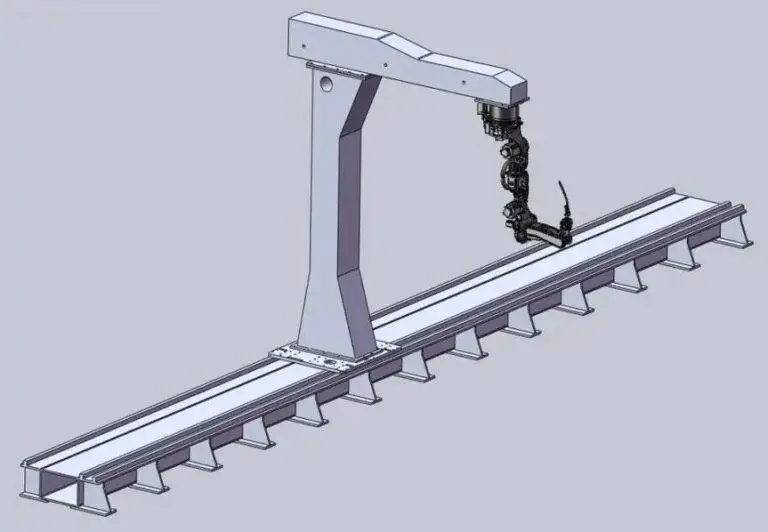
In the context of this workshop, the synergy between a 6-Axis Collaborative Welder and the broader concept of Automated Welding is not merely about replacing a hand with a clamp. It is about spatial freedom. Unlike traditional 3-axis linear gantries, the 6-axis articulation allows the torch to maintain a perpendicular relationship to the complex, curved geometries typical of tool steel molds.
2.1. Spatial Articulation and Torch Consistency
The 6-axis movement is critical for managing the “push vs. pull” angle in MAG welding. When performing Automated Welding on tool steel, even a 5-degree deviation in torch angle can result in turbulent gas coverage, leading to porosity. The collaborative robot (cobot) was programmed to maintain a constant 15-degree lead angle across 3D contoured surfaces. This level of precision is virtually impossible for a manual welder to sustain over a four-hour shift without fatigue-induced variance.
2.2. Collaborative Integration
The “Collaborative” aspect was leveraged by allowing senior welders to ‘lead-through’ the programming. In Barcelona’s specialized shops, the tribal knowledge of the welder regarding Tool Steel welding—knowing where the metal “pulls” or sinks—is invaluable. By manually guiding the 6-Axis Collaborative Welder through the initial path, the operator encodes decades of experience into the automated algorithm. This hybrid approach ensures the Automated Welding cycle respects the specific metallurgical nuances of the workpiece.

3. Metallurgical Focus: Tool Steel Welding Challenges
Tool Steel welding (specifically focusing on H13 and P20 grades at this site) is fraught with the risk of hydrogen-induced cracking and the formation of brittle martensite in the Heat Affected Zone (HAZ). The high carbon and alloy content requires precise interpass temperature control.
3.1. Low-Spatter Parameter Tuning
To achieve a low-spatter result, we utilized a modified pulse-MAG waveform. Spatter is often a result of uncontrolled globular transfer. By syncing the power source with the 6-Axis Collaborative Welder’s motion controller, we achieved a “Cold Metal Transfer” equivalent. The Automated Welding system monitored the arc length in real-time, adjusting the wire feed speed 100 times per second to ensure a smooth spray transfer even when the Tool Steel welding path encountered tight corners or varying heat sinks.
3.2. Heat Input Management
Excessive heat is the enemy of tool steel. The 6-Axis Collaborative Welder allowed for precise travel speed calibration. Manual welding often fluctuates between 250mm/min and 400mm/min. Our Automated Welding protocol locked the speed at a constant 320mm/min with a 2.5Hz weave pattern. This consistency reduced the HAZ width by 30%, preserving the base metal’s hardness and reducing the need for extensive post-weld heat treatment (PWHT).
4. Lessons Learned: Field Observations from the Barcelona Workshop
Over the three-week deployment, several technical hurdles provided significant “lessons learned” that should be applied to future Automated Welding projects in similar environments.
4.1. Atmospheric Interference
Barcelona’s coastal humidity was found to affect the MAG shielding gas (82% Ar / 18% CO2). We observed intermittent porosity during the first week. The lesson: Automated Welding systems are more sensitive to gas flow fluctuations than manual systems because they cannot “see” the puddle reacting in real-time. We installed a secondary gas heater and a dedicated flow stabilizer at the robot’s base to ensure laminar flow at the nozzle, regardless of the shop’s door being open to the sea breeze.
4.2. Workpiece Positioning and Calibration
A 6-Axis Collaborative Welder is only as good as its “Zero Point.” We found that the fixtures used for Tool Steel welding lacked the tolerances required for automation. We had to implement a touch-sensing protocol where the wire itself acts as a probe to find the mold edge before the arc ignites. This ensured that the Automated Welding path was offset correctly for every individual piece, accounting for slight variations in the manual setup.
4.3. Wire Feed Reliability
When welding tool steel with high-alloy filler wires, the wire is significantly stiffer than standard ER70S-6. The 6-axis movement of the arm can cause the conduit to kink or twist, leading to “bird-nesting” at the feeder. We learned to use a high-flexibility, low-friction liner and optimized the mounting of the 4-roll drive system directly onto the upper arm of the 6-Axis Collaborative Welder. This shortened the feed distance and eliminated voltage drops that contribute to spatter.
5. Productivity and Quality Analysis
The transition to a 6-Axis Collaborative Welder resulted in a quantifiable shift in the workshop’s output.
- Spatter Reduction: By moving from manual MAG to a stabilized Automated Welding process, post-weld cleaning time was reduced from 45 minutes per mold to approximately 5 minutes.
- Consumable Efficiency: Wire waste was reduced by 15% due to the elimination of “over-welding” often practiced by manual welders to ensure enough material is present for grinding.
- Metallurgical Consistency: Ultrasonic testing of the Tool Steel welding repairs showed a zero-defect rate in the fusion zone across 50 consecutive samples, a feat previously unattained in this facility.
6. Strategic Integration for the Spanish Market
In the Barcelona industrial landscape, where space is at a premium and labor costs are rising, the 6-Axis Collaborative Welder offers a footprint-efficient solution. Unlike traditional industrial robots that require extensive safety caging, this cobot was integrated into an existing workbench. This “open” Automated Welding environment allows the engineer to remain in close proximity to the Tool Steel welding process, providing the ability to abort or adjust if a specific casting defect in the mold is uncovered during the pass.
7. Final Engineering Conclusion
The deployment in Barcelona confirms that for Tool Steel welding, the precision of a 6-Axis Collaborative Welder is superior to manual application, provided that atmospheric and calibration variables are strictly controlled. The synergy between the human operator’s judgment and the Automated Welding system’s repeatability creates a high-performance environment. Future iterations will focus on integrating AI-based vision systems to further adapt the weld path to irregular wear patterns in the molds, but the mechanical foundation provided by the 6-axis cobot is now a proven asset in this high-stakes metallurgical field.
End of Report
Prepared by: Senior Welding Engineer
Location: Barcelona, Spain
Focus: Automation in Tool & Die Repair