Optimizing Pressure Vessel Fabrication with Automated Fillet Systems
In the heavy industrial sector, specifically within oil and gas and chemical processing, the construction of pressure vessels involves massive structural components that must be joined with absolute precision. The Tank Fillet Welding process is a critical bottleneck where manual intervention often leads to inconsistencies in leg length and penetration. To address these challenges, industrial engineers prioritize automated solutions that provide mechanical stability and real-time process monitoring. The use of specialized welding carriages designed for fillet applications significantly reduces the defect rate associated with out-of-position welding in field environments.
The Mechanical Foundation: Magnetic Crawler Systems
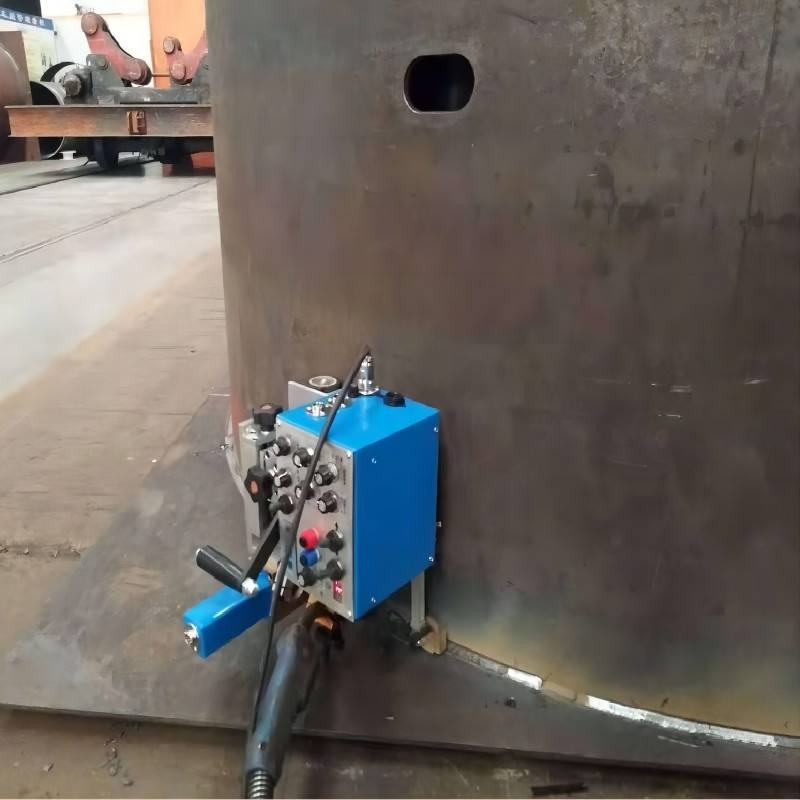
Unlike stationary workshop setups, field construction requires mobility and adaptability to large-diameter tanks. The Magnetic Crawler serves as the primary transport mechanism for the welding torch. These units utilize high-strength permanent magnets or switchable magnetic bases to adhere to the steel shell of the pressure vessel. This adhesion is critical for maintaining the torch’s trajectory along the joint line, even when navigating vertical or overhead sections.
Engineers favor magnetic crawlers because they eliminate the need for complex track systems or scaffolding. The traction provided by the magnetic wheels ensures that the carriage moves at a constant travel speed, which is a fundamental requirement for maintaining a uniform heat input. Any variation in travel speed directly impacts the weld’s cooling rate and, consequently, the mechanical properties of the heat-affected zone (HAZ).
Field Construction Stability and Environmental Resilience
Field construction presents variables that are absent in a controlled factory setting, such as wind, uneven ground, and fluctuating power supply. The stability of the welding platform is paramount. A high-torque drive system within the crawler prevents slippage, while the low center of gravity ensures that the torch remains centered in the fillet root. Field Construction Stability is achieved through a combination of heavy-duty chassis design and high-traction drive wheels that can overcome surface scale or minor rust often found on site-delivered steel plates.
The Technical Necessity of Arc Voltage Control (AVC)
While the crawler handles the horizontal or vertical movement, the quality of the fillet weld depends on the distance between the electrode and the workpiece. In manual operations, a welder adjusts this gap by hand. In automated systems, this is the role of the Arc Voltage Control (AVC) system. The AVC monitors the voltage across the arc; since voltage is directly proportional to the arc length, the system can detect minute changes in the distance between the torch and the metal surface.
Feedback Loops and Actuator Response
When the magnetic crawler encounters a slight ripple in the steel plate or a misalignment in the joint fit-up, the AVC system calculates the deviation from the preset voltage. A motorized slide (the Z-axis actuator) then moves the torch up or down to restore the target voltage. This sub-second response ensures that the arc force remains constant, preventing undercutting or lack of fusion. This is particularly vital in pressure vessel construction, where fillet welds at the shell-to-bottom or shell-to-roof junctions must withstand significant hydrostatic pressure.
Eliminating Geometric Inconsistencies
Fillet welds are prone to “crowning” or “slumping” if the torch position is not perfectly maintained. By using AVC, the machine maintains a consistent arc length, which stabilizes the weld pool. This consistency results in a flat or slightly convex bead profile, which is the engineering ideal for fatigue resistance. Without AVC, even a 1mm deviation in the plate surface could lead to a significant change in the weld’s effective throat thickness, potentially compromising the vessel’s integrity during its service life.
Integration with Flux-Cored and Solid Wire Processes
These machines are typically paired with Gas Metal Arc Welding (GMAW) or Flux-Cored Arc Welding (FCAW) power sources. The choice of filler metal is dictated by the base material of the pressure vessel, often high-tensile carbon steel or stainless steel. The automated carriage handles the high duty cycles of these processes, allowing for continuous welding over several meters without the stop-start defects common in manual stick welding.
Operational Advantages in Large-Scale Projects
The implementation of automated Tank Fillet Welding Machines yields measurable improvements in project timelines and quality metrics. For an industrial engineer, the focus is on the “Duty Cycle” and the “Deposition Rate.”
Increased Deposition and Duty Cycle
Manual welders typically operate at a duty cycle of 30% to 40% due to the need for repositioning and breaks. An automated magnetic crawler can achieve duty cycles exceeding 80%. Furthermore, because the machine can handle higher current settings without the risk of human error, the deposition rate (kg/h of weld metal) is significantly increased. This acceleration is crucial for large-diameter storage tanks where kilometers of fillet welds are required.
Reduction in Repair Rates
In pressure vessel fabrication, non-destructive testing (NDT) such as ultrasonic or radiographic testing is mandatory. Manual fillet welds often suffer from slag inclusions or porosity at the start and stop points. Automated systems minimize these transition points. The precision of the AVC ensures that the root of the fillet is consistently consumed, leading to a high “first-time-right” ratio. Reducing repair cycles not only saves costs on grinding and re-welding but also prevents the degradation of the base metal caused by multiple thermal cycles.
Technical Synthesis and Future Outlook
The synergy between a robust magnetic crawler and a responsive Arc Voltage Control system represents the current gold standard for field-based tank fabrication. By focusing on mechanical stability and electronic arc sensing, manufacturers can produce pressure vessels that meet stringent international codes (such as ASME Section VIII or API 650). The elimination of manual variability through these machines ensures that the engineered design specifications are translated perfectly into the physical structure.
As the industry moves toward thicker plates and more complex alloy compositions, the role of automated carriages will only grow. The focus remains on improving the torque-to-weight ratio of the crawlers and the sensitivity of the AVC sensors. For the industrial engineer, the goal is clear: to create a repeatable, stable, and high-output welding environment that survives the harsh realities of field construction while maintaining the precision of a laboratory instrument.
-


Cantilever Welding Robot solution
-


GF laser cutting machine
-

P3015 plasma cutting machine
-

LFP3015 Fiber Laser Cutter
-

pipe plasma cutting machine
-
LFH 4020 Fiber Laser Cutting Machine
-
LFP4020
-

gantry plasma air cutting machine
-

3D robot cutting machine
-

8 axis plasma cutting machine
-

5 axis plasma cutting machine
-

LT360 tube laser cutting machine
-

robot welding workstation
-

SF6060 fiber laser cutting machine
Advanced Fiber Laser Tube Processing Technology
Our CNC Fiber Laser Tube Cutting systems revolutionize metal fabrication by integrating high-precision cutting, punching, and profiling into a single automated workflow. Designed for versatility, this technology handles a wide array of profiles including Round, Square, Rectangular, and Oval tubes, as well as complex L-shaped and U-shaped channels.
- Precision Punching: High-speed hole punching with micron-level accuracy, eliminating the need for mechanical drilling or die-stamping.
- Complex Profiling: Advanced 3D pathing allows for intricate interlocking joints and specialized notch cuts, ideal for structural frames.
- High Material Efficiency: Intelligent nesting software minimizes scrap, reducing raw material costs across large production runs.
- Clean Finish: Delivers oxide-free, burr-free edges that require zero secondary grinding before welding.

Seamlessly processing multiple profiles with consistent precision.
Global Delivery & Logistics



From our high-tech manufacturing facility directly to your global site. PCL WeldCut ensures secure packaging, professional handling, and reliable international logistics to safeguard your equipment throughout the entire journey.