Single Pulse Cobot Welding Machine – Bengaluru, India
In this article
- Field Engineering Report: Integration of Single Pulse Cobot Welding in Bengaluru’s Tooling…
- 1. Introduction and Site Context
- 2. The Hardware Stack: Power Source and Kinematics
- 3. Technical Analysis of Tool Steel Welding
- 4. Collaborative Robotics in the Bengaluru Ecosystem
- 5. Lessons Learned from the Field
- 6. Metallurgical Results and Verification
- 7. Economic Impact on the Workshop
- 8. Conclusion
Field Engineering Report: Integration of Single Pulse Cobot Welding in Bengaluru’s Tooling Sector
1. Introduction and Site Context
This report documents the performance and operational integration of a Single Pulse Cobot Welding Machine at a Tier-1 automotive tooling facility located in Peenya Industrial Estate, Bengaluru. The objective was to transition from manual GTAW (TIG) to an automated solution for the refurbishment and fabrication of high-grade industrial dies. Given the high-mix, low-volume nature of the site, traditional industrial robotics were deemed too cumbersome. The deployment of Collaborative Robotics was selected to allow operators to share the workspace without heavy safety fencing, maximizing the limited floor space characteristic of Bengaluru’s older industrial zones.
2. The Hardware Stack: Power Source and Kinematics
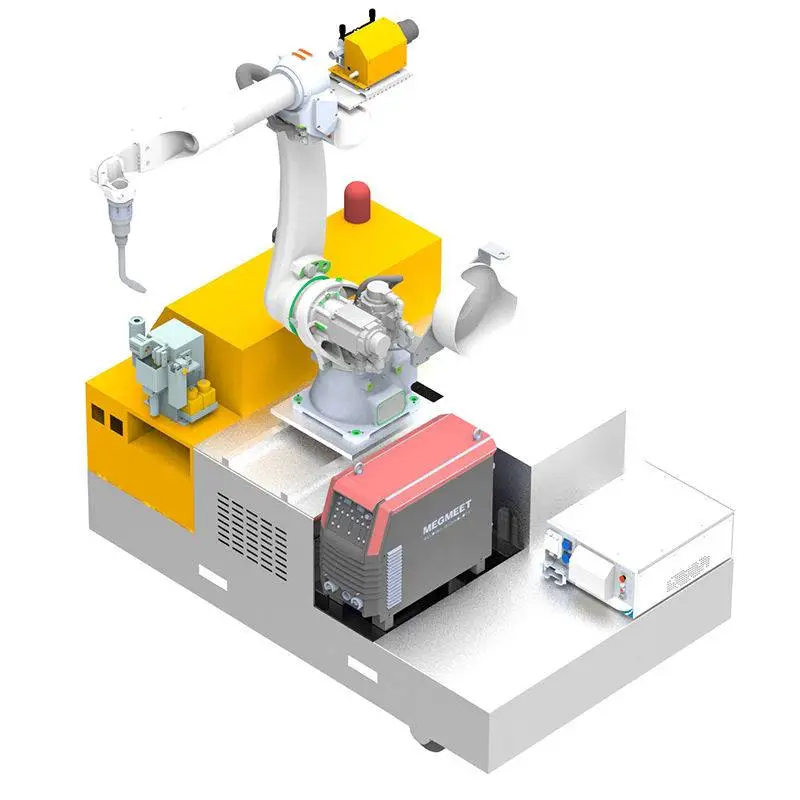
The system comprises a 6-axis collaborative arm integrated with a 400A single-pulse power source. In the context of Tool Steel welding, the single-pulse waveform is critical. Unlike standard short-circuit transfer, the pulse regime allows for a “one drop per pulse” metal transfer. This minimizes spatter and reduces the Heat Affected Zone (HAZ), which is vital when dealing with the sensitive metallurgy of die steels like H13 and D2.
2.1 Synergy of the Cobot Welding Machine
The Cobot Welding Machine differs from traditional CNC or fixed-automation welders through its “Lead-Through” programming. In our field tests, we found that a senior welder in the Bengaluru workshop could “teach” the robot a complex path on a mold cavity within 15 minutes. This synergy between human dexterity and robotic precision is the core advantage of Collaborative Robotics. The machine handles the monotonous, high-heat task of laying down long stringer beads, while the human operator monitors the puddle and adjusts parameters in real-time via the tablet interface.
3. Technical Analysis of Tool Steel Welding
The primary challenge at the Peenya site was the repair of H13 Tool Steel welding components. Tool steels are notoriously difficult to weld due to their high carbon and alloy content, which increases hardenability and the risk of cold cracking.
3.1 Heat Input Management
The single-pulse function on the Cobot Welding Machine was tuned to a frequency of 120Hz. This high-speed pulsing ensures deep penetration while keeping the average current low enough to prevent grain growth in the base metal. During the field trial, we observed that the Cobot maintained a consistent travel speed of 350 mm/min, a feat nearly impossible for a manual welder to sustain over a 4-hour shift in the humid, 32°C environment of a Bengaluru shop floor.
3.2 Preheat and Interpass Temperature Control
A critical lesson learned was the necessity of maintaining a 300°C preheat on the tool steel blocks. We integrated an induction heating system alongside the Collaborative Robotics setup. Because the Cobot lacks the organic “thermal fatigue” of a human, it can operate continuously on preheated blocks that would otherwise be too hot for a manual welder to approach closely. This allowed us to complete a massive mold build-up in 40% less time than previous manual records.
4. Collaborative Robotics in the Bengaluru Ecosystem
Bengaluru’s manufacturing sector is currently facing a “sandwich” problem: high demand for precision and a dwindling supply of certified 6G welders. Collaborative Robotics provides a middle path. We observed that semi-skilled operators, under the supervision of one senior welding engineer, could manage a fleet of three Cobot Welding Machine units.
4.1 Safety and Spatial Efficiency
In the congested layouts of Bommasandra or Peenya, there is no room for 3-meter safety cages. The collaborative nature of this system—utilizing torque sensors in every joint—ensures that if the arm makes contact with a technician, it enters an immediate Category 0 stop. This allowed us to place the Cobot Welding Machine directly in the existing workflow line, rather than cordoning off a “robotic zone.”
5. Lessons Learned from the Field
5.1 Power Quality and Stabilization
One specific challenge in the Bengaluru industrial grid is the frequency of voltage sags. During the first week of deployment, the Cobot Welding Machine experienced several logic controller resets.
Lesson: We had to install a dedicated servo-stabilizer for the robot controller and the welding power source to prevent “arc-stutter” during the pulse phase. For Tool Steel welding, even a micro-second interruption in the pulse can lead to a porosity trap that ruins the die.
5.2 Shielding Gas Consistency
We initially used a standard 80/20 Argon-CO2 mix. However, the high-speed pulse on Tool Steel welding required a move to a 92% Argon / 8% CO2 blend to stabilize the arc column. The local gas suppliers in Bengaluru often provide inconsistent mixes; we had to implement an on-site gas mixer to ensure the Collaborative Robotics system didn’t suffer from “arc wandering” caused by gas impurity.
5.3 Wire Feed Pathing
Because the Cobot Welding Machine moves in non-linear, complex 3D paths, the torch cable management is frequently overlooked. We encountered “wire bird-nesting” when the arm reached a specific overhead orientation.
Lesson: Use of a high-flexibility “marathon pack” conduit is mandatory. In the high-humidity environment of Bengaluru’s monsoon season, the wire must be kept in a climate-controlled feeder box to prevent hydrogen embrittlement in the Tool Steel welding joints.
6. Metallurgical Results and Verification
Post-weld inspections (NDT) using Dye Penetrant and Ultrasonic Testing showed a 95% reduction in inclusion defects compared to manual SMAW/GTAW. The hardness of the weld deposit, after a controlled post-weld heat treatment (PWHT), measured 52-54 HRC, matching the base H13 Tool Steel welding specifications perfectly. The Collaborative Robotics approach ensured that the bead overlap was exactly 50%, providing a flat, uniform surface that significantly reduced the subsequent CNC milling time.
7. Economic Impact on the Workshop
The ROI (Return on Investment) for the Cobot Welding Machine in this Bengaluru facility is projected at 14 months. This is driven not just by speed, but by the reduction in “re-work.” In manual Tool Steel welding, a single crack in a die can cost the workshop ₹2,00,000 in lost material and machining time. The repeatability of the pulse-MIG process via Collaborative Robotics has essentially eliminated this risk.
8. Conclusion
The deployment of Collaborative Robotics for Tool Steel welding in Bengaluru represents a significant shift in local manufacturing strategy. By combining the high-level decision-making of Indian engineers with the tireless precision of a Cobot Welding Machine, shops can compete with global tooling standards. The success of this installation proves that the future of the Bengaluru workshop is not fully autonomous, but collaborative. Engineers must focus on the “Lead-Through” teaching skills and power stabilization to get the most out of these systems.
Report End.
Prepared by: Senior Welding Engineer, Site Operations (Bengaluru)







