Optimizing Wind Tower Production with AVC Plasma Systems
The manufacturing of wind turbine towers demands exceptional structural integrity and geometric precision. As the industry shifts toward larger hub heights and more substantial base diameters, the role of Wind Tower Fabrication equipment becomes a critical factor in throughput. Plasma Cutting remains the primary thermal process for managing the thick-walled carbon steel plates required for these structures. However, the sheer scale of the plates—often exceeding 30 meters in length—introduces challenges regarding plate flatness and thermal deformation. This is where Arc Voltage Control (AVC) becomes the cornerstone of process stability.
Arc Voltage Control functions as an automated height regulation system. By monitoring the electrical potential between the plasma electrode and the workpiece, the system maintains a precise distance through a high-response Z-axis actuator. In the context of wind energy, where plates are often slightly warped from rolling or storage, AVC prevents torch collisions and ensures that the plasma jet maintains its optimal focal point, thereby stabilizing the kerf width and the angle of the cut.
Achieving Superior Intersection Accuracy in Conical Sections
Wind towers are rarely simple cylinders; they are composed of multiple conical sections (frustums) that must be joined with high precision. The Intersection Accuracy of these sections determines the ease of the subsequent fit-up process. When cutting the longitudinal and circumferential edges of a conical plate, the geometry is complex. A flat pattern must be cut so that, once rolled, the edges align perfectly without gaps or overlaps.
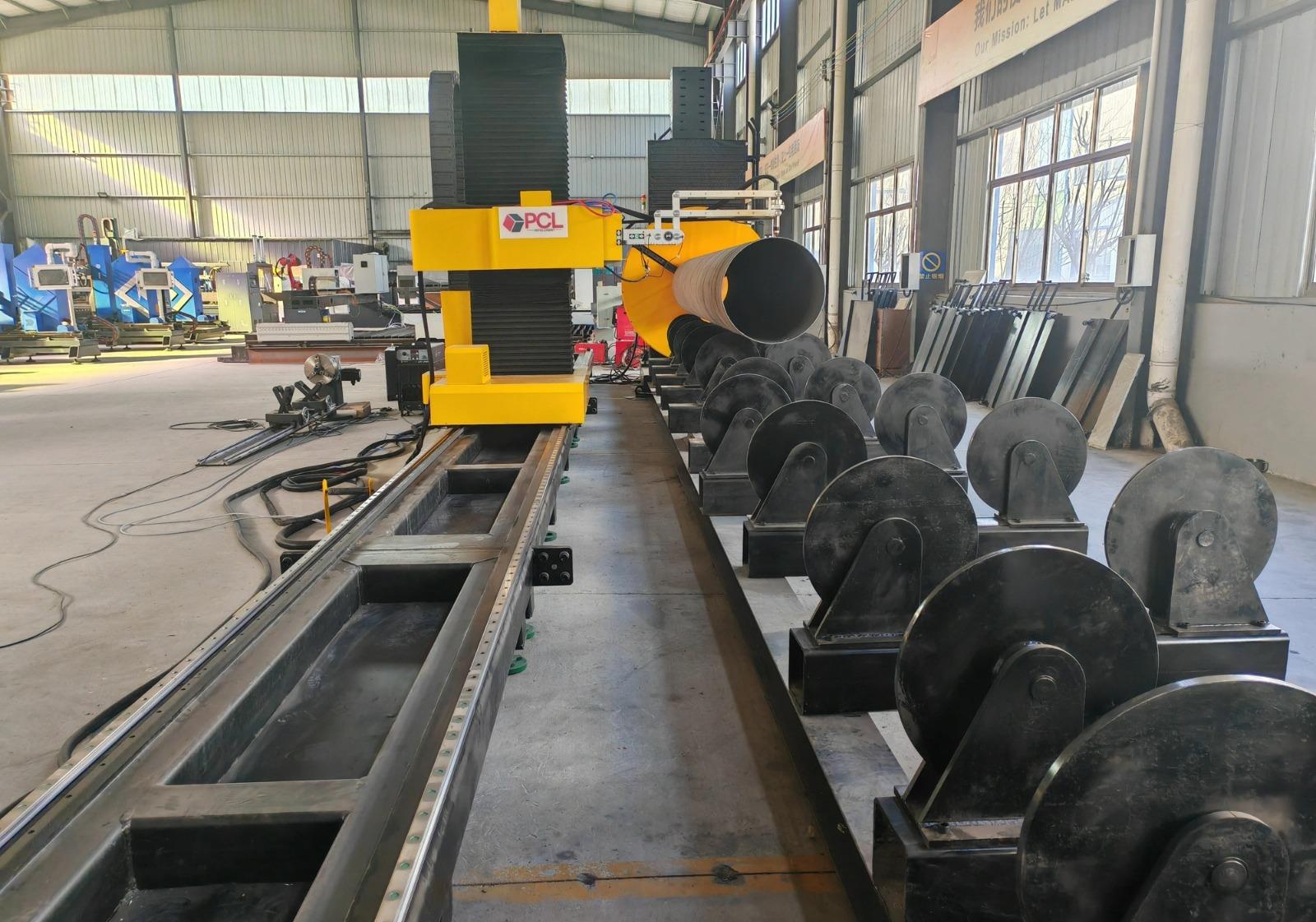
Using a plasma system equipped with AVC ensures that the torch remains perpendicular to the material surface, even if the plate has “memory” from the mill or is not perfectly leveled on the cutting bed. If the torch height fluctuates even by a few millimeters, the effective width of the cut changes. This deviation leads to cumulative errors in the circumference of the tower section. Engineers rely on AVC to keep the torch within a +/- 0.2mm height tolerance, which is essential for maintaining the dimensional integrity of the flat-pattern development. When the accuracy of the intersection is maintained at the cutting stage, the assembly time for the tower shells is reduced by up to 30%, as the need for manual grinding and “dogging” plates into position is minimized.
Mechanical Reliability: H-Beam Gantry and Low Maintenance
In a high-output industrial environment, machine downtime is a significant bottleneck. for Wind Tower fabrication, the cutting machine must operate in a dusty, high-heat environment for multiple shifts. The structural design of the machine typically employs a heavy-duty H-beam gantry. This design is favored by industrial engineers for its high stiffness-to-weight ratio, which prevents harmonic vibrations that can mar the cut surface at high speeds.
The H-beam low maintenance profile is achieved through a combination of robust linear guides and protected drive systems. Unlike lighter-duty aluminum extrusions, the steel H-beam maintains thermal stability, which is vital when the machine is located near pre-heating stations or large-scale plate heaters. Maintenance protocols are simplified because the gantry’s mass absorbs much of the mechanical shock from rapid acceleration and deceleration of the plasma torch carriage. Furthermore, modern plasma systems utilize pressurized bellows and scrapers on the rails to prevent the ingress of metallic dust—a byproduct of the plasma process—extending the lifespan of the bearings and rack-and-pinion drives.
Drive Systems and Thermal Management
To ensure long-term reliability, these machines utilize AC brushless servo motors coupled with high-precision planetary gearboxes. By minimizing the number of moving parts and utilizing central lubrication systems, the mean time between failures (MTBF) is significantly extended. For the wind energy sector, where project deadlines are stringent, the choice of a low-maintenance H-beam platform ensures that the cutting process remains the most reliable link in the production chain.
High-Precision Plasma Beveling for Weld Preparation
Perhaps the most technically demanding aspect of wind tower fabrication is the preparation of the plate edges for welding. Standard straight cuts are insufficient for the deep-penetration welds required for structural safety. Plates must be beveled into V, Y, X, or K configurations. Plasma Beveling units with multi-axis capability allow for these complex geometries to be cut in a single pass.
The AVC system is even more critical during beveling operations. As the torch tilts to achieve a 45-degree angle, the distance between the nozzle and the plate becomes harder to manage manually. If the height is off by a fraction of an inch, the bevel’s “land” (the flat portion of the edge) will be inconsistent, leading to potential weld defects. The AVC compensates for the trigonometric changes in distance as the torch rotates, ensuring a uniform bevel profile along the entire 30-meter edge. This level of precision is vital for automated longitudinal seam welding, where a uniform groove geometry is required to maintain a consistent weld bead and heat-affected zone (HAZ).
Managing the Heat Affected Zone (HAZ)
A key engineering concern in plasma cutting is the HAZ. While plasma provides high-speed cutting, it is a thermal process. To mitigate excessive metallurgical changes in the carbon steel, the cutting speed must be optimized. Modern plasma power sources, integrated with AVC, allow for “Constant Current” or “Constant Voltage” modes that adapt to the thickness of the plate. By maintaining a high travel speed and a stable arc, the heat input is localized, resulting in a narrow HAZ that meets the rigorous standards of wind tower structural certifications (such as EN 1090-2 or AWS D1.1).
System Integration and SEO for Digital Manufacturing
The integration of CNC software with plasma hardware allows for nested layouts that maximize material utilization. In wind tower manufacturing, where material costs represent a large portion of the total expenditure, reducing scrap is a priority. Advanced nesting algorithms account for the kerf width—stabilized by the AVC—to place parts as close as possible. This digital-to-physical synchronization is what defines a modern industrial cutting cell.
Summary of Technical Advantages
In conclusion, the application of plasma cutting with Arc Voltage Control in the wind energy sector is not merely about “cutting metal.” It is about controlling the physics of the arc to produce components that meet exacting tolerances. The H-beam gantry provides the necessary stability and low-maintenance operation for 24/7 production, while the AVC ensures that intersection accuracy and bevel quality remain consistent regardless of plate irregularities. By focusing on these specific technical pillars, manufacturers can ensure that their tower sections are ready for seamless assembly, high-load endurance, and decades of operational life in the field.

















