Optimizing Heavy-Duty Fabrication with Arc Voltage Control
In the sector of Wind Tower Fabrication, structural integrity and precision are the primary metrics for engineering success. The manufacturing of tower segments—large cylindrical shells of varying thicknesses—demands a cutting process that handles high-duty cycles while maintaining tight tolerances. Plasma Cutting technology, specifically when paired with advanced Arc Voltage Control (AVC), has become the industrial standard for these applications. AVC functions as a closed-loop feedback system that monitors the electrical potential between the plasma torch and the plate. As the material expands or shifts due to thermal stress during the cutting process, the AVC adjusts the torch height dynamically. This ensures a constant standoff distance, which is critical for maintaining a uniform arc shape and preventing kerf deviation.
From an industrial engineering perspective, the stability provided by AVC translates directly into reduced scrap rates and increased throughput. Without precise height control, the plasma arc can fluctuate, leading to dross accumulation or “top edge rounding,” both of which require secondary grinding operations. In wind tower production, where plates can exceed 50mm in thickness, the consistency of the plasma stream is paramount to ensuring the metallurgical properties of the cut edge remain within specification for subsequent assembly stages.
Intersection Accuracy in Tower Portals and Internals
Wind towers are not merely hollow tubes; they require complex internal structures and portal openings for maintenance access and electrical routing. Achieving high Intersection Accuracy is a significant challenge when cutting large-diameter curves on a contoured surface. Plasma Cutting Machines equipped with 5-axis heads and sophisticated CNC controllers allow for the precise interpolation of movement required for these intersections. When a door frame or a cable entry port is cut into a curved segment, the torch must maintain a perpendicular orientation to the surface tangent or follow a specific bevel angle.
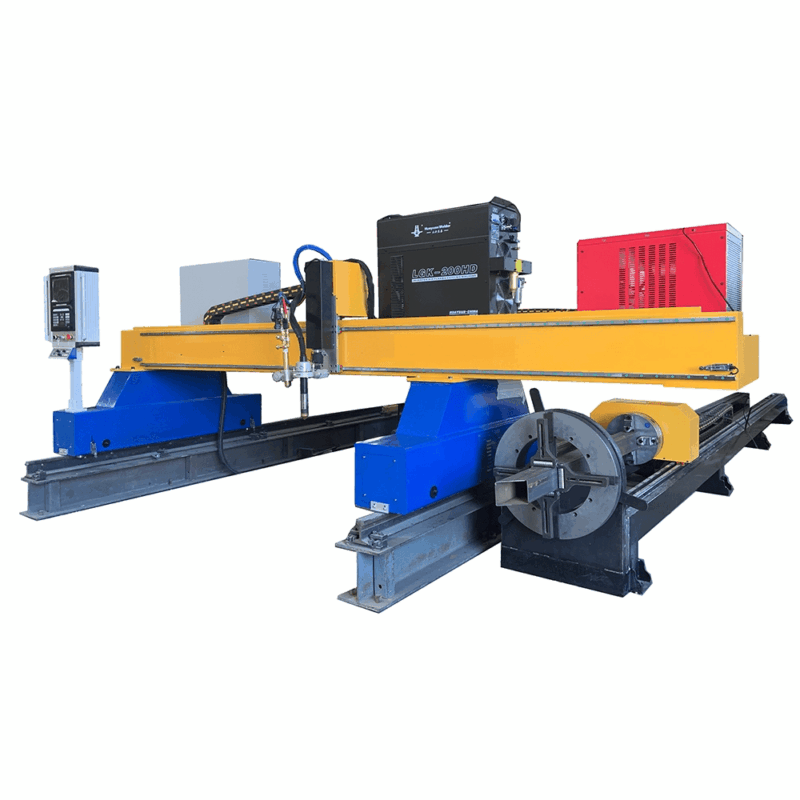
The accuracy of these intersections is governed by the machine’s ability to sync the rotational axes with the linear gantry movement. Industrial engineers prioritize plasma systems that utilize high-resolution encoders and low-backlash gearboxes. This hardware configuration ensures that the entry and exit points of a cut align perfectly, even on large-scale workpieces. For wind tower internals, such as platforms and brackets, the precision of these cuts dictates how well the components fit during the assembly phase, eliminating the need for costly manual rework or “filling” gaps caused by inaccurate thermal cutting.
Advanced Beveling for Structural Weld Preparation
High-quality Beveling is a non-negotiable requirement in wind tower construction. To achieve the deep penetration required for structural welds, plate edges must be prepared with V, Y, X, or K-shaped profiles. Plasma cutting machines utilizing a tilt-rotator head can execute these bevels in a single pass, significantly reducing the lead time compared to mechanical edge milling. The AVC plays a vital role here as well; as the torch tilts to create a bevel, the electrical path length changes. Intelligent software compensates for this shift, ensuring the “true” height of the torch remains consistent relative to the material surface.
The transition from straight cuts to beveled edges requires precise kerf compensation. Because the plasma arc is a pressurized gas stream, its behavior changes at an angle. Modern plasma power sources utilize “True Bevel” technology, which integrates specific cutting parameters—such as gas pressure, amperage, and travel speed—into the CNC nest. This level of automation ensures that the land thickness (the flat portion of a beveled edge) remains uniform throughout the entire circumference of a tower segment. This uniformity is essential for automated welding systems that follow the plasma-cut edge, as any variance in the groove geometry can lead to weld defects or inconsistent penetration.
H-Beam Processing and Low Maintenance Requirements
Wind tower internals and the secondary structures used in the fabrication facilities often rely on heavy H-beams and I-beams. Plasma cutting is the preferred method for coping, slotting, and trimming these sections due to its versatility and Low Maintenance profile compared to mechanical sawing or traditional machining. A plasma system does not involve the high tool-wear costs associated with drill bits or saw blades. The consumables—nozzles, electrodes, and swirl rings—are the only primary wear items, and they can be replaced in minutes without specialized tools.
In a high-output fabrication environment, mechanical reliability is key. Plasma gantries are designed with robust rack-and-pinion drives and shielded bearings to withstand the dust and heat of a heavy industrial shop. The absence of complex optical paths or high-pressure water systems reduces the mean time between failures (MTBF). For H-beam processing, plasma torches can reach into the web and flanges of the beam to execute complex geometries that would be impossible for other thermal cutting methods without repositioning the workpiece multiple times. This capability reduces material handling time, which is often the biggest bottleneck in heavy fabrication.
Thermal Management and Material Integrity
One of the critical concerns in wind tower fabrication is the Heat-Affected Zone (HAZ). While plasma cutting is a thermal process, high-definition systems utilize a narrowed arc and high travel speeds to minimize the energy input into the base metal. This prevents the degradation of the steel’s grain structure near the cut edge. For the S355 and S420 grade steels commonly used in wind energy, maintaining the mechanical properties of the edge is vital for fatigue resistance. The precision of the AVC ensures the torch does not linger or dip, which would otherwise create localized hotspots and expand the HAZ.
Integration with Industry 4.0 Standards
Modern plasma cutting machines are no longer isolated workstations. They are integrated into the facility’s ERP and PLM systems. Real-time data regarding gas consumption, consumable life, and arc-on time allows industrial engineers to perform predictive maintenance and optimize the supply chain for spare parts. The AVC data can also be logged to provide a digital “birth certificate” for each tower segment, proving that the cut parameters remained within the required tolerances throughout the production cycle.
Conclusion on Process Efficiency
The implementation of a plasma cutting machine with Arc Voltage Control represents a strategic investment in wind tower fabrication. By focusing on intersection accuracy and the mechanical simplicity of the plasma process, manufacturers can achieve a balance between high precision and low operational costs. The ability to perform complex beveling on thick plates while maintaining a low-maintenance schedule for H-beam and plate processing ensures that the fabrication line remains productive and the final structures meet the rigorous safety and longevity standards of the global wind energy market.
-


LT240S tube laser cutting machine
-
LT120S tube laser cutting machine
-
Sale

Tank Fillet Welding Machine
Original price was: $1,000.00.$900.00Current price is: $900.00. -
Sale

MAK100 tube laser cutting machine
Original price was: $5,500.00.$5,000.00Current price is: $5,000.00. -

portable plasma air cutting machine
$1,200.00 -

2in1 fiber laser cutting machine
-

Air cooling Laser welding machine
-

HF h beam laser cutting machine
-

LT240 laser cutting machine
-

Laser welding machine
-


Cobot Welding Station
-

Gantry welding robot solution
-

Tracked Wheeled AGV Welding robot
-

LFH6020 Fiber laser cutting machine
-
LFP6020
-

robotic welidng machine
Advanced Fiber Laser Tube Processing Technology
Our CNC Fiber Laser Tube Cutting systems revolutionize metal fabrication by integrating high-precision cutting, punching, and profiling into a single automated workflow. Designed for versatility, this technology handles a wide array of profiles including Round, Square, Rectangular, and Oval tubes, as well as complex L-shaped and U-shaped channels.
- Precision Punching: High-speed hole punching with micron-level accuracy, eliminating the need for mechanical drilling or die-stamping.
- Complex Profiling: Advanced 3D pathing allows for intricate interlocking joints and specialized notch cuts, ideal for structural frames.
- High Material Efficiency: Intelligent nesting software minimizes scrap, reducing raw material costs across large production runs.
- Clean Finish: Delivers oxide-free, burr-free edges that require zero secondary grinding before welding.

Seamlessly processing multiple profiles with consistent precision.
Global Delivery & Logistics



From our high-tech manufacturing facility directly to your global site. PCL WeldCut ensures secure packaging, professional handling, and reliable international logistics to safeguard your equipment throughout the entire journey.