Engineering Precision in Wind Tower Section Fabrication
The manufacturing of wind turbine towers demands rigorous adherence to structural integrity standards, primarily due to the dynamic loading and environmental stress these structures endure. From an industrial engineering perspective, the transition from traditional straight-line cutting to advanced 5-axis plasma beveling represents a significant leap in throughput efficiency. Wind tower segments, typically constructed from S355 or higher-grade structural steel with thicknesses ranging from 20mm to over 80mm, require precise edge preparation to facilitate deep-penetration welds.
Plasma Cutting technology, particularly high-definition systems utilizing oxygen or nitrogen-water injection, provides the necessary thermal energy density to penetrate these thicknesses while maintaining a narrow heat-affected zone (HAZ). Unlike mechanical milling, plasma processes allow for rapid contouring and complex beveling in a single pass, which is critical for the large-scale diameters associated with offshore and onshore tower foundations.
The Mechanics of 5-Axis Beveling for Weld Preparation
A 5-axis plasma head introduces two rotational axes (typically A and B or C) to the standard X, Y, and Z Cartesian coordinates. In the context of wind tower fabrication, this allows the torch to tilt and rotate dynamically. This capability is essential for creating V, Y, X, and K-type bevel profiles. For the circumferential seams where tower cans are joined, the bevel angle must be consistent across the entire diameter to ensure uniform weld volume.
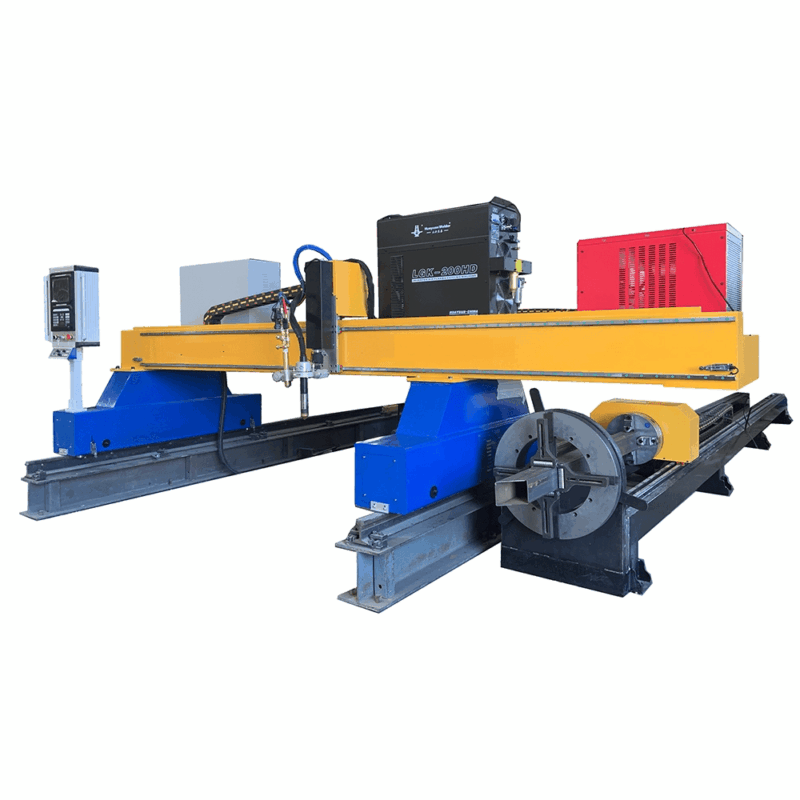
Modern CNC controllers compensate for the inherent lag in the plasma arc, a phenomenon known as “arc tilt,” by adjusting the torch angle in real-time. This ensures that the root face and the bevel angle meet the tight tolerances—often within plus or minus 0.5 degrees—required by automated submerged arc welding systems that follow the plasma cutting process. By eliminating the need for secondary grinding or edge dressing, the 5-axis system reduces the total cycle time per tower section by approximately 30%.
Optimizing Intersection Accuracy for Internal Components
Wind towers are not merely hollow tubes; they contain complex internal infrastructures including platforms, ladder brackets, cable trays, and door frames. The accuracy of the intersections where these components meet the curved inner wall of the tower is paramount. Industrial engineers focus on intersection accuracy to ensure that fit-up gaps are minimized, which prevents excessive weld metal deposition and reduces the risk of structural fatigue.
Plasma cutting systems equipped with sophisticated nesting and path-planning software can calculate the precise elliptical or saddle-shaped cuts needed for door openings and ventilation ports. The software accounts for the curvature of the plate (the “wrap”) and adjusts the torch path to maintain a constant perpendicularity or specific bevel angle relative to the surface tangent. This level of geometric precision ensures that internal structural members fit flush against the shell, maintaining the aerodynamic and structural integrity of the tower.
The H-Beam Advantage: Low Maintenance and Structural Rigidity
The mechanical backbone of a heavy-duty Plasma Cutting Machine is its gantry and rail system. In high-output wind tower facilities, the environment is characterized by conductive dust, metallic slag, and heavy vibration. Systems utilizing H-beam low maintenance architecture provide a distinct advantage. The H-beam construction offers superior torsional rigidity compared to lighter aluminum extrusions, allowing for the high acceleration and deceleration rates required for accurate cornering without introducing harmonic vibration into the cut edge.
From an O&M (Operations and Maintenance) standpoint, the H-beam rail system is engineered for longevity. Steel-on-steel contact points, protected by robust bellows and scrapers, minimize the ingress of plasma dust. Unlike optical delivery systems that are sensitive to particulate contamination, the plasma torch and lead-screw or rack-and-pinion drive systems are resilient. This results in higher machine availability and a lower Mean Time To Repair (MTTR), which is a critical KPI for facilities operating on a 24/7 production schedule.
Thermal Management and Material Integrity
A common concern in thermal cutting of thick plate steel is the deformation caused by localized heat input. Plasma cutting systems address this through precise gas flow control and torch height sensing. Initial height sensing (IHS) ensures the torch maintains the optimal standoff distance, which is critical for maintaining the beveling angle. Furthermore, the use of underwater plasma cutting or water-shroud technology can significantly reduce the thermal signature on the plate, preventing the warping of large-diameter sections that could otherwise complicate the rolling and fit-up stages of fabrication.
Digital Integration and Throughput Scaling
The integration of CAD/CAM data directly into the plasma controller eliminates manual layout errors. For wind tower production, where each section may have unique door placements or bracket configurations, this digital workflow is indispensable. The ability to nest multiple parts on a single 12-meter plate while incorporating complex bevels and marking lines for subsequent assembly steps ensures that the plasma station acts as a high-efficiency hub in the production line.
By focusing on high-definition plasma capabilities, engineers can achieve dross-free cuts on the bottom edge and minimal dross on the top, even at the high speeds required for large-scale industrial output. The result is a streamlined process where the “cut-to-weld” transition is seamless, reducing the footprint of the fabrication area and lowering the overall cost per kilowatt-hour of the manufactured turbine.
Summary of Operational Benefits
In conclusion, the deployment of a 5-axis plasma cutting machine in wind tower fabrication provides three primary engineering benefits: superior edge preparation through dynamic beveling, high-tolerance intersection accuracy for complex internal geometry, and long-term operational reliability through heavy-duty H-beam construction. By prioritizing these technical factors, manufacturers can achieve the necessary balance between structural quality and high-volume production demands without the maintenance overhead of more sensitive technologies.
-


LT240S tube laser cutting machine
-
LT120S tube laser cutting machine
-
Sale

Tank Fillet Welding Machine
Original price was: $1,000.00.$900.00Current price is: $900.00. -
Sale

MAK100 tube laser cutting machine
Original price was: $5,500.00.$5,000.00Current price is: $5,000.00. -

portable plasma air cutting machine
$1,200.00 -

2in1 fiber laser cutting machine
-

Air cooling Laser welding machine
-

HF h beam laser cutting machine
-

LT240 laser cutting machine
-

Laser welding machine
-


Cobot Welding Station
-

Gantry welding robot solution
-

Tracked Wheeled AGV Welding robot
-

LFH6020 Fiber laser cutting machine
-
LFP6020
-

robotic welidng machine
Advanced Fiber Laser Tube Processing Technology
Our CNC Fiber Laser Tube Cutting systems revolutionize metal fabrication by integrating high-precision cutting, punching, and profiling into a single automated workflow. Designed for versatility, this technology handles a wide array of profiles including Round, Square, Rectangular, and Oval tubes, as well as complex L-shaped and U-shaped channels.
- Precision Punching: High-speed hole punching with micron-level accuracy, eliminating the need for mechanical drilling or die-stamping.
- Complex Profiling: Advanced 3D pathing allows for intricate interlocking joints and specialized notch cuts, ideal for structural frames.
- High Material Efficiency: Intelligent nesting software minimizes scrap, reducing raw material costs across large production runs.
- Clean Finish: Delivers oxide-free, burr-free edges that require zero secondary grinding before welding.

Seamlessly processing multiple profiles with consistent precision.
Global Delivery & Logistics



From our high-tech manufacturing facility directly to your global site. PCL WeldCut ensures secure packaging, professional handling, and reliable international logistics to safeguard your equipment throughout the entire journey.
One thought on “Plasma Cutting Machine with 5-Axis Beveling for for Wind Tower fabrication”
Fast shipping to our facility. The setup was straightforward for our team.