Optimizing Wind Tower Production via Advanced Plasma Kinematics
In the current landscape of renewable energy infrastructure, the fabrication of wind towers demands a convergence of structural integrity and high-volume throughput. The primary challenge lies in processing thick-walled steel plates and large-diameter sections with the precision required for subsequent assembly phases. A Plasma Cutting Machine utilizing high-definition power sources has become the industry standard for this application, specifically when integrated with a sophisticated 5-axis beveling head.
From an industrial engineering perspective, the transition from standard 2D cutting to multi-axis plasma processing represents a significant reduction in secondary operations. For wind tower sections, which are essentially truncated cones or cylinders, the edge preparation for longitudinal and circumferential seams must be precise to accommodate submerged arc welding processes. The 5-axis system allows for the simultaneous control of X, Y, Z, A (tilt), and C (rotation) axes, enabling the machine to execute complex geometries without manual repositioning or secondary grinding.
The Mechanics of 5-Axis Beveling in Thick Plate Processing
The core of the 5-axis beveling system is the robotic or gantry-mounted torch head capable of tilting up to 45 or 50 degrees. In wind tower fabrication, plates often range from 20mm to over 60mm in thickness. Standard perpendicular cuts are insufficient; instead, engineers require V, Y, X, or K-type bevels. The ability of the CNC system to adjust the torch angle dynamically while compensating for kerf width and plasma arc characteristics is essential for maintaining dimensional tolerances.
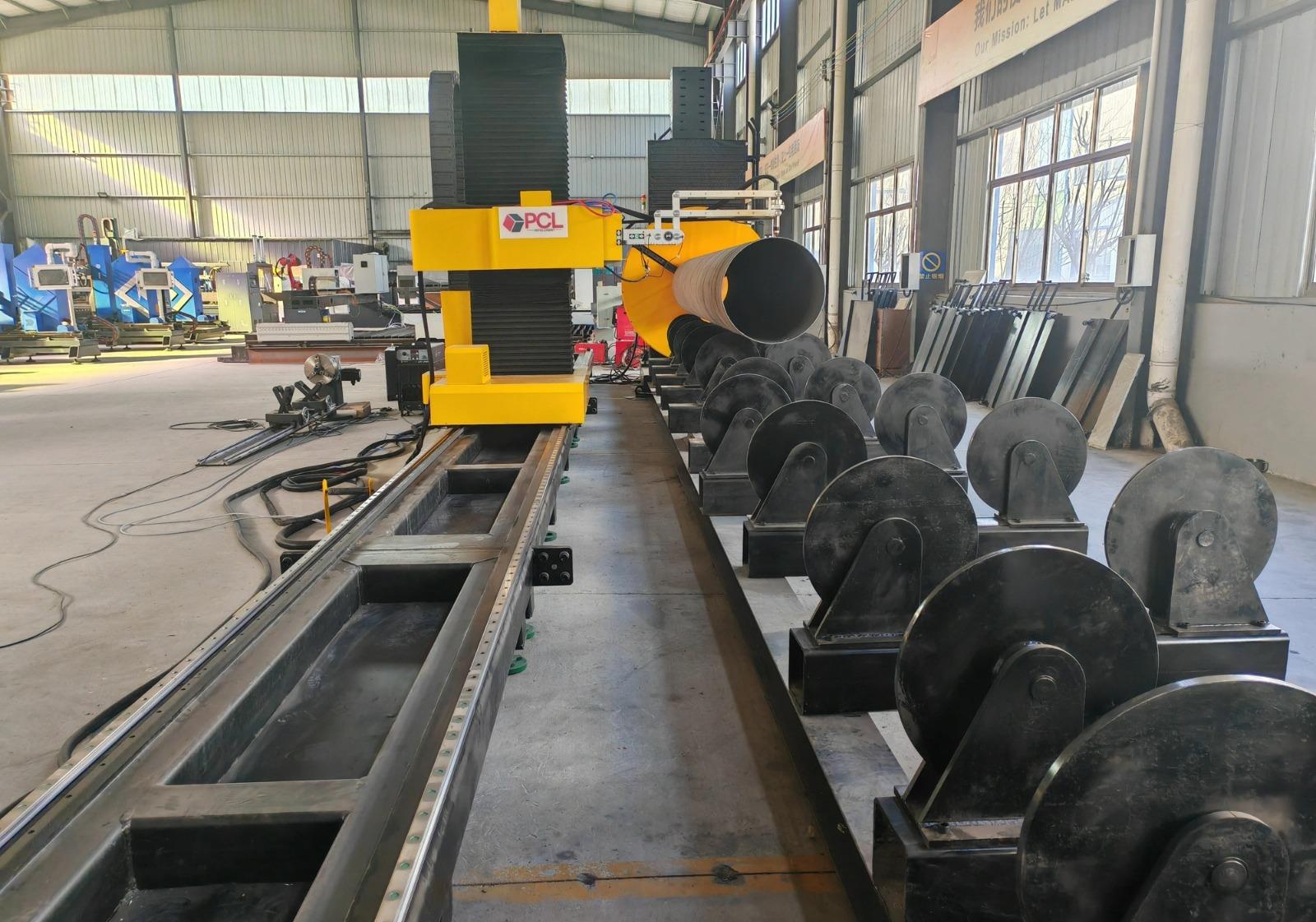
Modern plasma systems utilize sophisticated software algorithms that calculate the “torch lead” and “tilt angle” in real-time. This accounts for the conical shape of the plasma arc itself. Without this compensation, a programmed 45-degree angle would result in an actual cut angle with a 2-3 degree variance due to the swirling nature of the plasma gas. By implementing 5-axis interpolation, the machine ensures that the land thickness and the bevel face remain consistent across the entire length of a 12-meter plate, which is a standard dimension in tower segment production.
Achieving Superior Intersection Accuracy for Door Frames and Ports
One of the most complex aspects of wind tower fabrication is the cutting of internal apertures, specifically the access door frames and cable entry ports. These intersections occur on curved surfaces, necessitating intersection accuracy that traditional 2D cutting cannot provide. When a flat plate is cut before being rolled into a cylinder, the geometry of the hole must be mathematically projected to ensure that, once rolled, the aperture perfectly matches the mating door frame component.
The 5-axis plasma head excels here by providing varying bevel angles along the perimeter of the cut. As the torch moves around the elliptical path of a door opening, the angle of the cut must change relative to the surface normal to ensure a constant weld gap. Industrial engineers prioritize this accuracy because any deviation leads to excessive gap bridging during assembly, which increases consumable consumption and reduces the structural fatigue life of the tower. High-definition plasma ensures the heat-affected zone (HAZ) is minimized, preserving the metallurgical properties of the high-tensile steel used in offshore and onshore towers.
Structural Durability and the H-Beam Bed Advantage
The mechanical environment of a wind tower production facility is harsh, involving heavy plate loading and continuous thermal cycles. The design of the machine bed is therefore a critical factor in long-term maintenance costs and system uptime. Industrial-grade plasma tables often employ an H-beam low maintenance support structure. Unlike lighter sheet metal frames, H-beam construction provides the torsional rigidity required to support plates weighing several tons while resisting the thermal expansion caused by the plasma arc.
The use of heavy-duty H-beams in the gantry and the support table minimizes vibration during high-speed traverses. For the industrial engineer, this translates to higher “cut-to-cut” speeds and reduced mechanical wear on the linear guides and rack-and-pinion drives. Furthermore, the H-beam design allows for integrated dross management systems and water tables or downdraft systems that do not compromise the structural integrity of the machine over years of multi-shift operation. Low maintenance is achieved through the use of oversized bearings and protected cable tracks, ensuring that the 5-axis head remains calibrated despite the grit and heat inherent in heavy plate processing.
Nesting Efficiency and Material Utilization
Material costs represent the largest percentage of the total cost of ownership in wind tower production. High-definition plasma cutting systems, when paired with 5-axis capability, allow for tighter nesting of components. Since the machine can cut bevels directly, there is no need for additional “buffer” material typically required for mechanical beveling machines. The CNC software can nest parts with shared edges, even when those edges require complex beveling, maximizing the utilization of each steel plate.
Moreover, the precision of the plasma arc voltage control (AVC) ensures that the torch height is maintained at an optimal distance from the plate, even if the plate has slight undulations. This prevents torch collisions and nozzle damage, further reducing the cost per part. In a wind tower fabrication environment, where hundreds of segments are processed monthly, a 2% increase in material utilization through better nesting and accuracy can result in six-figure annual savings.
Integration with Industrial 4.0 and Data Feedback Loops
Modern 5-axis plasma machines are no longer isolated tools; they are nodes in a digital manufacturing ecosystem. Industrial engineers utilize the data output from these machines to monitor gas flow, pierce times, and consumable life. By analyzing the “arc-on” time versus the total shift time, facilities can identify bottlenecks in plate loading or dross removal. The 5-axis head’s sensors provide feedback on angular positioning, allowing for predictive maintenance before the mechanical play begins to affect the intersection accuracy of the cuts.
This data-centric approach ensures that the wind tower segments are produced to a “just-in-time” schedule for the rolling and assembly stations. By eliminating the secondary beveling station, the floor space is optimized, and the risk of material handling damage is significantly reduced. The plasma process, characterized by its high speed compared to oxy-fuel and its cost-effectiveness in thick plate compared to other methods, remains the backbone of the wind energy supply chain.
Final Engineering Considerations
When selecting or optimizing a plasma system for wind tower production, the focus must remain on the synergy between the power source, the kinematic head, and the structural base. A 5-axis beveling system is only as good as the software driving it and the H-beam frame supporting it. The ability to maintain high intersection accuracy on large-scale components directly dictates the efficiency of the subsequent assembly stages. By focusing on these technical pillars, manufacturers can ensure a low-maintenance lifecycle and a high return on investment in the demanding field of renewable energy infrastructure.
-


LT240S tube laser cutting machine
-
LT120S tube laser cutting machine
-
Sale

Tank Fillet Welding Machine
Original price was: $1,000.00.$900.00Current price is: $900.00. -
Sale

MAK100 tube laser cutting machine
Original price was: $5,500.00.$5,000.00Current price is: $5,000.00. -

portable plasma air cutting machine
$1,200.00 -

2in1 fiber laser cutting machine
-

Air cooling Laser welding machine
-

HF h beam laser cutting machine
-

LT240 laser cutting machine
-

Laser welding machine
-


Cobot Welding Station
-

Gantry welding robot solution
-

Tracked Wheeled AGV Welding robot
-

LFH6020 Fiber laser cutting machine
-
LFP6020
-

robotic welidng machine
Advanced Fiber Laser Tube Processing Technology
Our CNC Fiber Laser Tube Cutting systems revolutionize metal fabrication by integrating high-precision cutting, punching, and profiling into a single automated workflow. Designed for versatility, this technology handles a wide array of profiles including Round, Square, Rectangular, and Oval tubes, as well as complex L-shaped and U-shaped channels.
- Precision Punching: High-speed hole punching with micron-level accuracy, eliminating the need for mechanical drilling or die-stamping.
- Complex Profiling: Advanced 3D pathing allows for intricate interlocking joints and specialized notch cuts, ideal for structural frames.
- High Material Efficiency: Intelligent nesting software minimizes scrap, reducing raw material costs across large production runs.
- Clean Finish: Delivers oxide-free, burr-free edges that require zero secondary grinding before welding.

Seamlessly processing multiple profiles with consistent precision.
Global Delivery & Logistics



From our high-tech manufacturing facility directly to your global site. PCL WeldCut ensures secure packaging, professional handling, and reliable international logistics to safeguard your equipment throughout the entire journey.