Optimizing Maritime Fabrication with 5-Axis Plasma Technology
In the rigorous environment of industrial shipbuilding, the demand for structural integrity and geometric precision is absolute. The shift toward automated Plasma Cutting Machine systems has redefined the workflow for heavy plate fabrication. Unlike traditional 2D cutting, 5-axis systems allow for the simultaneous manipulation of the torch across the X, Y, and Z axes, complemented by A (tilt) and B (rotation) movements. This kinematic flexibility is essential for creating the complex weld preparations required for high-tonnage vessels, where plate thickness and curvature vary significantly across the hull and internal bulkheads.
Kinematic Precision in 5-Axis Beveling
The core advantage of a 5-axis plasma system lies in its ability to execute variable bevel angles in a single pass. In shipbuilding, weld preparation is not a uniform process. Engineers frequently require V, Y, X, and K-shaped grooves to ensure deep penetration during the subsequent welding phases. A 5-axis head utilizes sophisticated CNC algorithms to calculate the torch offset in real-time. This ensures that the focal point of the plasma arc remains consistent even as the head tilts up to 45 or 50 degrees.
From an industrial engineering perspective, the reduction in secondary operations is the primary metric for success. Traditionally, plates were cut to size and then manually beveled using grinders or track torches. This introduced human error and increased the “man-hours per ton” ratio. By integrating 5-axis beveling directly into the primary cutting cycle, shipyards achieve a “done-in-one” workflow. The CNC controller manages the kerf compensation dynamically, accounting for the increased material thickness encountered when the torch is at an angle, thereby maintaining strict tolerances on the root face and bevel land.
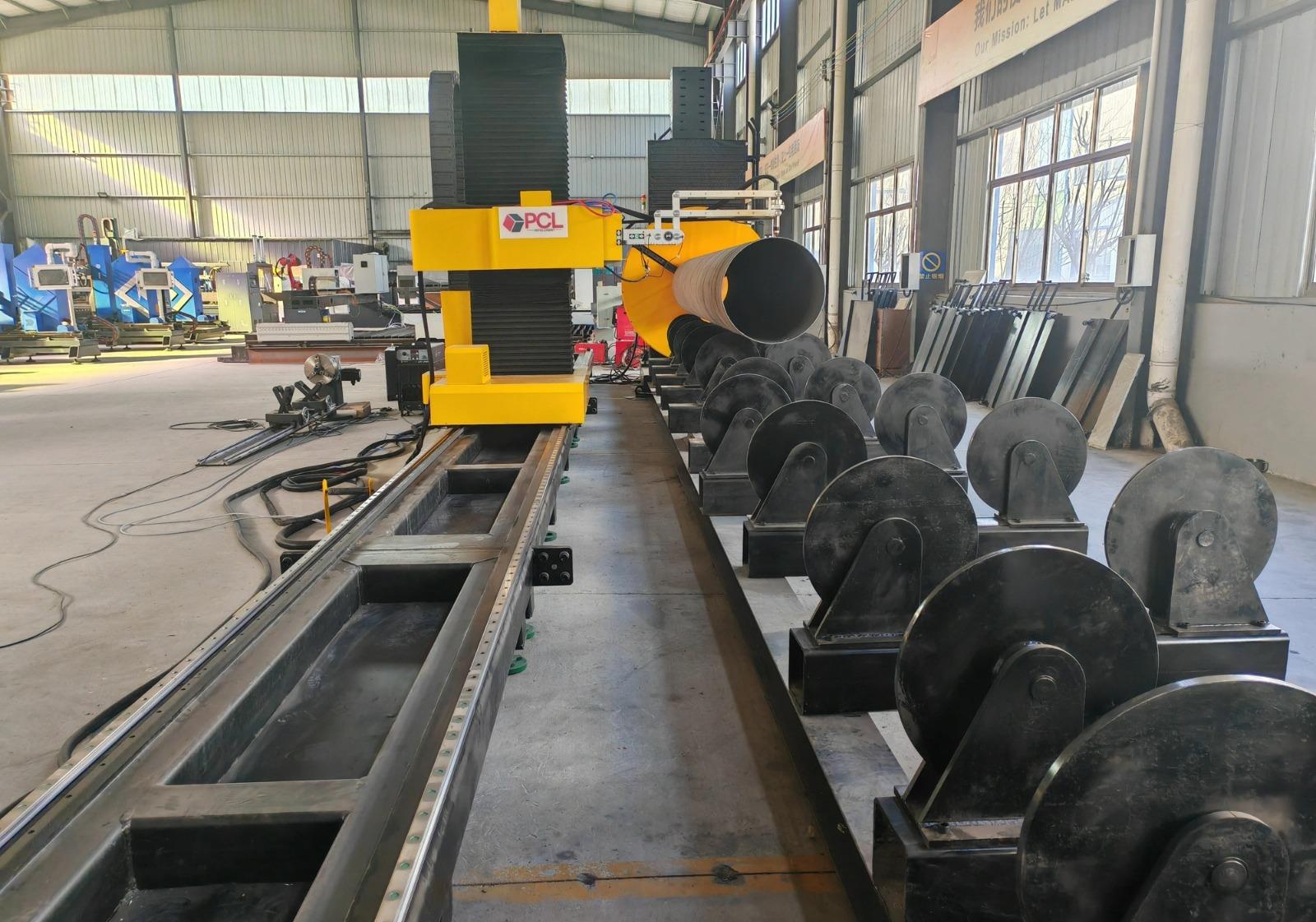
Intersection Accuracy for Complex Structural Geometries
Shipbuilding involves the assembly of thousands of intersecting components, including pipes, stiffeners, and curved hull plates. Achieving high intersection accuracy is critical to avoid large gaps that compromise structural weld integrity. Plasma cutting systems equipped with advanced sensing technology can map the surface of the material before the arc is struck. This surface mapping allows the machine to adjust its path for any slight deformations in the large-format plates typically used in maritime construction.
When cutting holes for pipe penetrations or slotting stiffeners through bulkheads, the plasma arc must maintain a perpendicular relationship to the theoretical tangent of the curve. The 5-axis motion allows the torch to “follow” the geometry of the intersection. This precision ensures that when a longitudinal stiffener meets a transverse bulkhead, the fit-up is tight, often within tolerances of +/- 0.5mm. This level of accuracy is vital for managing the heat-affected zone (HAZ) and ensuring that the final assembly meets the stringent classification society standards for maritime safety.
Advanced Gas Flow and Arc Stability
The quality of a plasma cut is heavily dependent on the stabilization of the plasma gas and the shield gas. High-definition plasma systems use a secondary gas to constrict the arc, resulting in a higher energy density and a narrower kerf. For shipbuilders, this means cleaner edges with minimal dross. In 5-axis operations, gas pressure must be modulated based on the angle of the torch to prevent “blow-back” and to ensure that the molten metal is efficiently ejected from the bottom of the cut. The integration of automatic gas consoles allows for seamless transitions between nitrogen, oxygen, and H35 (argon-hydrogen) mixes depending on whether the material is carbon steel, stainless, or aluminum.
Low Maintenance Advantages in H-Beam Processing
Beyond flat plate processing, shipbuilding relies heavily on structural profiles such as H-beams, I-beams, and bulb flats. Conventional mechanical processing of these sections—such as sawing or milling—involves significant consumable costs and mechanical wear. A plasma-based approach to structural profiling offers H-beam low maintenance benefits that significantly impact the bottom line.
Since plasma is a non-contact cutting process, there is no tool pressure exerted on the workpiece. This eliminates the need for heavy-duty clamping systems and prevents the mechanical vibration that leads to premature failure in saw blades or drill bits. The maintenance of a plasma system is primarily localized to the torch consumables—nozzles, electrodes, and swirl rings—which are easily replaced in minutes. Furthermore, a 5-axis plasma robot can reach all four sides of an H-beam, executing cope cuts, flange thins, and bolt holes in a single setup, which reduces material handling risks and equipment downtime.
Real-Time Torch Height Control (THC)
The volatility of the plasma arc requires constant adjustment to the distance between the torch tip and the workpiece. This is known as Torch Height Control (THC). In 5-axis shipbuilding applications, THC becomes exponentially more complex. As the torch tilts for a bevel cut, the arc voltage changes. Modern systems use predictive software to maintain the “tip-to-work” distance based on voltage feedback loops. This prevents torch collisions and ensures that the bevel angle remains consistent across the entire length of a 12-meter plate.
Enhancing Shipbuilding Efficiency through Nesting
Efficiency in a shipyard is often measured by material utilization. Advanced nesting software works in tandem with the 5-axis plasma machine to minimize scrap. Because the plasma arc is capable of tight radii and complex pathing, parts can be nested closer together. The software also calculates “common-line cutting” where a single cut separates two parts, further reducing gas consumption and processing time. For beveled parts, the nesting logic must also account for the “swing” of the 5-axis head to ensure that the torch body does not collide with adjacent parts or plate skeletons during the beveling sequence.
Thermal Management and Distortion Control
A common challenge in plasma cutting large maritime plates is thermal distortion. The concentrated heat of the plasma arc can cause the plate to expand and contract, leading to “bowing.” Industrial engineers mitigate this through strategic cut sequencing. By jumping the torch to different quadrants of the plate rather than cutting in a continuous linear path, the heat is distributed more evenly. Combined with the speed of high-definition plasma, which minimizes the time the heat source is in contact with any single point, the resulting parts maintain their dimensional stability, which is essential for the shipbuilding efficiency required in modern modular construction.
Conclusion: The Strategic Value of Plasma in Heavy Fabrication
The integration of 5-axis plasma cutting represents a significant leap forward for Shipbuilding productivity. By mastering the variables of bevel geometry, intersection precision, and profile processing, shipyards can produce complex structural components with a level of accuracy that was previously unattainable with manual methods. The shift toward low-maintenance plasma systems for H-beam and plate processing ensures that production lines remain active with minimal intervention. As maritime engineering continues to push the boundaries of vessel size and complexity, the 5-axis plasma machine remains the foundational tool for transforming raw steel into the sophisticated structures that define modern naval architecture.
-


LT240S tube laser cutting machine
-
LT120S tube laser cutting machine
-
Sale

Tank Fillet Welding Machine
Original price was: $1,000.00.$900.00Current price is: $900.00. -
Sale

MAK100 tube laser cutting machine
Original price was: $5,500.00.$5,000.00Current price is: $5,000.00. -

portable plasma air cutting machine
$1,200.00 -

2in1 fiber laser cutting machine
-

Air cooling Laser welding machine
-

HF h beam laser cutting machine
-

LT240 laser cutting machine
-

Laser welding machine
-


Cobot Welding Station
-

Gantry welding robot solution
-

Tracked Wheeled AGV Welding robot
-

LFH6020 Fiber laser cutting machine
-
LFP6020
-

robotic welidng machine
Advanced Fiber Laser Tube Processing Technology
Our CNC Fiber Laser Tube Cutting systems revolutionize metal fabrication by integrating high-precision cutting, punching, and profiling into a single automated workflow. Designed for versatility, this technology handles a wide array of profiles including Round, Square, Rectangular, and Oval tubes, as well as complex L-shaped and U-shaped channels.
- Precision Punching: High-speed hole punching with micron-level accuracy, eliminating the need for mechanical drilling or die-stamping.
- Complex Profiling: Advanced 3D pathing allows for intricate interlocking joints and specialized notch cuts, ideal for structural frames.
- High Material Efficiency: Intelligent nesting software minimizes scrap, reducing raw material costs across large production runs.
- Clean Finish: Delivers oxide-free, burr-free edges that require zero secondary grinding before welding.

Seamlessly processing multiple profiles with consistent precision.
Global Delivery & Logistics



From our high-tech manufacturing facility directly to your global site. PCL WeldCut ensures secure packaging, professional handling, and reliable international logistics to safeguard your equipment throughout the entire journey.