Optimizing Naval Fabrication via 5-Axis Plasma Kinematics
The shipbuilding industry demands extreme dimensional fidelity across large-scale steel assemblies. As an industrial engineer focusing on throughput optimization, the implementation of a Plasma Cutting Machine equipped with a 5-axis beveling head represents a critical shift from manual labor to automated precision. In the context of naval architecture, where curved hull plates and intricate internal bulkheads intersect at varying angles, a standard 2D cutting approach is insufficient. The 5-axis system introduces two additional degrees of rotation—typically tilt and swivel—allowing the plasma torch to maintain a constant perpendicularity or a specific programmed angle relative to the material surface.
This capability is not merely about aesthetic finishing; it is a foundational requirement for structural integrity. In heavy-duty steel fabrication, the quality of the weld preparation directly dictates the strength of the final assembly. By utilizing 5-axis plasma technology, engineers can program complex V, K, X, and Y-type bevels directly into the primary cutting cycle. This eliminates the need for secondary beveling via handheld grinders or portable milling tools, significantly reducing the total man-hours per ton of steel processed.
Precision Engineering in Intersection Accuracy
One of the most significant challenges in shipbuilding is the precision required at the intersection of structural members. Whether it is a pipe-to-plate connection or the fitting of longitudinal stiffeners against a curved shell, the intersection accuracy determines the gap tolerance for subsequent assembly phases. High-definition plasma systems utilize advanced gas flow dynamics and high-frequency arc stabilization to ensure that the kerf remains consistent, even when the torch is tilted at extreme angles.
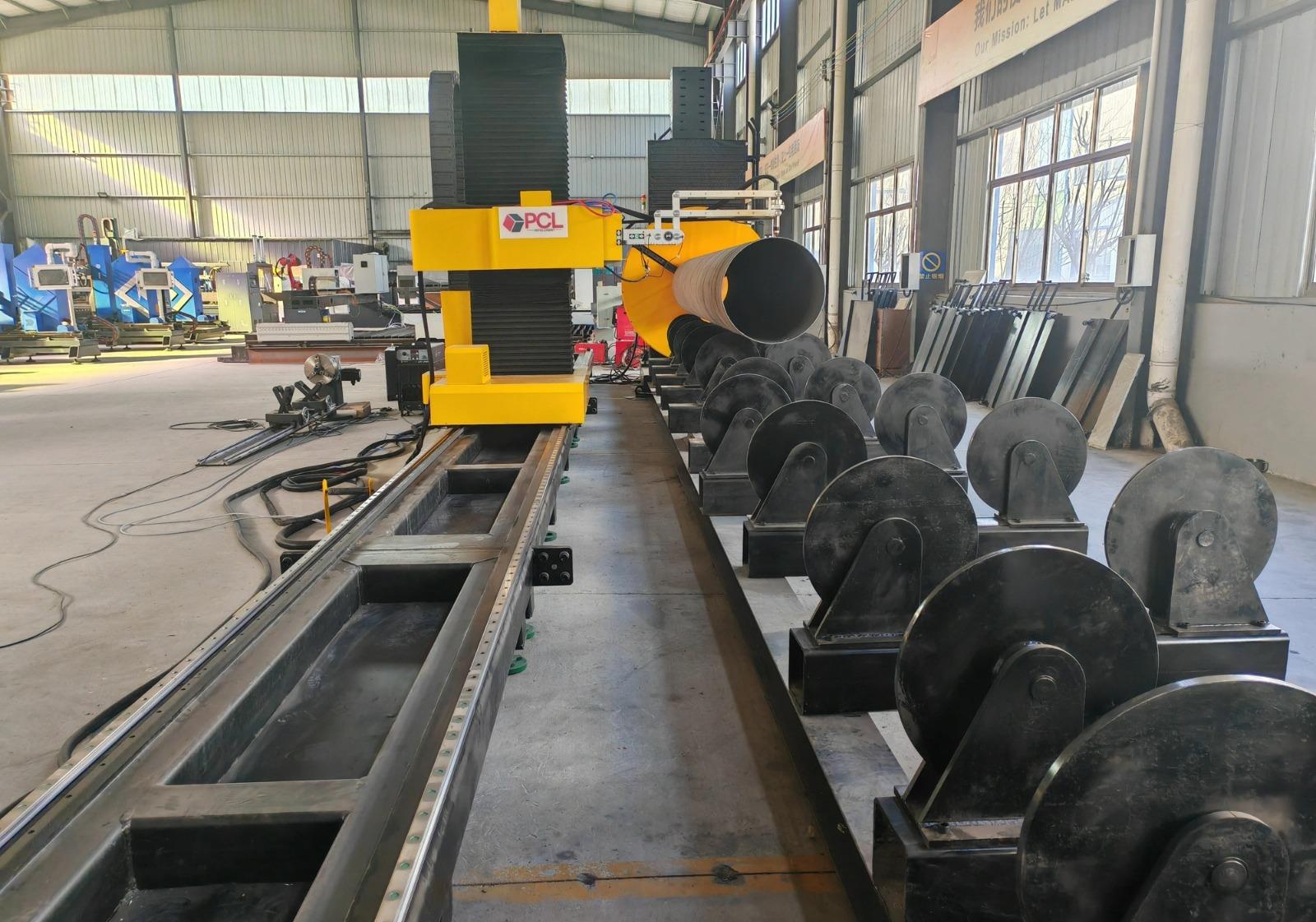
From a mechanical perspective, the CNC controller must synchronize five axes of motion while simultaneously adjusting for arc voltage and torch height. This real-time compensation is vital because even a millimeter of deviation in the intersection profile can lead to excessive weld volume requirements or structural misalignment. Industrial-grade plasma systems employ sophisticated algorithms to calculate the exact tool path, accounting for the plasma arc’s natural taper. By achieving high-precision intersections, shipyards minimize “fit-up” time, which is traditionally one of the most bottlenecked stages in the dry dock.
Structural H-Beam Processing and Operational Uptime
Beyond flat plate processing, the integration of H-beam and I-beam structural members is central to the skeletal framework of large vessels. Traditional mechanical methods for notched or miter-cut beams involve heavy sawing and drilling equipment, which carry high overhead in terms of consumable tool wear and mechanical maintenance. Transitioning these tasks to a 5-axis beveling plasma system offers a distinct advantage in terms of operational longevity.
The non-contact nature of plasma cutting means there is no mechanical force exerted on the machine gantry or the cutting head. Unlike saws that require blade replacements and frequent lubrication of drive systems, plasma systems primarily deal with electrode and nozzle replacement—consumables that can be swapped in minutes. This leads to a low maintenance cycle that is highly predictable. For an industrial engineer, predictability is the cornerstone of effective shop-floor scheduling. The ability to process H-beams with complex cut-outs, cope holes, and beveled ends on a single machine platform reduces material handling and minimizes the footprint of the fabrication line.
Advanced Thermal Management and Kerf Control
A common concern in thermal cutting is the Heat Affected Zone (HAZ). In shipbuilding, excessive heat can alter the metallurgical properties of high-tensile steel, potentially leading to embrittlement. Modern high-definition plasma power sources address this through narrowed arc constriction and optimized secondary gas shielding. By increasing the energy density of the plasma stream, the cutting speed is increased, which paradoxically reduces the total heat input into the base material.
Detailed kerf management is handled through the CNC interface, where the software adjusts the feed rate based on the bevel angle. As the angle increases, the effective thickness of the material increases, requiring the system to automatically modulate the amperage and gas pressure. This level of control ensures that the bevel face remains smooth and free of excessive dross, allowing for immediate transition to the assembly stage. The reduction in dross adherence is particularly important for H-beams, where internal corners are difficult to clean manually.
Integration with CAM and Nesting Workflows
The efficiency of a 5-axis plasma machine is maximized when it is tightly integrated with Computer-Aided Manufacturing (CAM) software tailored for marine engineering. These software suites allow for the nesting of parts across large plates, accounting for the swing radius of the 5-axis head to prevent collisions with previously cut components. For structural beams, the software can map out the entire length of the member, optimizing the sequence of cuts to maintain structural rigidity during the process.
This digital thread from design to execution ensures that the “as-built” dimensions match the “as-designed” specifications with a high degree of repeatability. In an environment where multiple sub-assemblies must converge from different areas of the yard, this repeatability is what allows for modular shipbuilding techniques. The 5-axis plasma machine serves as the bridge between theoretical naval design and physical reality, providing the geometric versatility required for modern hull forms.
Economic Impact on Shipyard Throughput
The capital expenditure of a high-end 5-axis plasma system is offset by the drastic reduction in secondary processing costs. Industrial engineering audits frequently show that the most expensive part of steel fabrication is not the initial cut, but the subsequent handling and preparation for welding. By delivering a “weld-ready” part directly from the plasma table, the shipyard can reallocate its labor force toward higher-value assembly tasks.
Furthermore, the reliability of plasma technology in harsh shipyard environments is well-documented. With robust dust extraction and water-table options, these machines operate consistently in three-shift environments. The combination of high-speed cutting, automated 5-axis beveling, and low mechanical wear makes the plasma system the workhorse of the modern shipyard. It provides a scalable solution that can handle everything from thin-gauge ventilation ducting to thick-section keel plates and structural H-beams with equal efficacy.
Summary of Technical Advantages
To conclude the technical assessment, the adoption of 5-axis plasma cutting technology provides three distinct advantages: dimensional accuracy in complex intersections, a significant reduction in maintenance overhead for structural beam processing, and the automation of weld-prep beveling. For the industrial engineer, these factors translate into a leaner production cycle, reduced material waste, and a significant improvement in overall vessel construction timelines. The focus remains on leveraging the plasma arc’s versatility to meet the rigorous demands of naval structural integrity.
-


LT240S tube laser cutting machine
-
LT120S tube laser cutting machine
-
Sale

Tank Fillet Welding Machine
Original price was: $1,000.00.$900.00Current price is: $900.00. -
Sale

MAK100 tube laser cutting machine
Original price was: $5,500.00.$5,000.00Current price is: $5,000.00. -

portable plasma air cutting machine
$1,200.00 -

2in1 fiber laser cutting machine
-

Air cooling Laser welding machine
-

HF h beam laser cutting machine
-

LT240 laser cutting machine
-

Laser welding machine
-


Cobot Welding Station
-

Gantry welding robot solution
-

Tracked Wheeled AGV Welding robot
-

LFH6020 Fiber laser cutting machine
-
LFP6020
-

robotic welidng machine
Advanced Fiber Laser Tube Processing Technology
Our CNC Fiber Laser Tube Cutting systems revolutionize metal fabrication by integrating high-precision cutting, punching, and profiling into a single automated workflow. Designed for versatility, this technology handles a wide array of profiles including Round, Square, Rectangular, and Oval tubes, as well as complex L-shaped and U-shaped channels.
- Precision Punching: High-speed hole punching with micron-level accuracy, eliminating the need for mechanical drilling or die-stamping.
- Complex Profiling: Advanced 3D pathing allows for intricate interlocking joints and specialized notch cuts, ideal for structural frames.
- High Material Efficiency: Intelligent nesting software minimizes scrap, reducing raw material costs across large production runs.
- Clean Finish: Delivers oxide-free, burr-free edges that require zero secondary grinding before welding.

Seamlessly processing multiple profiles with consistent precision.
Global Delivery & Logistics



From our high-tech manufacturing facility directly to your global site. PCL WeldCut ensures secure packaging, professional handling, and reliable international logistics to safeguard your equipment throughout the entire journey.