Technical Specification of Plasma Cutting in LNG Infrastructure
Liquefied Natural Gas (LNG) projects demand rigorous structural integrity due to the cryogenic temperatures and high-pressure environments inherent in gas processing and storage. The primary fabrication challenge involves the heavy-wall piping and massive structural skeletons required for modular plants. In this context, plasma cutting technology stands as the industrial standard for processing carbon steel, stainless steel, and nickel alloys. Unlike standard mechanical cutting, plasma offers a thermal process capable of handling the extreme thicknesses required for LNG storage tank supports and manifold systems.
From an industrial engineering perspective, the selection of plasma systems over mechanical alternatives is driven by the duty cycle and the ability to maintain high speeds across 50mm to 100mm plate thicknesses. Modern high-definition plasma systems utilize oxygen or nitrogen-shielded arcs to produce narrow kerfs and minimal heat-affected zones (HAZ). This is vital for LNG components where metallurgical properties must remain stable to prevent brittle fractures at sub-zero temperatures.
The Mechanics of 5-Axis Beveling for Weld Preparation
The core innovation in modern LNG fabrication is the 5-axis plasma head. Traditional 2D cutting requires secondary manual grinding to create the V, Y, X, or K-shaped bevels necessary for full-penetration welds. A 5-axis system introduces two additional rotational axes (A and B), allowing the torch to tilt and rotate dynamically during the cutting path. This capability is essential for 5-axis beveling, which ensures that the edge geometry is perfectly prepared for the automated welding robots that follow in the production line.
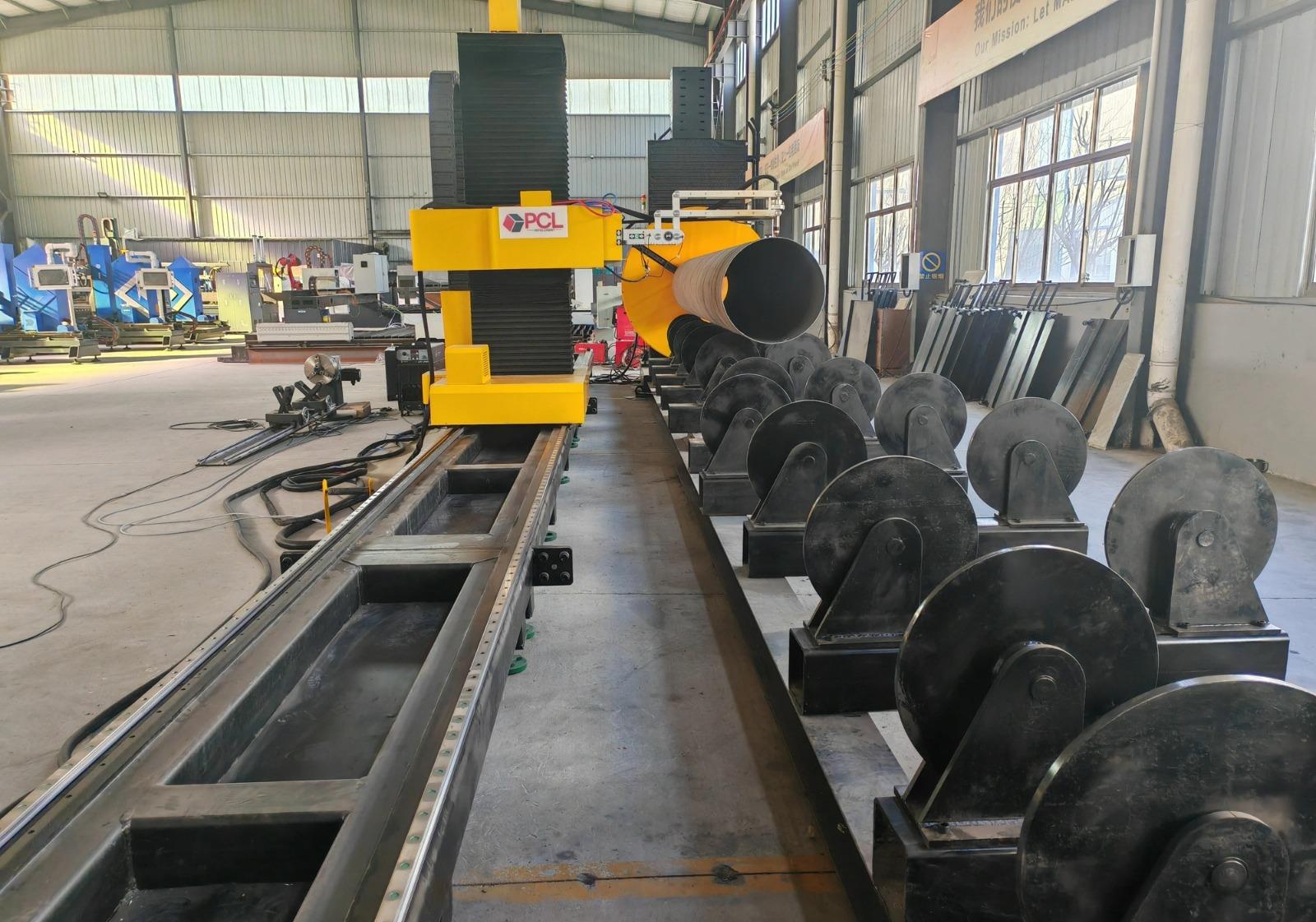
The kinematic complexity of a 5-axis head requires sophisticated CNC interpolation. The software must compensate for the “arc wander” and the plasma torch’s natural lag. For LNG engineers, this means the machine can cut a complex saddle hole on a large diameter pipe while simultaneously applying a varying bevel angle along the circumference. This geometric precision ensures that when two pipes meet, the root gap is consistent, reducing the volume of filler metal required and decreasing the likelihood of weld defects.
Intersection Accuracy in Pipe and Vessel Fabrication
Intersection accuracy is perhaps the most critical metric in the construction of LNG heat exchangers and distribution manifolds. When a branch pipe intersects a header pipe at an oblique angle, the resulting hole is a complex elliptical shape with a changing bevel. Manual layout of these intersections is prone to human error, leading to poor fit-up and increased stress concentrations.
Advanced plasma machines use laser sensors to map the actual surface profile of the workpiece before cutting. This “real-world” mapping accounts for any slight deformations in the H-beam or pipe, adjusting the tool path in real-time. The result is a fit-up tolerance of less than 1.0mm across a 12-meter span. For an industrial engineer, this precision translates directly into a reduction in man-hours. By achieving high intersection accuracy at the cutting stage, the downstream assembly time is cut by as much as 40%, as components “click” into place without the need for hydraulic jacks or excessive tack welding.
Low Maintenance Advantages of H-Beam Plasma Gantries
Industrial environments for LNG Projects, often located in coastal or harsh regions, require machinery with high uptime. Plasma systems integrated into H-beam processing lines are designed for 24/7 operation. The mechanical simplicity of a plasma gantry is a significant advantage. The primary components—power source, gas console, and drive motors—are robust and easily serviced. Unlike more delicate systems, plasma machines are resilient to the dust and vibration common in heavy structural steel shops.
Maintenance of the H-beam transport system is similarly straightforward. Because plasma cutting is a non-contact process, there is no tool wear in the traditional sense. The consumables (electrodes and nozzles) are the only high-frequency replacement items, and modern CNCs track their life cycles to prevent “burn-through” that could damage the torch head. This low maintenance profile ensures that the fabrication of structural supports for LNG modules stays on schedule, avoiding the costly delays associated with specialized technician call-outs.
Optimization of Structural H-Beam Processing
LNG modules rely heavily on H-beams (Universal Beams) for their primary skeletal structure. Processing these beams involves more than simple length cutting; it requires coping, bolt hole drilling (often replaced by high-precision plasma holes), and web penetrations for utility routing. A 5-axis plasma machine can rotate around the beam, cutting the flanges and the web in a single sequence without needing to flip the workpiece.
The accuracy of plasma-cut bolt holes in H-beams is now comparable to drilled holes, provided the system utilizes “True Hole” or similar gas-control technologies. By precisely timing the gas flow and current ramp-down, the plasma arc eliminates the “taper” typically found in thermal holes. This allows for the immediate installation of high-strength structural bolts, further streamlining the assembly of the LNG module’s structural frame.
Thermal Management and Material Integrity
A common concern in LNG engineering is the Heat Affected Zone (HAZ) created by plasma. However, the high travel speeds of modern plasma systems mean that the heat input per linear inch is relatively low. For the 9% nickel steel often used in LNG storage, controlling the cooling rate is essential. 5-axis plasma systems can be programmed to optimize the cutting sequence, jumping between different areas of the plate to prevent localized heat buildup. This maintains the material’s toughness and ensures compliance with international standards such as ASME Section VIII or API 620.
Conclusion: Throughput and Economic Impact
The integration of 5-axis plasma cutting into LNG infrastructure projects represents a shift from manual labor to high-precision engineering. By focusing on intersection accuracy and eliminating the need for secondary beveling, fabricators can achieve a much higher throughput. The low maintenance requirements of the H-beam plasma gantry ensure that the machine remains a reliable asset in the production chain. Ultimately, the precision provided by 5-axis plasma technology results in safer, more reliable LNG facilities where every joint and structural member meets the highest possible tolerances for cryogenic service.
-


LT240S tube laser cutting machine
-
LT120S tube laser cutting machine
-
Sale

Tank Fillet Welding Machine
Original price was: $1,000.00.$900.00Current price is: $900.00. -
Sale

MAK100 tube laser cutting machine
Original price was: $5,500.00.$5,000.00Current price is: $5,000.00. -

portable plasma air cutting machine
$1,200.00 -

2in1 fiber laser cutting machine
-

Air cooling Laser welding machine
-

HF h beam laser cutting machine
-

LT240 laser cutting machine
-

Laser welding machine
-


Cobot Welding Station
-

Gantry welding robot solution
-

Tracked Wheeled AGV Welding robot
-

LFH6020 Fiber laser cutting machine
-
LFP6020
-

robotic welidng machine
Advanced Fiber Laser Tube Processing Technology
Our CNC Fiber Laser Tube Cutting systems revolutionize metal fabrication by integrating high-precision cutting, punching, and profiling into a single automated workflow. Designed for versatility, this technology handles a wide array of profiles including Round, Square, Rectangular, and Oval tubes, as well as complex L-shaped and U-shaped channels.
- Precision Punching: High-speed hole punching with micron-level accuracy, eliminating the need for mechanical drilling or die-stamping.
- Complex Profiling: Advanced 3D pathing allows for intricate interlocking joints and specialized notch cuts, ideal for structural frames.
- High Material Efficiency: Intelligent nesting software minimizes scrap, reducing raw material costs across large production runs.
- Clean Finish: Delivers oxide-free, burr-free edges that require zero secondary grinding before welding.

Seamlessly processing multiple profiles with consistent precision.
Global Delivery & Logistics



From our high-tech manufacturing facility directly to your global site. PCL WeldCut ensures secure packaging, professional handling, and reliable international logistics to safeguard your equipment throughout the entire journey.