Technical Optimization of 5-Axis Plasma Cutting in LNG Infrastructure
The global demand for Liquefied Natural Gas (LNG) has necessitated a rapid expansion of cryogenic storage tanks, regasification facilities, and complex pipeline networks. From an industrial engineering perspective, the structural integrity of these facilities depends entirely on the precision of metal fabrication and the quality of weld penetration. The implementation of 5-axis plasma beveling has become the standard for processing large-diameter pipes and structural steel, providing a necessary balance between high-speed thermal cutting and the strict tolerances required by international pressure vessel codes.
Kinematics of 5-Axis Beveling for Weld Preparation
In LNG projects, the transition from simple orthogonal cuts to complex bevel profiles is a critical workflow improvement. A standard 3-axis system is limited to perpendicular cuts, which requires manual secondary grinding to create the bevels needed for full-penetration welding. However, a 5-axis plasma head introduces rotational and tilt axes, typically referred to as the A and B axes, alongside the standard X, Y, and Z coordinates.
This configuration allows the torch to maintain a consistent standoff distance while tilting at angles up to 45 or 60 degrees. For LNG piping, this is vital for creating V, Y, K, and X-shaped bevels. The ability to perform “on-the-fly” angle changes during the cutting cycle ensures that the root face and bevel angle remain constant, even when the torch is navigating the elliptical path of a pipe intersection. This geometric consistency is the foundation of high-quality automated welding sequences that follow the cutting process.
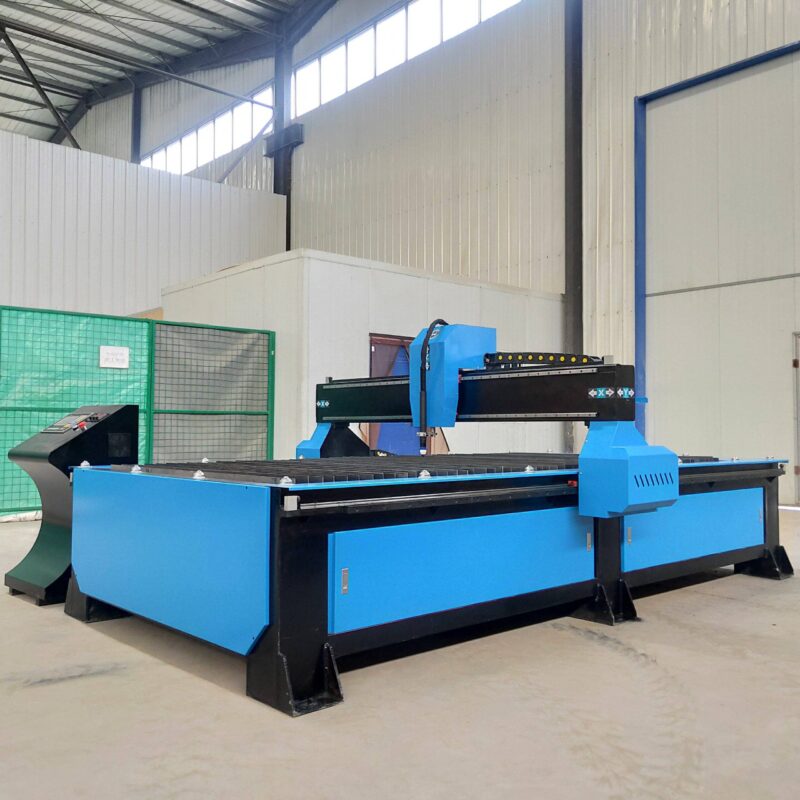
Intersection Accuracy in Complex Pipe Geometry
LNG facilities utilize intricate manifold systems where pipes of varying diameters intersect at diverse angles. Achieving intersection accuracy in these scenarios is mathematically demanding. When a branch pipe meets a header pipe at an oblique angle, the resulting cut profile is a complex three-dimensional curve. Industrial-grade plasma software must calculate the “unrolled” geometry of this intersection while simultaneously adjusting the bevel angle to ensure a uniform weld gap around the entire circumference.
High-definition plasma systems utilize sophisticated nesting and motion control algorithms to compensate for the plasma arc’s natural kerf width. Because the arc is a dynamic cone of ionized gas, the CNC system must adjust the torch trajectory in real-time. This level of precision eliminates the gaps often found in manual fit-ups, directly reducing the volume of filler metal required and minimizing the risk of hydrogen-induced cracking in the heat-affected zone (HAZ).
Structural Efficiency: H-Beam Processing and Low Maintenance
Beyond piping, LNG modules rely heavily on H-beams and I-beams for structural support. These components must withstand extreme thermal stresses and environmental loads. Traditional mechanical methods for notched or mitered beam cuts involve heavy saw systems or drilling rigs that require significant floor space and frequent tool replacement. In contrast, H-beam structural fabrication via plasma cutting offers a high-throughput, low-maintenance alternative.
Reduced Mechanical Wear and Consumable Life
One of the primary advantages of plasma systems in a structural environment is the lack of physical contact between the cutting tool and the workpiece. In mechanical milling or sawing, the vibration and torque lead to significant wear on bearings, spindles, and blades. Plasma cutting is a non-contact thermal process. The primary maintenance requirements are limited to the periodic replacement of electrodes, nozzles, and shields.
For industrial engineers, this translates to higher machine uptime and lower Mean Time To Repair (MTTR). Modern high-definition plasma power sources are engineered with “long-life” oxygen and air-cooled technology, which extends the duty cycle of consumables even when cutting thick-walled structural steel. Furthermore, the absence of cutting fluids and coolants simplifies the workspace and reduces the environmental footprint of the fabrication facility.
Precision Notching and Web Access Holes
The 5-axis capability is equally beneficial for H-beams, particularly for “rat holes” or weld access holes and complex web-to-flange transitions. When beams are joined at 90-degree angles or skewed angles in an LNG module, the plasma torch can bevel the flanges while simultaneously cutting out the web. This allows for a “flush fit” that distributes loads more evenly across the structure. The accuracy of these cuts ensures that structural components can be bolted or welded in the field with minimal site-side adjustments, which is crucial for modular construction projects where components are fabricated off-site and assembled in remote locations.
Advanced Gas Management and Material Integrity
The metallurgical requirements for LNG Projects are stringent. Materials often include low-temperature carbon steels or specialized alloys that must maintain ductility at cryogenic temperatures. The use of high-definition plasma cutting involves sophisticated gas consoles that automatically mix oxygen, nitrogen, and H35 (a hydrogen-argon mix) depending on the material thickness and type.
Optimizing the Heat Affected Zone (HAZ)
A common concern in thermal cutting is the width of the Heat Affected Zone. Excessive heat input can alter the grain structure of the steel, potentially leading to brittle failure. Modern plasma systems mitigate this through high-speed travel and concentrated energy density. By narrowing the arc, the system minimizes the duration of thermal exposure. The 5-axis head further assists by maintaining the optimal focal point of the arc relative to the plate or pipe surface, ensuring that the energy is directed efficiently through the kerf rather than dissipating into the surrounding material.
Operational ROI and Throughput Metrics
From a lean manufacturing perspective, the integration of 5-axis plasma cutting addresses several “wastes” in the fabrication process. It eliminates the waste of movement associated with transporting parts between a cutting station and a separate beveling station. It reduces the waste of defects by providing digital consistency that manual operators cannot replicate over an 8-hour shift.
In large-scale LNG projects, the throughput of the fabrication shop is often the bottleneck. By automating the beveling of intersections and H-beam ends, a single 5-axis plasma machine can replace the output of multiple manual cutting and grinding teams. The digital integration of CAD/CAM software allows engineers to import 3D models directly, generating G-code that accounts for every bevel and intersection with absolute fidelity. This “digital-to-physical” workflow is essential for meeting the aggressive timelines associated with modern energy infrastructure development.
Conclusion
The adoption of 5-axis Plasma Cutting Machines represents a strategic shift in how LNG infrastructure is built. By focusing on the intersection of geometric accuracy, structural maintenance efficiency, and advanced thermal processing, industrial facilities can produce components that meet the highest safety and performance standards. As the industry moves toward greater modularization and automation, the precision of the plasma-cut bevel will remain a fundamental requirement for the integrity of the world’s most critical energy systems.
-


LT240S tube laser cutting machine
-
LT120S tube laser cutting machine
-
Sale

Tank Fillet Welding Machine
Original price was: $1,000.00.$900.00Current price is: $900.00. -
Sale

MAK100 tube laser cutting machine
Original price was: $5,500.00.$5,000.00Current price is: $5,000.00. -

portable plasma air cutting machine
$1,200.00 -

2in1 fiber laser cutting machine
-

Air cooling Laser welding machine
-

HF h beam laser cutting machine
-

LT240 laser cutting machine
-

Laser welding machine
-


Cobot Welding Station
-

Gantry welding robot solution
-

Tracked Wheeled AGV Welding robot
-

LFH6020 Fiber laser cutting machine
-
LFP6020
-

robotic welidng machine
Advanced Fiber Laser Tube Processing Technology
Our CNC Fiber Laser Tube Cutting systems revolutionize metal fabrication by integrating high-precision cutting, punching, and profiling into a single automated workflow. Designed for versatility, this technology handles a wide array of profiles including Round, Square, Rectangular, and Oval tubes, as well as complex L-shaped and U-shaped channels.
- Precision Punching: High-speed hole punching with micron-level accuracy, eliminating the need for mechanical drilling or die-stamping.
- Complex Profiling: Advanced 3D pathing allows for intricate interlocking joints and specialized notch cuts, ideal for structural frames.
- High Material Efficiency: Intelligent nesting software minimizes scrap, reducing raw material costs across large production runs.
- Clean Finish: Delivers oxide-free, burr-free edges that require zero secondary grinding before welding.

Seamlessly processing multiple profiles with consistent precision.
Global Delivery & Logistics



From our high-tech manufacturing facility directly to your global site. PCL WeldCut ensures secure packaging, professional handling, and reliable international logistics to safeguard your equipment throughout the entire journey.