Optimizing Heavy-Duty Fabrication via 5-Axis Plasma Beveling
Construction machinery manufacturing—encompassing the production of excavators, mobile cranes, and earth-moving equipment—demands extreme structural integrity and high throughput. The primary challenge lies in the preparation of thick-plate carbon steel and structural profiles that require complex weld geometries. Implementing a 5-axis plasma beveling system addresses these challenges by consolidating cutting and edge preparation into a single CNC operation. From an industrial engineering perspective, this integration reduces material handling cycles and eliminates the bottlenecks associated with manual grinding or secondary edge milling.
The transition from traditional 2D cutting to 5-axis kinematic motion allows for the execution of V, X, Y, and K-type bevels. These profiles are essential for full-penetration welds in load-bearing chassis and boom structures. By maintaining a constant torch-to-workpiece distance and utilizing advanced kerf compensation algorithms, plasma systems deliver the dimensional precision required for robotic assembly lines.
Kinematic Precision and Intersection Accuracy
In the fabrication of crane booms and telescopic arms, intersection accuracy is a critical metric. These components often involve complex junctions where cylindrical or rectangular tubes meet at compound angles. A 5-axis plasma system utilizes sophisticated motion control software to calculate the real-time position of the torch head, ensuring that the plasma arc remains perpendicular to the theoretical weld line or at the programmed bevel angle throughout the entire cut path.
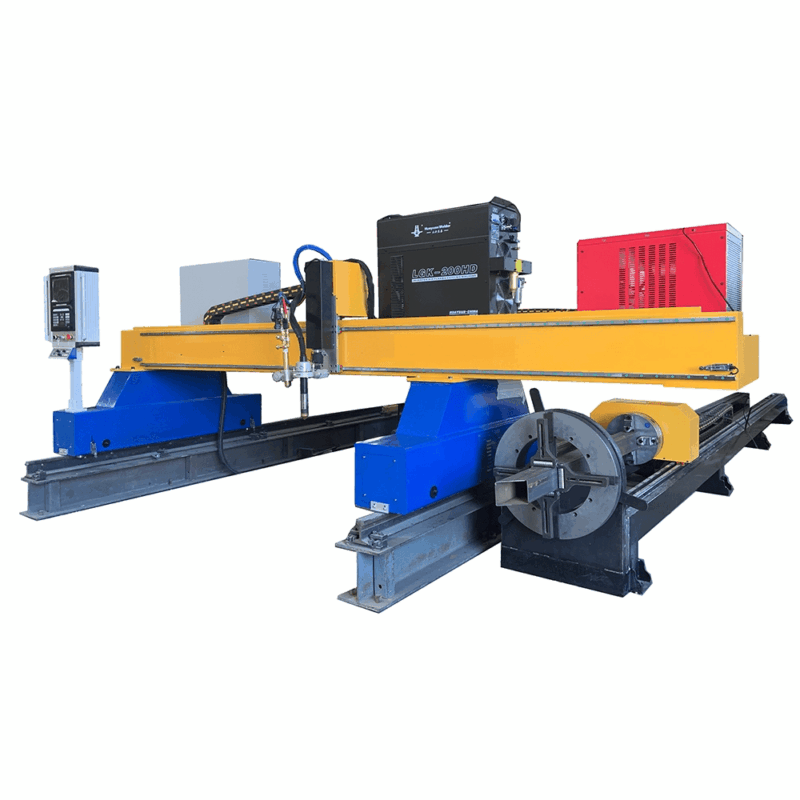
The accuracy of these intersections is governed by the machine’s ability to synchronize the X, Y, and Z linear axes with the A and C rotational axes. for Construction Machinery, where plate thicknesses often range from 12mm to 50mm, thermal displacement and arc deflection must be managed. Industrial-grade plasma power sources integrated with high-speed CNC controllers provide real-time feedback loops. This ensures that the intersection accuracy of the cut parts meets ISO 9013 tolerance classes, specifically regarding perpendicularity and angularity, which are vital for minimizing gaps during fit-up.
H-Beam Processing and Structural Integrity
Structural profiles, particularly H-beams and I-beams, form the backbone of many construction machinery frames. Processing these profiles presents unique challenges, including flange-to-web transitions and the need for precision copes and bolt holes. Plasma technology is uniquely suited for this environment due to its ability to maintain a stable arc over varying surface topologies.
One of the significant advantages of plasma systems in H-beam fabrication is the H-beam low maintenance profile. Unlike alternative thermal cutting processes that are sensitive to surface contaminants, rust, or mill scale, Plasma Cutting is highly robust. The mechanical components of a plasma gantry are designed for the high-impact, high-dust environment of a structural steel shop. The absence of sensitive optical components means that the machine can operate in non-climate-controlled environments with minimal downtime. For maintenance engineers, this translates to longer service intervals for consumables and lower sensitivity to the vibrations common in heavy machinery plants.
Advanced Torch Height Control (THC) and Arc Voltage Management
To ensure consistent bevel angles, the system must employ a highly responsive Torch Height Control (THC). In 5-axis operations, the distance between the nozzle and the plate changes dynamically as the head tilts. The plasma arc voltage control system must interpret voltage fluctuations instantaneously to adjust the Z-axis height. This prevents “diving” or “climbing” of the torch, which would otherwise result in inconsistent bevel widths and compromised weld prep quality.
In construction machinery applications, where large plates may have slight curvatures or “waves,” the THC must be capable of sampling the arc voltage at high frequencies (often above 1kHz). This level of control ensures that even on a 10-meter-long chassis plate, the bevel angle remains within a ±0.5-degree tolerance, facilitating high-quality automated welding downstream.
Thermal Management and Material Science
Industrial engineers must also consider the Heat Affected Zone (HAZ) when selecting cutting parameters for high-tensile steels like Q460 or Hardox grades used in construction equipment. Modern high-definition plasma systems utilize oxygen or multi-gas (H35/N2) mixtures to constrict the arc, increasing energy density. This narrowed arc results in a smaller HAZ compared to older air-plasma systems, preserving the mechanical properties of the base metal near the cut edge.
Effective dross management is another critical factor. Through optimized gas flow and precise feed rate control, 5-axis plasma machines produce “dross-free” cuts on the bottom edge of the bevel. This removes the need for manual chipping or grinding, directly reducing the labor cost per part and improving the overall Equipment Effectiveness (OEE) of the fabrication department.
Integration with PLM and CAD/CAM Workflows
The efficiency of a 5-axis plasma machine is maximized when integrated into a digital manufacturing workflow. Modern CAM software allows for the direct import of 3D models, automatically generating the 5-axis toolpaths required for complex bevels. This “Art-to-Part” workflow minimizes human error in manual programming and allows for nesting optimization, which is crucial given the high cost of heavy-gauge steel. The software accounts for the specific plasma arc characteristics, such as the “V” shape of the kerf, to ensure that the final part dimensions are exact.
Operational Efficiency and Total Cost of Ownership
From an investment perspective, the 5-axis plasma beveling machine offers a compelling ROI for construction machinery manufacturers. The primary drivers of this value are:
- Reduction in secondary processing: Bevels are cut simultaneously with the part profile, eliminating separate bevelling stations.
- Improved Weld Quality: Precise edge preparation leads to lower weld wire consumption and fewer weld defects detected during ultrasonic testing.
- Robustness: The system handles the rigors of heavy-duty fabrication with high uptime and a simplified spare parts inventory.
By focusing on the mechanical reliability of the plasma process and the geometric precision of 5-axis motion, manufacturers can achieve a significant leap in production capacity. The ability to produce complex, weld-ready components for H-beams and thick plates ensures that the fabrication line keeps pace with the demands of global construction infrastructure projects.
Conclusion
The application of 5-axis plasma beveling represents a strategic shift in construction machinery fabrication. By prioritizing intersection accuracy and leveraging the low-maintenance characteristics of plasma hardware for H-beam processing, industrial engineers can significantly optimize the production of heavy-duty structural components. The focus remains on delivering high-precision, weld-ready parts that meet the rigorous safety and durability standards of the construction industry while maintaining a lean and efficient manufacturing environment.
-


LT240S tube laser cutting machine
-
LT120S tube laser cutting machine
-
Sale

Tank Fillet Welding Machine
Original price was: $1,000.00.$900.00Current price is: $900.00. -
Sale

MAK100 tube laser cutting machine
Original price was: $5,500.00.$5,000.00Current price is: $5,000.00. -

portable plasma air cutting machine
$1,200.00 -

2in1 fiber laser cutting machine
-

Air cooling Laser welding machine
-

HF h beam laser cutting machine
-

LT240 laser cutting machine
-

Laser welding machine
-


Cobot Welding Station
-

Gantry welding robot solution
-

Tracked Wheeled AGV Welding robot
-

LFH6020 Fiber laser cutting machine
-
LFP6020
-

robotic welidng machine
Advanced Fiber Laser Tube Processing Technology
Our CNC Fiber Laser Tube Cutting systems revolutionize metal fabrication by integrating high-precision cutting, punching, and profiling into a single automated workflow. Designed for versatility, this technology handles a wide array of profiles including Round, Square, Rectangular, and Oval tubes, as well as complex L-shaped and U-shaped channels.
- Precision Punching: High-speed hole punching with micron-level accuracy, eliminating the need for mechanical drilling or die-stamping.
- Complex Profiling: Advanced 3D pathing allows for intricate interlocking joints and specialized notch cuts, ideal for structural frames.
- High Material Efficiency: Intelligent nesting software minimizes scrap, reducing raw material costs across large production runs.
- Clean Finish: Delivers oxide-free, burr-free edges that require zero secondary grinding before welding.

Seamlessly processing multiple profiles with consistent precision.
Global Delivery & Logistics



From our high-tech manufacturing facility directly to your global site. PCL WeldCut ensures secure packaging, professional handling, and reliable international logistics to safeguard your equipment throughout the entire journey.