Integrating 5-Axis Plasma Kinematics in Bridge Truss Production
In the heavy structural steel industry, specifically within the fabrication of bridge trusses, the transition from manual layout to automated Plasma Cutting systems represents a significant shift in production efficiency. Bridge trusses, characterized by massive H-beams and I-beams, require high-load-bearing intersections that demand absolute geometric precision. Traditional 3-axis systems are insufficient for the complex geometries found in skewed or curved bridge designs. The introduction of 5-axis plasma technology allows for the simultaneous control of the X, Y, and Z axes alongside tilt and rotation, enabling the torch to perform intricate weld preparations in a single pass.
From an industrial engineering perspective, the primary objective is to minimize the total cost per cut while maximizing throughput. This is achieved through high-definition plasma power sources that provide a constricted, high-energy arc. For bridge components, where material thickness often exceeds 25mm, the ability to maintain a consistent arc voltage and torch height is critical. The 5-axis head facilitates the creation of compound miters and saddle cuts on heavy profiles, ensuring that the fit-up at the job site is seamless and requires zero on-site modifications.
Optimizing Intersection Accuracy for Structural Integrity
The integrity of a bridge truss depends heavily on the accuracy of its intersections. When H-beams meet at non-orthogonal angles, the resulting geometry is complex. Intersection accuracy is not merely about the cut path; it is about the volumetric compensation for the plasma kerf and the lead-in/lead-out strategies that prevent divots or gouges in the base material. Modern CNC controllers utilize advanced algorithms to adjust the torch angle dynamically as it traverses the flange and web transitions of a beam.
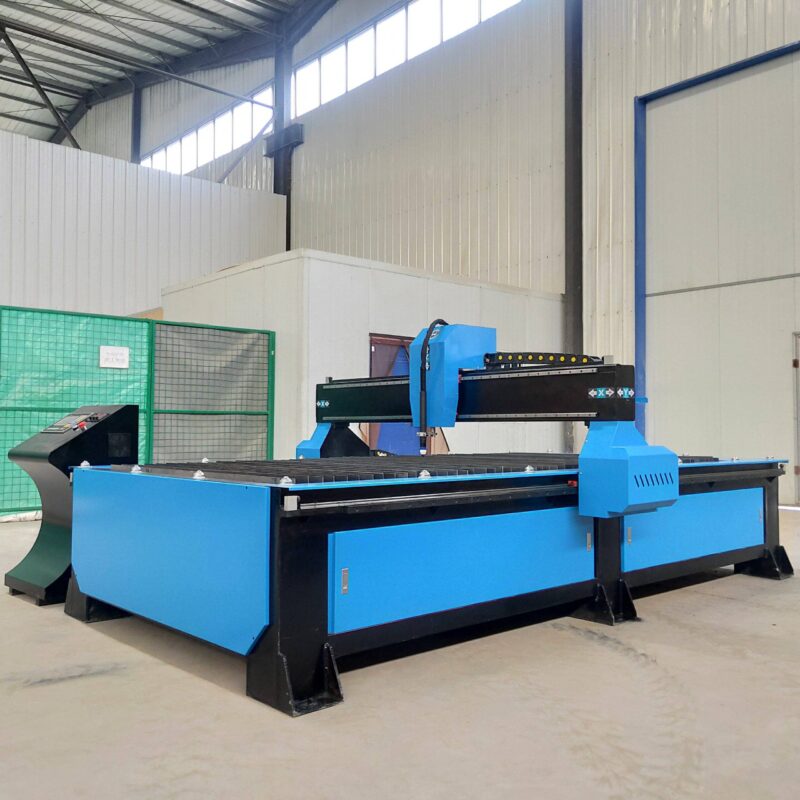
To meet the requirements of standards such as AWS D1.5 (Bridge Welding Code), the fit-up gap must be strictly controlled. A 5-axis plasma system utilizes laser scanning or mechanical probing to detect the actual dimensions of the beam, which often deviate from theoretical CAD models due to mill tolerances. By mapping the beam’s real-world “as-built” profile, the software recalibrates the cutting path in real-time. This ensures that the intersection between a diagonal member and a chord member is tight, reducing the volume of filler metal required in subsequent stages and ensuring uniform load distribution across the truss node.
5-Axis Beveling and Weld Preparation Efficiency
Manual beveling of heavy plate or H-beam sections is a labor-intensive process prone to human error and inconsistency. Implementing 5-axis beveling within the plasma cycle eliminates the need for secondary grinding or oxy-fuel hand-cutting. The system can execute V, Y, K, and X-type bevels with high repeatability. For bridge engineers, this means the specified root face and bevel angle are maintained across the entire length of the cut, regardless of the beam’s orientation.
The mechanical design of the 5-axis head must account for the harsh environment of a structural steel shop. High-speed servo motors and precision gearboxes are required to handle the rapid direction changes necessary during bevel transitions. The ability to tilt the torch up to 45 or even 50 degrees allows for the deep chamfers required for full-penetration joints. This automated approach ensures that the heat-affected zone (HAZ) is minimized by maintaining optimal travel speeds, which preserves the metallurgical properties of high-strength structural steels.
H-Beam Processing and Low Maintenance Requirements
In high-output bridge fabrication facilities, machine uptime is a critical KPI. The selection of plasma technology for H-beam processing is often driven by its robust nature and low maintenance profile compared to other thermal cutting methods in heavy-duty applications. While mechanical drilling and sawing have their place, plasma systems provide a non-contact cutting solution that reduces the mechanical stress on the machine gantry and the drive system.
Maintenance cycles in a plasma environment are largely focused on consumable management—nozzles, electrodes, and swirl rings. Advanced plasma systems now feature automated gas consoles that precisely mix oxygen, nitrogen, or H35 (35% hydrogen, 65% argon) to optimize the cut quality based on the specific alloy and thickness. Because the process is non-contact, there is no tool wear in the traditional sense, and no cutting fluids are required that would otherwise contaminate the shop floor or require complex filtration. The focus remains on the extraction of plasma dust and the periodic inspection of the linear guides and rack-and-pinion drives.
Dimensional Stability in Heavy Section Cutting
One of the challenges in bridge truss fabrication is managing thermal distortion during the cutting of large-scale H-beams. When heat is applied to one side of a thick flange, the beam tends to “walk” or bow. Industrial-grade plasma machines mitigate this through programmed cutting sequences that balance the heat input across the member. The precision of the 5-axis head allows for “stitch cutting” or strategic tabbing, which keeps the part stable within the raw material until the final release cut is made.
Furthermore, the integration of the CNC system with TEKLA or other structural BIM software ensures that every bolt hole (if plasma-pierced) and every cope is placed with an accuracy of +/- 0.5mm over the length of a 12-meter beam. This level of precision is vital for modular bridge construction, where components may be fabricated in different facilities and must align perfectly during field assembly. The plasma process, when combined with high-definition motion control, delivers the edge squareness and surface finish required to pass ultrasonic or radiographic testing without extensive post-processing.
Economic Impact of Automated Plasma Beveling
The ROI for a 5-axis plasma system in a bridge shop is realized through the radical reduction in man-hours per ton of steel. By consolidating the processes of measuring, marking, cutting, and beveling into a single automated station, the flow of material through the shop is streamlined. Engineers can specify tighter tolerances and more complex joint designs, knowing that the 5-axis plasma system can execute them consistently.
In conclusion, the application of 5-axis plasma cutting to bridge truss fabrication addresses the core requirements of the infrastructure sector: structural reliability, geometric precision, and operational efficiency. By focusing on the mechanical advantages of the 5-axis head, the precision of intersection calculations, and the low-maintenance reality of high-definition plasma units, fabricators can achieve a level of quality that exceeds traditional manual methods while significantly lowering the total cost of production.
-


LT240S tube laser cutting machine
-
LT120S tube laser cutting machine
-
Sale

Tank Fillet Welding Machine
Original price was: $1,000.00.$900.00Current price is: $900.00. -
Sale

MAK100 tube laser cutting machine
Original price was: $5,500.00.$5,000.00Current price is: $5,000.00. -

portable plasma air cutting machine
$1,200.00 -

2in1 fiber laser cutting machine
-

Air cooling Laser welding machine
-

HF h beam laser cutting machine
-

LT240 laser cutting machine
-

Laser welding machine
-


Cobot Welding Station
-

Gantry welding robot solution
-

Tracked Wheeled AGV Welding robot
-

LFH6020 Fiber laser cutting machine
-
LFP6020
-

robotic welidng machine
Advanced Fiber Laser Tube Processing Technology
Our CNC Fiber Laser Tube Cutting systems revolutionize metal fabrication by integrating high-precision cutting, punching, and profiling into a single automated workflow. Designed for versatility, this technology handles a wide array of profiles including Round, Square, Rectangular, and Oval tubes, as well as complex L-shaped and U-shaped channels.
- Precision Punching: High-speed hole punching with micron-level accuracy, eliminating the need for mechanical drilling or die-stamping.
- Complex Profiling: Advanced 3D pathing allows for intricate interlocking joints and specialized notch cuts, ideal for structural frames.
- High Material Efficiency: Intelligent nesting software minimizes scrap, reducing raw material costs across large production runs.
- Clean Finish: Delivers oxide-free, burr-free edges that require zero secondary grinding before welding.

Seamlessly processing multiple profiles with consistent precision.
Global Delivery & Logistics



From our high-tech manufacturing facility directly to your global site. PCL WeldCut ensures secure packaging, professional handling, and reliable international logistics to safeguard your equipment throughout the entire journey.