Mechanized Tank Construction and the Role of Arc Voltage Control
In the field of heavy construction machinery and storage tank fabrication, achieving consistent weld quality across expansive surfaces remains a primary engineering challenge. Traditional manual welding processes are often hindered by operator fatigue and environmental variables. To address these inefficiencies, the industry has pivoted toward mechanized solutions that prioritize Field Construction Stability. One of the most critical components in this transition is the implementation of Arc Voltage Control (AVC).
AVC technology functions by monitoring the electrical potential between the welding electrode and the base metal. In applications such as Tank Fillet Welding, the distance between the torch and the workpiece—known as the arc length—directly influences the heat input and penetration depth. As the mechanized carrier moves along a seam, surface irregularities or slight plate warping can alter this distance. The AVC system detects these minute voltage fluctuations and triggers a vertical motorized slide to adjust the torch position in real-time. This ensures a constant arc length, which is fundamental for maintaining the integrity of fillet joints in large-scale structural projects.
The Mechanics of the Magnetic Crawler System
For field construction, where heavy scaffolding is often impractical, the Magnetic Crawler serves as the backbone of the automated welding process. These units are engineered to traverse both flat and curved surfaces, utilizing high-strength permanent magnets or electromagnets to maintain adhesion against gravity. This magnetic traction allows the system to carry the weight of the welding torch, wire feeder, and AVC sensors without the risk of slipping or losing path accuracy.
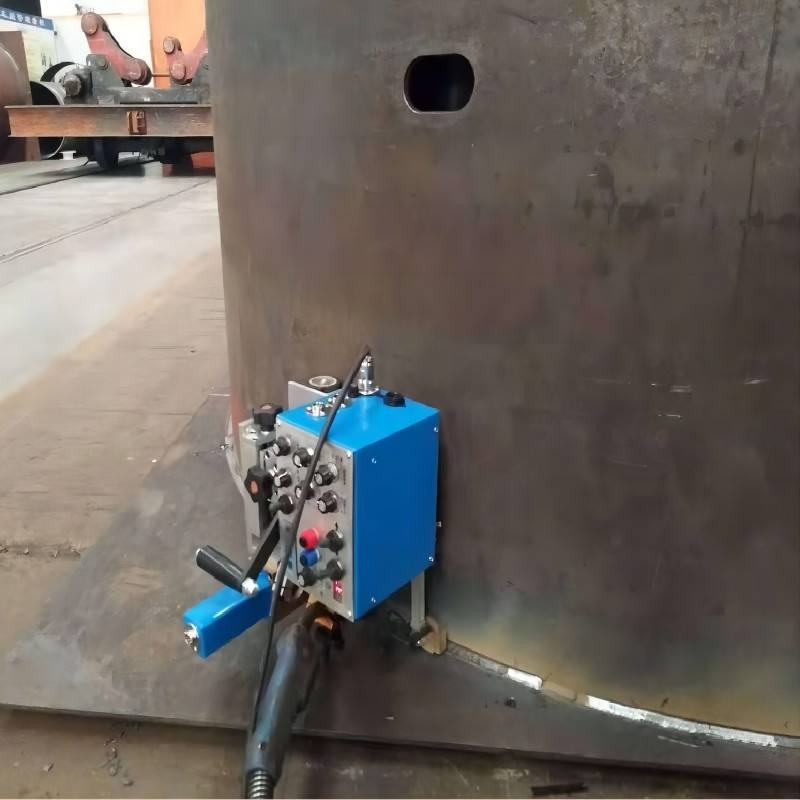
Unlike stationary shop equipment, the magnetic crawler must operate in uncontrolled environments. Wind, moisture, and temperature fluctuations can affect the stability of the weld pool. The crawler’s drive system is typically geared for high-torque, low-speed movement, providing the steady travel speed necessary for thick-plate welding. By integrating the crawler with a profile-tracking mechanism, the system can follow the natural geometry of the tank shell-to-floor joint, ensuring that the fillet weld remains centered in the root of the connection.
Optimizing Fillet Welding for Structural Integrity
Fillet welds in tank construction are subjected to significant hydrostatic and structural loads. Achieving a uniform throat thickness and deep penetration is non-negotiable. Using Arc Voltage Control in conjunction with mechanized crawlers eliminates the “zig-zag” inconsistency often found in manual welds. The system maintains a steady travel angle and work angle, which are calibrated based on the plate thickness and material grade.
The stability provided by the magnetic grip ensures that the vibration from the wire feeding mechanism does not translate into defects such as porosity or undercut. In the context of “Pipe Profile” logic applied to tanks, the system treats the large radius of the tank shell as a continuous profile. This allows for long, uninterrupted weld beads, significantly reducing the number of starts and stops—the primary locations for potential weld failure and leak paths.
Industrial Efficiency and Field Reliability
From an industrial engineering perspective, the deployment of these machines focuses on the “Duty Cycle” and “Deposition Rate.” Manual welders typically operate at a 30-40% duty cycle due to the need for repositioning and slag removal. Mechanized crawlers, however, can achieve duty cycles exceeding 70%. By utilizing flux-cored arc welding (FCAW) or submerged arc welding (SAW) processes on a mobile platform, the volume of weld metal deposited per hour increases dramatically.
Reliability in the field is further enhanced by the lack of complex optical sensors. By relying on the electrical feedback of the arc itself (AVC), the machine is less susceptible to the dust, sparks, and intense ultraviolet light that often blind more delicate sensor systems. This “low-tech, high-durability” approach is essential for Construction Machinery that must operate in remote oil fields, refineries, or water treatment facilities where repair facilities are limited.
Technical Specifications for Field Deployment
Engineers must consider several variables when configuring a magnetic crawler for tank work. First is the magnetic pull force, which must be rated for at least twice the weight of the fully loaded system to account for surface oxidation or paint thickness on the plates. Second is the AVC response speed; it must be fast enough to compensate for plate “oil-canning” but damped enough to ignore momentary electrical noise.
The integration of these systems reduces the requirement for skilled labor in high-risk positions. Instead of a welder hanging from a bracket to perform a vertical fillet, an operator can control the parameters from a ground-based interface. This shift not only improves safety but also standardizes the output across multiple machines, ensuring that the final structure meets stringent international codes such as API 650 or AWWA D100.
Economic Impact and Process Conclusion
The capital investment in Arc Voltage Control and crawler-based systems is justified by the reduction in rework. In large-scale tank projects, the cost of grinding out a failed fillet weld and re-welding it is three to five times higher than the cost of the initial weld. By ensuring precision through mechanical pathing and electrical arc regulation, the first-pass success rate is nearly absolute.
In summary, the use of mechanized systems for tank fillet welding represents a peak in practical industrial engineering. By focusing on the fundamentals of magnetic adhesion, arc physics, and mechanical stability, construction firms can deliver high-quality infrastructure more efficiently. The absence of complex robotic programming makes these systems accessible to the existing workforce, bridging the gap between traditional craftsmanship and modern industrial automation.
-


Cantilever Welding Robot solution
-


GF laser cutting machine
-

P3015 plasma cutting machine
-

LFP3015 Fiber Laser Cutter
-

pipe plasma cutting machine
-
LFH 4020 Fiber Laser Cutting Machine
-
LFP4020
-

gantry plasma air cutting machine
-

3D robot cutting machine
-

8 axis plasma cutting machine
-

5 axis plasma cutting machine
-

LT360 tube laser cutting machine
-

robot welding workstation
-

SF6060 fiber laser cutting machine
Advanced Fiber Laser Tube Processing Technology
Our CNC Fiber Laser Tube Cutting systems revolutionize metal fabrication by integrating high-precision cutting, punching, and profiling into a single automated workflow. Designed for versatility, this technology handles a wide array of profiles including Round, Square, Rectangular, and Oval tubes, as well as complex L-shaped and U-shaped channels.
- Precision Punching: High-speed hole punching with micron-level accuracy, eliminating the need for mechanical drilling or die-stamping.
- Complex Profiling: Advanced 3D pathing allows for intricate interlocking joints and specialized notch cuts, ideal for structural frames.
- High Material Efficiency: Intelligent nesting software minimizes scrap, reducing raw material costs across large production runs.
- Clean Finish: Delivers oxide-free, burr-free edges that require zero secondary grinding before welding.

Seamlessly processing multiple profiles with consistent precision.
Global Delivery & Logistics



From our high-tech manufacturing facility directly to your global site. PCL WeldCut ensures secure packaging, professional handling, and reliable international logistics to safeguard your equipment throughout the entire journey.