Mechanical Synergy: Magnetic Crawlers in Heavy Structural Fabrication
In the domain of bridge truss assembly, the transition from workshop fabrication to field integration presents significant logistical and qualitative challenges. The use of large-diameter pipe profiles requires a high degree of precision in both the preparation of joints and the execution of final welds. While 5-axis beveling provides the necessary geometric accuracy for complex intersections, such as saddle cuts and multi-member nodes, the physical act of welding these joints in the field demands a solution that prioritizes stability over mobility. The magnetic crawler serves as the primary mechanism for ensuring weld bead consistency on these curved, often vertical, steel surfaces.
Industrial engineering standards dictate that field welds must mirror the quality of shop-controlled environments. However, bridge sites are subject to environmental variables including wind, humidity, and irregular footing. By utilizing a specialized crawler system that adheres to the workpiece via high-strength permanent magnets, the dependency on manual operator steadiness is minimized. This system provides a constant travel speed and a fixed torch-to-workpiece distance, which are critical for the thermal management of the weld pool.
Kinematics of the Fillet Welding Process
Fillet welding in the context of bridge trusses often involves joining the branch pipe to the chord pipe at various angles. Once the 5-axis beveling machine has processed the pipe ends to create a precise fit-up, the crawler is deployed to execute the fillet or partial penetration weld. The mechanical design of the crawler typically involves a four-wheel drive system where each wheel or the chassis itself contains integrated magnets. This ensures that the unit remains perpendicular to the pipe surface, even when navigating the convex geometry of a large-diameter truss member.
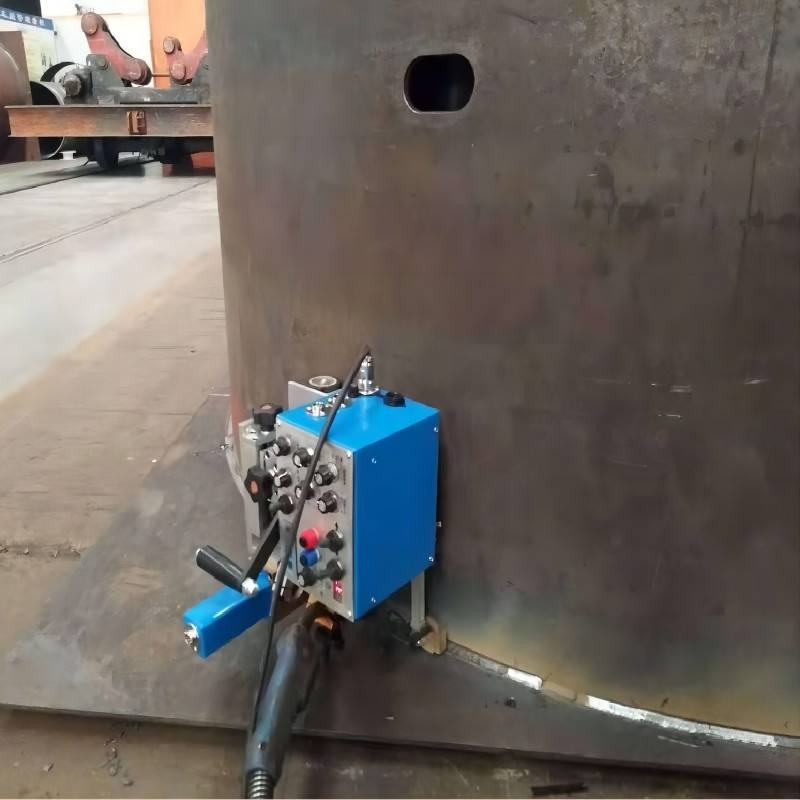
The movement of the torch is controlled through a localized carriage system. Unlike standard linear tracks, the magnetic crawler adapts to the radius of the pipe. This is particularly vital for fillet welding, where the torch must maintain a specific work angle (usually 45 degrees) and travel angle to ensure deep penetration into the root of the joint. The crawler’s ability to maintain this orientation throughout a 360-degree rotation around a horizontal or inclined pipe is what separates industrial-grade crawlers from simplified track-mounted oscillators.
Field Construction Stability and Surface Adhesion
The core requirement for any field-deployed welding system is field construction stability. In bridge engineering, the sheer scale of the components means that vibration and structural oscillation are common. A magnetic crawler mitigates these factors by creating a rigid coupling between the welding tool and the steel substrate. The magnetic force must be calculated to exceed the weight of the crawler and the lead cables by a factor of at least 3:1 to prevent slippage or detachment during vertical climbs.
To enhance stability, these crawlers utilize non-marring wheels or specialized stainless-steel treads that prevent contamination of the base metal. The drive motors are high-torque, low-RPM units equipped with encoders to provide real-time feedback on travel velocity. This level of control allows the welding engineer to prescribe specific heat input parameters (kJ/mm), ensuring that the cooling rate of the weld metal stays within the range required to maintain the required Charpy V-notch toughness for bridge applications.
Optimizing the Fillet Weld Profile
A successful fillet weld in a pipe-to-pipe connection is measured by its leg length, throat thickness, and lack of undercut. When the crawler moves along the beveled edge prepared by the 5-axis machine, it must compensate for the varying gap widths that are inherent in large-scale field fit-ups. Mechanical oscillators integrated into the crawler’s torch holder allow for a “weave” pattern. This weave distributes the weld metal more evenly across the joint, bridging any slight fit-up gaps and ensuring a smooth transition between the two pipe surfaces.
The industrial engineering benefit here is the reduction in rework. Manual fillet welding on large pipes often leads to “stop-start” defects as the welder reposition themselves. A magnetic crawler allows for continuous travel over long arcs, significantly reducing the number of weld craters and potential leak paths or stress concentrators. The consistency of the travel speed ensures that the weld reinforcement remains uniform, which is a key aesthetic and structural requirement for exposed bridge trusses.
Thermal Management and Heat Input Control
Bridge steels are sensitive to heat-affected zone (HAZ) degradation. Excessive heat input can lead to grain coarsening, reducing the fatigue life of the truss. By utilizing an automated crawler, the travel speed is kept constant, which in turn keeps the heat input within a narrow, pre-qualified range. The crawler can be programmed to slow down or speed up slightly depending on the thickness of the material as determined by the 5-axis beveling profile, ensuring that the weld penetration is sufficient without causing burn-through or excessive distortion.
In field construction, where preheating is often required, the crawler’s ability to operate on heated surfaces is essential. Magnetic materials used in the crawler must have a high Curie temperature to ensure that adhesion does not diminish as the pipe reaches its interpass temperature limits. This thermal resilience is a cornerstone of maintaining field construction stability during multi-pass welding operations on thick-walled bridge components.
Operational Efficiency and Labor Productivity
From a throughput perspective, the deployment of magnetic crawlers represents a significant shift in labor allocation. A single operator can oversee multiple crawlers, focusing on parameter adjustment and wire spool management rather than the physical strain of maintaining a torch position for hours. This reduces operator fatigue, which is a primary cause of weld defects in the final stages of a work shift. The integration of these tools into the bridge construction workflow allows for predictable project timelines, as the “linear meters per hour” metric becomes a constant rather than a variable based on manual skill.
Conclusion: The Future of Field-Applied Welding Technology
The reliance on magnetic crawler technology for fillet welding in bridge truss construction highlights a move toward mechanized precision in uncontrolled environments. By focusing on the mechanical stability provided by magnetic adhesion and the procedural consistency of automated travel, engineers can ensure that the complex geometries produced by 5-axis beveling are joined with the highest integrity. The absence of complex robotic programming or high-maintenance beam delivery systems makes these crawlers the ideal choice for the rugged demands of field construction stability, providing a reliable link between digital preparation and physical execution.
Ultimately, the objective of the industrial engineer is to minimize variance. In the context of bridge trusses, where safety and longevity are paramount, the magnetic crawler serves as the most effective tool for stabilizing the welding process, ensuring that every fillet weld meets the rigorous standards of the infrastructure industry.
-


Cantilever Welding Robot solution
-


GF laser cutting machine
-

P3015 plasma cutting machine
-

LFP3015 Fiber Laser Cutter
-

pipe plasma cutting machine
-
LFH 4020 Fiber Laser Cutting Machine
-
LFP4020
-

gantry plasma air cutting machine
-

3D robot cutting machine
-

8 axis plasma cutting machine
-

5 axis plasma cutting machine
-

LT360 tube laser cutting machine
-

robot welding workstation
-

SF6060 fiber laser cutting machine
Advanced Fiber Laser Tube Processing Technology
Our CNC Fiber Laser Tube Cutting systems revolutionize metal fabrication by integrating high-precision cutting, punching, and profiling into a single automated workflow. Designed for versatility, this technology handles a wide array of profiles including Round, Square, Rectangular, and Oval tubes, as well as complex L-shaped and U-shaped channels.
- Precision Punching: High-speed hole punching with micron-level accuracy, eliminating the need for mechanical drilling or die-stamping.
- Complex Profiling: Advanced 3D pathing allows for intricate interlocking joints and specialized notch cuts, ideal for structural frames.
- High Material Efficiency: Intelligent nesting software minimizes scrap, reducing raw material costs across large production runs.
- Clean Finish: Delivers oxide-free, burr-free edges that require zero secondary grinding before welding.

Seamlessly processing multiple profiles with consistent precision.
Global Delivery & Logistics



From our high-tech manufacturing facility directly to your global site. PCL WeldCut ensures secure packaging, professional handling, and reliable international logistics to safeguard your equipment throughout the entire journey.