Strategic Implementation of 3D Vision in Wind Tower Fillet Welding
In the heavy industrial sector, specifically within wind tower fabrication, the transition from manual fillet welding to automated carriage systems represents a critical leap in production efficiency. The sheer scale of wind tower sections, often categorized as large-diameter pressure vessels or tanks, requires a rigorous approach to structural integrity. The primary challenge lies in the fillet welds connecting internal platforms, flange rings, and longitudinal stiffeners. Traditional methods often succumb to human fatigue and inconsistent travel speeds, leading to rework and failure in non-destructive testing (NDT).
By utilizing 3D vision positioning, engineers can now map the weld interface in real-time. Unlike basic sensors, 3D vision provides a spatial coordinate system that allows the welding carriage to adjust its torch proximity and angle based on the actual fit-up of the steel plates. This is particularly vital in wind tower construction where plate rolling tolerances can create gaps or offsets that vary by several millimeters over a single circumference.
Mechanics of Magnetic Crawler Systems for Vertical Stability
The core of field-based automation in wind tower assembly is the magnetic crawler welding unit. These systems utilize high-strength neodymium permanent magnets or switchable electromagnets to adhere to the curved steel surfaces of the tower sections. From an industrial engineering perspective, the traction-to-weight ratio is the most critical metric. The crawler must support not only its own chassis but also the welding torch, lead cables, and potentially a flux recovery system if submerged arc processes are simulated, though gas-shielded wire processes are more common for fillet applications.
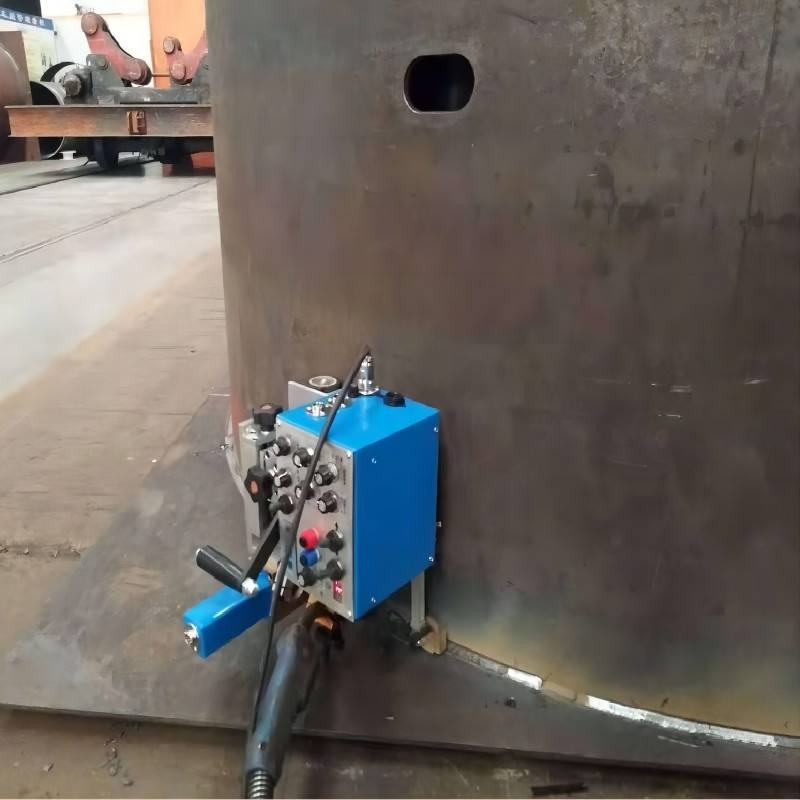
Field construction stability is compromised by environmental factors such as wind gusts, temperature fluctuations, and surface contaminants like mill scale or flash rust. Magnetic crawlers mitigate these risks by providing a constant force of attraction that outweighs the gravitational pull acting on the unit during vertical or overhead maneuvers. This constant pressure ensures that the drive wheels maintain a non-slip grip, which is essential for maintaining the precise travel speed required for a consistent heat-affected zone (HAZ).
Topographic Mapping and 3D Path Correction
The integration of 3D vision goes beyond simple seam tracking. It involves a comprehensive topographic scan of the fillet joint immediately ahead of the torch. The vision system identifies the root of the fillet and the edges of the vertical and horizontal members. This data is processed to calculate the volume of the weld groove. If the fit-up is tight, the system maintains a standard travel speed; if the gap widens, the 3D vision positioning logic automatically slows the crawler or increases the oscillation width of the torch to ensure full fusion.
This level of autonomy is crucial for wind towers because the internal geometry is rarely a perfect circle. Minor ovality in the sections can cause a fixed-track system to lose its alignment. A 3D-guided magnetic crawler, however, operates independently of rigid tracks, using the vision system as its “eyes” to navigate the contour of the section. This reduces the setup time significantly, as operators do not need to install complex guidance rails inside the confined space of the tower segment.
Optimizing Fillet Weld Integrity and Deposition Rates
From a throughput analysis, the primary goal of automating fillet weld integrity is the maximization of the duty cycle. A manual welder may achieve a 20-30% arc-on time due to the need for repositioning, heat breaks, and ergonomic constraints. An automated magnetic crawler can achieve arc-on times exceeding 70%. In the context of wind tower fabrication, where kilometers of fillet welds are required across a single wind farm project, these incremental gains translate into weeks of saved production time.
Furthermore, the 3D vision system logs the parameters of every inch of the weld. This digital twin of the welding process provides industrial engineers with a data-driven path to quality assurance. Instead of relying solely on spot-check NDT, the fabrication facility can review the vision logs to identify areas where the fit-up was out of spec, allowing for targeted inspections rather than blanket testing. This precision reduces the overhead costs associated with ultrasonic and radiographic testing.
Thermal Management and Deformation Control
A significant concern in tank fillet welding is the thermal distortion caused by the high heat input required for thick-walled wind tower sections. When welding internal components to the main shell, excessive heat can cause “telegraphing,” where the weld seam becomes visible on the exterior of the tower, potentially compromising the aerodynamic profile or the protective coating. The 3D vision system assists in managing this by enabling precise control over the heat input.
By maintaining an optimal torch angle and travel speed, the crawler ensures that the energy is directed precisely into the root of the joint. This localized heating minimizes the overall thermal load on the plate. Industrial engineers design the welding sequence—often employing a skip-welding or back-step technique—which the automated crawler can execute with much higher repeatability than a manual operator. The result is a flatter, more aesthetically pleasing exterior shell and a more robust internal structure.
Reducing Labor Vulnerability in Field Construction
Field construction of wind towers often occurs in remote locations where skilled welding labor is scarce. By deploying 3D-guided magnetic crawlers, the requirement shifts from needing dozens of highly skilled manual welders to needing a smaller team of specialized technicians who can oversee multiple automated units. This transition addresses the labor shortage while simultaneously raising the floor for minimum quality standards.
The stability of the magnetic crawler also enhances safety. Welding inside a wind tower section involves working at heights and in confined spaces with limited ventilation. Automation allows the operator to remain at a distance from the immediate welding arc and fumes, reducing exposure to manganese and other hazardous particulates. From an EHS (Environmental Health and Safety) standpoint, this is a significant improvement in the industrial workflow.
Final Synthesis of Process Advantages
The synergy between 3D vision and magnetic crawler technology provides a solution for the most demanding aspects of wind energy infrastructure. By focusing on the mechanical stability of the carriage and the intelligent positioning of the torch, manufacturers can overcome the geometric irregularities inherent in large-scale steel fabrication. The result is a measurable increase in wind tower fabrication speed, a reduction in the total cost of quality, and a superior structural product capable of withstanding the multi-axial loading stresses of offshore and onshore wind environments.
In summary, the application of 3D vision to fillet welding is not merely a technical upgrade; it is a fundamental shift in the industrial engineering approach to heavy fabrication. It moves the process from a reactive, craft-based activity to a proactive, data-controlled manufacturing system. As tower heights continue to increase and material thicknesses grow to support larger turbines, the reliance on such automated stability and positioning systems will become the industry standard for ensuring the longevity of renewable energy assets.
-


Cantilever Welding Robot solution
-


GF laser cutting machine
-

P3015 plasma cutting machine
-

LFP3015 Fiber Laser Cutter
-

pipe plasma cutting machine
-
LFH 4020 Fiber Laser Cutting Machine
-
LFP4020
-

gantry plasma air cutting machine
-

3D robot cutting machine
-

8 axis plasma cutting machine
-

5 axis plasma cutting machine
-

LT360 tube laser cutting machine
-

robot welding workstation
-

SF6060 fiber laser cutting machine
Advanced Fiber Laser Tube Processing Technology
Our CNC Fiber Laser Tube Cutting systems revolutionize metal fabrication by integrating high-precision cutting, punching, and profiling into a single automated workflow. Designed for versatility, this technology handles a wide array of profiles including Round, Square, Rectangular, and Oval tubes, as well as complex L-shaped and U-shaped channels.
- Precision Punching: High-speed hole punching with micron-level accuracy, eliminating the need for mechanical drilling or die-stamping.
- Complex Profiling: Advanced 3D pathing allows for intricate interlocking joints and specialized notch cuts, ideal for structural frames.
- High Material Efficiency: Intelligent nesting software minimizes scrap, reducing raw material costs across large production runs.
- Clean Finish: Delivers oxide-free, burr-free edges that require zero secondary grinding before welding.

Seamlessly processing multiple profiles with consistent precision.
Global Delivery & Logistics



From our high-tech manufacturing facility directly to your global site. PCL WeldCut ensures secure packaging, professional handling, and reliable international logistics to safeguard your equipment throughout the entire journey.