Precision Engineering in Heavy-Duty Tank Fillet Welding
In the domain of large-scale steel structure fabrication, particularly within the petrochemical and water storage industries, the intersection of pipe profiles and tank shells represents a significant engineering challenge. The traditional reliance on manual templates and hand-marking often leads to cumulative tolerances that compromise the structural integrity of the Tank Fillet Welding zone. To mitigate these risks, industrial standards are shifting toward automated Pipe Profile Cutting Machines that utilize advanced 3D vision positioning. Unlike static shop environments, field construction demands a specialized approach where equipment must maintain stability against gravity, wind loads, and irregular surface geometries.
The Role of 3D Vision in Profile Mapping
The core of modern profile cutting efficiency lies in the ability of the machine to “see” and interpret the physical workpiece in real-time. 3D vision systems employed in these machines utilize structured light or stereoscopic imaging to create a high-density point cloud of the pipe surface and the corresponding tank aperture. For an industrial engineer, the value proposition here is the elimination of the “fit-up” gap. By scanning the actual curvature of the tank wall, the vision system calculates the precise saddle or elliptical cut path required for the pipe to seat perfectly against the shell.
This spatial data is processed through coordinate transformation algorithms that adjust the cutting torch’s angle and travel speed. In the context of tank construction, where plates may have slight deformations or deviations from the theoretical radius, the 3D vision system provides a “best-fit” solution that manual layout cannot achieve. This ensures that the fillet weld throat thickness remains consistent around the entire circumference of the joint, directly impacting the fatigue life of the structure.
Mechanical Stability via Magnetic Crawler Systems
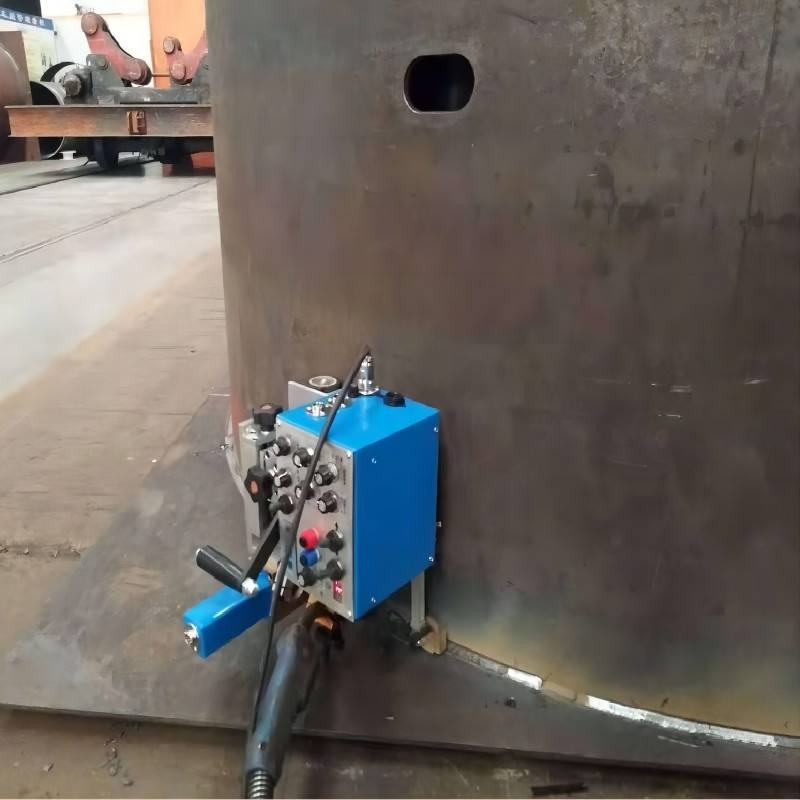
In field environments, the use of large gantry systems is often impractical due to space constraints and the scale of the tanks. The solution is the magnetic crawler—a compact, high-torque mobile unit that adheres to the steel surface using permanent magnets or high-flux electromagnets. The Magnetic Crawler serves as the mobile platform for both the 3D vision sensors and the oxy-fuel cutting torch. The engineering priority for these crawlers is traction and stability.
To ensure Field Construction Stability, the crawler’s drive system must overcome the gravitational pull when climbing vertical tank walls or traversing the underside of spherical vessels. Industrial-grade crawlers utilize independent four-wheel drives and specialized non-slip treads to maintain a constant velocity. Velocity fluctuations are the primary cause of dross accumulation and surface irregularities in thermal cutting; therefore, the integration of high-resolution encoders within the crawler’s drivetrain is essential for maintaining the synchronized movement dictated by the 3D vision pathing.
Optimizing the Oxy-Fuel Cutting Process
While various thermal cutting methods exist, oxy-fuel remains the standard for thick-walled steel structures in field conditions due to its portability and lack of requirement for high-voltage power supplies. In the pipe profiling process, the machine must manage the pre-heat timing and oxygen flow rates dynamically. When the 3D vision system detects a change in the bevel angle—necessary for a transitioning fillet weld—the machine’s control unit adjusts the torch height and inclination (lead and lag angles) to ensure the kerf remains clean.
The absence of complex robotic arms reduces the mechanical failure points, making the crawler-based system more resilient to the dust and humidity typical of construction sites. The engineering focus is on the “motion control” aspect, where the 2D path of the crawler on the pipe or tank surface is translated into a 3D cut through the material thickness. This is particularly critical for “set-on” or “set-in” pipe configurations where the weld prep must accommodate varying root gaps.
Managing Environmental Variables in the Field
Field construction is inherently volatile. Factors such as ambient temperature shifts, wind gusts, and surface oxidation can interfere with automated systems. The 3D vision housing is typically designed with IP67-rated enclosures and pressurized air curtains to keep the optical sensors clear of smoke and slag. Furthermore, the magnetic crawler must be designed with a low center of gravity to prevent “tipping” moments when the cutting torch is extended to its maximum reach.
Stability is also a function of the magnetic force. Engineers must calculate the “breakaway force” required to detach the crawler, ensuring that even in the event of a power loss (for electromagnetic models), safety tethers or permanent magnetic backups prevent the equipment from falling. This level of Field Construction Stability allows for 24-hour operation cycles, significantly compressing the project timeline compared to manual welding preparation.
Enhanced Quality Assurance and Weld Integrity
The primary KPI (Key Performance Indicator) for any industrial engineer on a tank project is the pass rate of Non-Destructive Testing (NDT). Manual cuts often result in uneven bevels that lead to slag inclusions or lack of fusion during the welding phase. By using a 3D vision-positioned cutting machine, the bevel geometry is mathematically optimized for the welding process that follows. The crawler can be re-fitted with a welding head to perform the actual fillet weld, ensuring that the torch follows the exact path previously mapped and cut.
The consistency provided by the automated crawler reduces the volume of weld metal required. In manual fit-ups, large gaps are often filled with excessive weld beads, increasing the Heat Affected Zone (HAZ) and potential for structural warping. The precision of the Magnetic Crawler ensures that the joint design is strictly adhered to, minimizing thermal distortion and ensuring the final assembly meets API or ASME code requirements.
Conclusion: The Future of On-Site Fabrication
The transition from manual layout to 3D vision-guided automation represents a significant leap in structural engineering efficiency. By focusing on the specific mechanics of the magnetic crawler and the spatial accuracy of vision systems, manufacturers can achieve shop-quality results in the most challenging field conditions. The focus remains on the stability of the platform and the precision of the cut, ensuring that every pipe profile is a perfect match for the tank shell, thereby securing the long-term safety and performance of the steel structure.
-


Cantilever Welding Robot solution
-


GF laser cutting machine
-

P3015 plasma cutting machine
-

LFP3015 Fiber Laser Cutter
-

pipe plasma cutting machine
-
LFH 4020 Fiber Laser Cutting Machine
-
LFP4020
-

gantry plasma air cutting machine
-

3D robot cutting machine
-

8 axis plasma cutting machine
-

5 axis plasma cutting machine
-

LT360 tube laser cutting machine
-

robot welding workstation
-

SF6060 fiber laser cutting machine
Advanced Fiber Laser Tube Processing Technology
Our CNC Fiber Laser Tube Cutting systems revolutionize metal fabrication by integrating high-precision cutting, punching, and profiling into a single automated workflow. Designed for versatility, this technology handles a wide array of profiles including Round, Square, Rectangular, and Oval tubes, as well as complex L-shaped and U-shaped channels.
- Precision Punching: High-speed hole punching with micron-level accuracy, eliminating the need for mechanical drilling or die-stamping.
- Complex Profiling: Advanced 3D pathing allows for intricate interlocking joints and specialized notch cuts, ideal for structural frames.
- High Material Efficiency: Intelligent nesting software minimizes scrap, reducing raw material costs across large production runs.
- Clean Finish: Delivers oxide-free, burr-free edges that require zero secondary grinding before welding.

Seamlessly processing multiple profiles with consistent precision.
Global Delivery & Logistics



From our high-tech manufacturing facility directly to your global site. PCL WeldCut ensures secure packaging, professional handling, and reliable international logistics to safeguard your equipment throughout the entire journey.