Advanced Integration of 3D Vision in Tank Fillet Welding
In the domain of large-scale steel structure assembly, the transition from manual stick welding to mechanized Tank Fillet Welding represents a significant leap in industrial efficiency. The core challenge in field environments—such as oil storage tanks or pressure vessel foundations—is the inherent irregularity of the steel plates. Unlike shop-controlled environments, field construction deals with plate warping, fit-up gaps, and environmental variables that render static automation useless.
Industrial engineers now utilize 3D vision positioning as a non-contact sensing method to map the exact geometry of the fillet joint before and during the welding process. This technology does not rely on pre-programmed paths. Instead, it employs structured light or stereoscopic sensors to generate a point cloud of the intersection between the vertical shell and the annular bottom plate. By calculating the vertex of the fillet in real-time, the system compensates for tack weld obstructions and gap fluctuations, ensuring the torch maintains a consistent work angle and lead angle.
The Mechanics of the Magnetic Crawler System
Mobility in field construction is achieved through the Magnetic Crawler, a specialized tractor unit designed to adhere to ferromagnetic surfaces. For tank fillet welding, the crawler must provide sufficient attractive force to overcome the weight of the wire feeder, the welding torch, and the umbilical cables while navigating vertical or overhead curvatures.
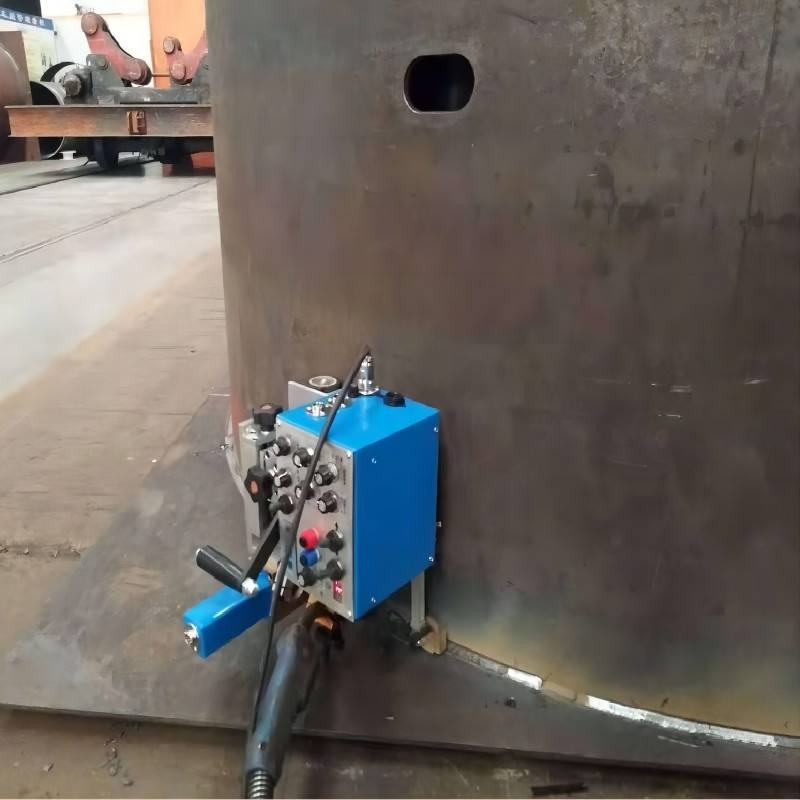
The engineering of these crawlers centers on permanent Neodymium magnet arrays or switchable magnetic bases. The flux density must be calibrated to ensure a high “clamping force” that prevents slippage on mill scale or protective primers, yet allows for smooth motion. Stepper motors with high torque-to-weight ratios drive the wheels or tracks, providing the granular speed control necessary for heat input management. In an industrial context, the stability of this platform is the primary determinant of weld bead morphology and penetration depth.
Ensuring Field Construction Stability
Field Construction Stability is often compromised by uneven terrain, wind gusts affecting shielding gas, and the thermal expansion of the steel plates during the welding cycle. To mitigate these factors, the mechanized system incorporates a low-center-of-gravity chassis design. By keeping the mass as close to the tank wall as possible, the moment arm acting against the magnetic grip is minimized.
Furthermore, stability is managed through closed-loop feedback. The 3D vision system identifies the physical constraints of the tank’s circumference. If the crawler encounters a surface irregularity that threatens its orientation, the onboard controller adjusts the differential drive to correct the heading. This level of mechanical autonomy is crucial for long-seam fillet welds where manual intervention would lead to stop-start defects and potential leak paths in the storage structure.
3D Vision Positioning and Joint Tracking
The technical application of 3D vision in this sector focuses on “seam tracking” without the overhead of complex robotics. The sensor scans the groove geometry several millimeters ahead of the arc. It identifies the root of the fillet and the edges of the fusion zone. This data is processed to control a cross-slide mechanism that fine-tunes the torch position.
For industrial engineers, the value lies in the reduction of “over-welding.” Manual operators often create larger-than-necessary fillets to compensate for poor fit-up, which wastes consumables and increases the heat-affected zone (HAZ). The vision-guided crawler maintains the specific leg length required by the engineering specification, optimizing material usage and reducing the risk of plate distortion caused by excessive thermal input.
Thermal Management and Bead Quality
Fillet welding on thick-walled steel structures requires precise control over the cooling rate to avoid hydrogen cracking. The mechanized crawler allows for a continuous travel speed that is unattainable by human hands over long distances. This consistency results in a uniform grain structure within the weld metal.
Because the 3D vision system monitors the joint volume, it can theoretically signal the controller to adjust wire feed speed if it detects a widening gap. This “adaptive fill” capability ensures that the throat thickness of the fillet weld remains constant, satisfying stringent non-destructive testing (NDT) requirements such as vacuum box testing or magnetic particle inspection.
Optimization of Industrial Workflow
The implementation of 3D-positioned Magnetic Crawler systems fundamentally alters the labor dynamics of a construction site. A single technician can oversee multiple units, moving from a role of physical exertion to one of process monitoring. This transition enhances safety by removing the welder from the immediate vicinity of fumes and intense ultraviolet radiation.
From a project management perspective, the predictability of mechanized welding allows for more accurate scheduling. Since the machines do not suffer from fatigue, the linear meters of weld completed per shift become a fixed constant. This reliability is the cornerstone of modern industrial engineering in the steel structure sector, where timeframe overruns can result in massive liquidated damages.
Conclusion on System Efficacy
The marriage of 3D vision and magnetic crawling technology addresses the most persistent variables in field tank construction. By prioritizing mechanical stability and precise joint mapping, these systems provide a robust solution for fillet welding that meets the high standards of the oil, gas, and water storage industries. The focus remains on leveraging mechanical intelligence to solve the physical challenges of steel assembly, ensuring structural longevity through superior weld quality and process control.
-


Cantilever Welding Robot solution
-


GF laser cutting machine
-

P3015 plasma cutting machine
-

LFP3015 Fiber Laser Cutter
-

pipe plasma cutting machine
-
LFH 4020 Fiber Laser Cutting Machine
-
LFP4020
-

gantry plasma air cutting machine
-

3D robot cutting machine
-

8 axis plasma cutting machine
-

5 axis plasma cutting machine
-

LT360 tube laser cutting machine
-

robot welding workstation
-

SF6060 fiber laser cutting machine
Advanced Fiber Laser Tube Processing Technology
Our CNC Fiber Laser Tube Cutting systems revolutionize metal fabrication by integrating high-precision cutting, punching, and profiling into a single automated workflow. Designed for versatility, this technology handles a wide array of profiles including Round, Square, Rectangular, and Oval tubes, as well as complex L-shaped and U-shaped channels.
- Precision Punching: High-speed hole punching with micron-level accuracy, eliminating the need for mechanical drilling or die-stamping.
- Complex Profiling: Advanced 3D pathing allows for intricate interlocking joints and specialized notch cuts, ideal for structural frames.
- High Material Efficiency: Intelligent nesting software minimizes scrap, reducing raw material costs across large production runs.
- Clean Finish: Delivers oxide-free, burr-free edges that require zero secondary grinding before welding.

Seamlessly processing multiple profiles with consistent precision.
Global Delivery & Logistics



From our high-tech manufacturing facility directly to your global site. PCL WeldCut ensures secure packaging, professional handling, and reliable international logistics to safeguard your equipment throughout the entire journey.