Advancing Shipbuilding Efficiency through 3D Vision Positioning
In the demanding environment of a shipyard, particularly within the construction of double-bottom tanks and bulkheads, the transition from manual labor to automated systems is a prerequisite for maintaining structural integrity and meeting delivery timelines. The application of 3D vision positioning has emerged as a critical component in bridging the gap between stationary workshop fabrication and mobile field assembly. While traditionally associated with the precision of pipe profile cutting, the logic of three-dimensional spatial awareness is now the primary driver for high-performance tank Fillet Welding.
The industrial engineering challenge in tank construction involves the reconciliation of theoretical CAD designs with the reality of “as-built” steel structures. Thermal distortion, plate waviness, and fit-up gaps often render pre-programmed paths obsolete. By utilizing vision-based sensors, the welding system can dynamically adjust its trajectory, ensuring that the torch remains centered within the fillet joint regardless of structural deviations. This real-time feedback loop is essential for maintaining the throat thickness and leg length requirements specified by maritime classification societies.
Mechanical Dynamics of the Magnetic Crawler
The core of field-based automation in shipbuilding is the magnetic crawler. Unlike stationary gantries, the crawler must navigate vertical, horizontal, and overhead planes within confined tank spaces. The stability of this platform is paramount. High-strength permanent magnets or switchable electromagnets provide the necessary clamping force to counteract gravity and the torque generated by the welding lead and umbilical cables.
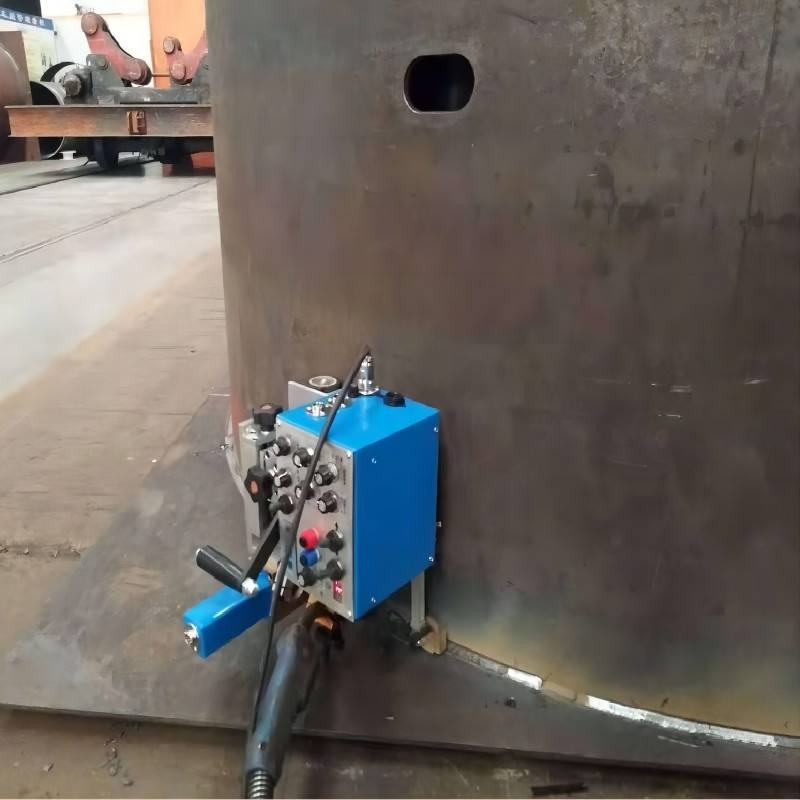
From an engineering perspective, the crawler serves as a mobile tool-carrier that replicates the steady hand of a master welder but with higher duty cycles. The integration of 3D vision allows the crawler to compensate for surface irregularities. As the sensors scan the path ahead, the onboard controller adjusts the drive motors to maintain a constant contact-to-work distance (CTWD). This mechanical stability ensures that the arc remains stable, minimizing spatter and reducing the need for post-weld grinding, which is a significant cost driver in shipyard operations.
Sensor Integration and Surface Mapping
The 3D vision system operates by projecting a structured light pattern or utilizing stereoscopic imaging to generate a point cloud of the fillet joint. This data is processed locally to identify the vertex of the angle where the two plates meet. In shipbuilding automation, this process must be robust enough to handle various surface conditions, including shop primers, light oxidation, and reflections from the metallic surface.
Once the geometry is mapped, the system calculates the optimal torch angle and travel speed. Because the system does not rely on pre-defined paths, it can account for “tack welds” and other obstructions by either stepping over them or adjusting the weave parameters to integrate the tack into the final bead. This level of autonomy is achieved through sophisticated algorithms that prioritize the volumetric center of the joint, ensuring full penetration and a concave or flat profile as required by the engineering specifications.
Field Construction Stability and Environmental Variables
Field construction presents variables that are absent in controlled shop environments. Humidity, ambient temperature fluctuations, and the physical constraints of the tank interior affect both the machinery and the welding process. The 3D vision positioning system must be ruggedized to IP67 standards or higher to withstand the dust and fumes inherent in shipbuilding.
The stability of the magnetic crawler is further enhanced by four-wheel drive systems and independent suspension modules. These features allow the unit to traverse lap joints and slight misalignments in the base plating without losing traction or oscillating the torch. In long-seam fillet welding, such as the attachment of longitudinal stiffeners to the hull plating, the crawler’s ability to maintain a straight line over a twenty-meter span without human intervention significantly reduces the total man-hours per block construction.
Optimization of Weld Parameters through Vision Logic
The data harvested by the 3D vision system does more than just guide the crawler; it informs the welding power source. By measuring the actual gap width in real-time, the system can modulate the wire feed speed and voltage. If the gap widens due to poor fit-up, the vision system signals the controller to slow the travel speed and increase the weave width, ensuring that the weld volume remains consistent.
This “intelligent” approach to fillet welding eliminates common defects such as undercut, lack of fusion, and excessive reinforcement. By maintaining the torch at the perfect bisecting angle of the fillet, the system ensures an even distribution of heat between the web and the flange. This balance is critical in high-tensile steel applications where excessive heat input can lead to a softened heat-affected zone (HAZ), compromising the vessel’s structural longevity.
Operational Throughput and Industrial Impact
Implementing 3D vision-guided crawlers in tank welding produces a measurable increase in kilograms of weld metal deposited per hour. While a manual welder may operate at a 30-40% duty cycle due to fatigue and the need for frequent repositioning in cramped spaces, a magnetic crawler can operate at duty cycles exceeding 80%. This throughput is achieved without compromising quality, as the vision system never suffers from the parallax errors or visual fatigue that affect human operators.
Furthermore, the reduction in rework is the most significant contributor to the return on investment (ROI). In shipbuilding, the cost of gouging out a defective weld and re-welding it is typically five to seven times the cost of the initial weld. By ensuring “first-time-right” deposition through precise positioning and real-time adjustment, shipyards can significantly compress their construction schedules and reduce their overall carbon footprint by minimizing gas and wire wastage.
Conclusion: The Future of Mechanical Guidance in Shipbuilding
The transition toward 3D vision-guided magnetic crawlers represents a pragmatic evolution in maritime engineering. By focusing on the mechanical stability of the crawler and the precision of the positioning sensors, shipyards can achieve levels of quality and efficiency that were previously impossible in field conditions. This technology respects the constraints of the shipyard—confined spaces, variable fit-up, and harsh environments—while providing a scalable solution for the complex task of tank fillet welding. As the industry moves toward more complex vessel designs and tighter tolerances, the role of vision-integrated automation will only become more central to the manufacturing workflow, ensuring that the structural backbone of the global fleet is built to the highest possible standards.
-


Cantilever Welding Robot solution
-


GF laser cutting machine
-

P3015 plasma cutting machine
-

LFP3015 Fiber Laser Cutter
-

pipe plasma cutting machine
-
LFH 4020 Fiber Laser Cutting Machine
-
LFP4020
-

gantry plasma air cutting machine
-

3D robot cutting machine
-

8 axis plasma cutting machine
-

5 axis plasma cutting machine
-

LT360 tube laser cutting machine
-

robot welding workstation
-

SF6060 fiber laser cutting machine
Advanced Fiber Laser Tube Processing Technology
Our CNC Fiber Laser Tube Cutting systems revolutionize metal fabrication by integrating high-precision cutting, punching, and profiling into a single automated workflow. Designed for versatility, this technology handles a wide array of profiles including Round, Square, Rectangular, and Oval tubes, as well as complex L-shaped and U-shaped channels.
- Precision Punching: High-speed hole punching with micron-level accuracy, eliminating the need for mechanical drilling or die-stamping.
- Complex Profiling: Advanced 3D pathing allows for intricate interlocking joints and specialized notch cuts, ideal for structural frames.
- High Material Efficiency: Intelligent nesting software minimizes scrap, reducing raw material costs across large production runs.
- Clean Finish: Delivers oxide-free, burr-free edges that require zero secondary grinding before welding.

Seamlessly processing multiple profiles with consistent precision.
Global Delivery & Logistics



From our high-tech manufacturing facility directly to your global site. PCL WeldCut ensures secure packaging, professional handling, and reliable international logistics to safeguard your equipment throughout the entire journey.