Advancing Tank Fillet Welding through 3D Vision Positioning
In the high-stakes environment of naval architecture and commercial shipbuilding, the integrity of internal tank structures is paramount. The shift toward automated assembly is driven by the need for consistent mechanical properties across thousands of meters of fillet welds. While many workshops rely on stationary gantries, field construction within ship blocks requires a more mobile, adaptive approach. The implementation of 3D Vision Positioning integrated with specialized pipe and profile joining systems has transformed how industrial engineers approach the complexities of internal tank welding.
Tank fillet welding often involves joining curved pipe profiles to flat or slightly curved bulkheads. These joints are notoriously difficult to automate due to the tight clearances and the inherent variability in plate fit-up. Standard automated tractors often fail to compensate for these variances, leading to inconsistent penetration or lack of fusion. By utilizing vision-based topography mapping, the system can identify the exact seam location in three-dimensional space before the arc is struck, ensuring the torch maintains the optimal work angle and lead angle throughout the circumference of the pipe.
Mechanical Stability via Magnetic Crawler Systems
The primary challenge of field construction is maintaining a stable welding platform on vertical or overhead surfaces. Traditional rail systems are time-consuming to install and lack the flexibility needed for the diverse geometry of fuel and ballast tanks. A Magnetic Crawler provides the necessary adhesion force to carry the welding payload—including the wire feeder, vision sensors, and torch—without the risk of slippage. These crawlers utilize high-flux permanent magnets or switchable electromagnets to lock onto the hull plating, providing a rigid datum for the welding process.
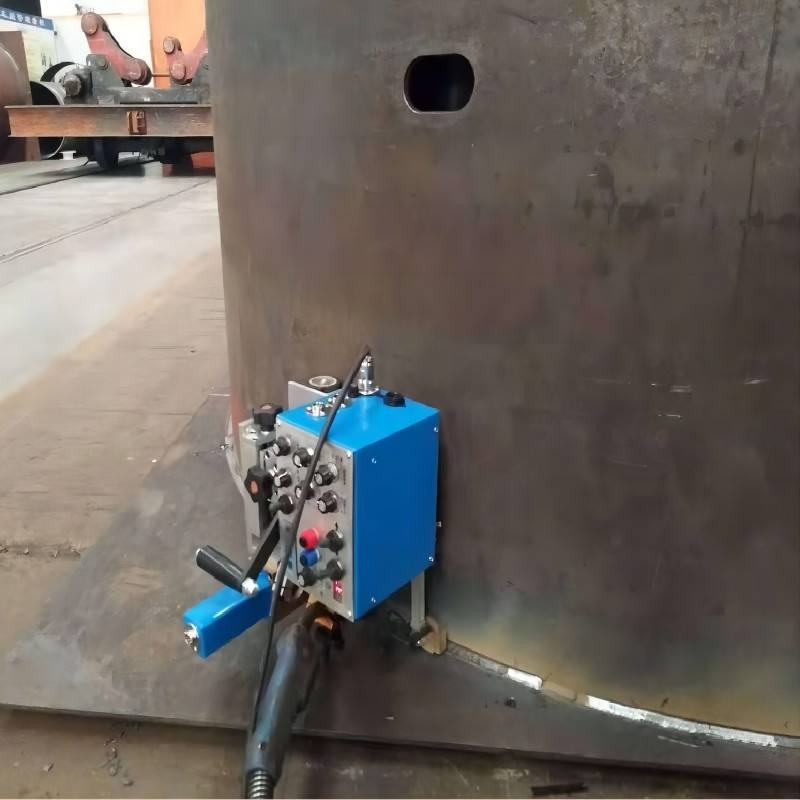
Stability is not merely about staying attached to the wall; it is about dampening vibrations that could interfere with the 3D vision sensors. Industrial engineers specify crawler chassis with low centers of gravity and high-torque stepper motors to ensure smooth, jitter-free movement. This mechanical steadiness allows the vision system to capture high-fidelity point clouds of the joint, which are then processed to calculate the required travel speed and oscillation parameters. In the context of Shipbuilding Automation, the synergy between magnetic adhesion and vision guidance eliminates the need for manual tack-welding of guide tracks.
Vision-Guided Path Correction for Pipe-to-Plate Joints
The core of the 3D vision system lies in its ability to perform real-time path correction. Unlike pre-programmed paths, vision-guided systems scan the groove geometry immediately ahead of the weld pool. This is critical for Tank Fillet Welding because thermal distortion during the welding process can actually move the joint position in real-time. The vision system detects these micro-shifts and adjusts the crawler’s steering and the torch’s cross-slide position simultaneously.
From an engineering perspective, the 3D vision sensor acts as a volumetric measurement tool. It calculates the area of the fillet throat required based on the gap it detects. If the fit-up between the pipe profile and the tank wall is wider than the nominal specification, the system can automatically slow the travel speed or increase the wire feed rate to ensure the weld meets structural classification society standards. This level of autonomy ensures that the weld strength is maintained even when the upstream profile cutting or plate preparation has slight deviations.
Integration with Profile Cutting Data
Efficiency in shipbuilding is gained by connecting the design phase directly to the assembly phase. The geometry of the pipe profile, often cut on advanced CNC pipe machines, is exported as a digital twin. When the magnetic crawler is placed on the tank wall, the 3D vision system correlates the physical pipe it “sees” with the digital model. This alignment process allows for rapid deployment, as the operator does not need to manually teach points to the machine. The system recognizes the start and end points of the fillet, identifies potential obstructions like stiffeners or existing welds, and plans the most efficient path.
Enhancing Productivity in Confined Space Construction
Environmental conditions within ship tanks—such as limited lighting, high humidity, and restricted airflow—make manual welding hazardous and prone to human error. Transitioning to a vision-guided magnetic crawler removes the operator from the immediate vicinity of the welding fumes and intense heat, allowing them to monitor the process via a remote interface. This shift not only improves safety but also significantly increases the duty cycle of the welding equipment.
A manual welder may have a duty cycle of 30-40% due to the need for frequent breaks and repositioning in cramped spaces. In contrast, an automated Magnetic Crawler can maintain an arc-on time of over 70%. The 3D vision system ensures that this increased speed does not come at the cost of quality. By constantly monitoring the bead profile, the system can stop the process if it detects a condition that would lead to a defect, such as excessive undercut or porosity, allowing for immediate rectification rather than costly post-weld repairs.
Operational Parameters and Material Considerations
When deploying these systems, industrial engineers must consider the material properties of the ship’s hull. Most maritime structures utilize high-tensile strength carbon steels, which are ideal for magnetic adhesion. However, the surface condition—ranging from mill scale to shop primer—can affect the friction coefficient of the crawler’s wheels. Advanced vision systems are now capable of filtering out the visual noise caused by reflective primers or surface rust, focusing purely on the geometric intersection of the pipe and the plate.
The control logic of the crawler must also account for the mass of the umbilical cable. In deep tanks, the weight of the power leads and gas hoses can exert a significant pull on the machine. Engineers mitigate this by using tension-sensing algorithms that allow the crawler to compensate its motor torque to maintain a constant velocity. When combined with the 3D vision’s ability to detect the actual travel speed over the surface, the system achieves a level of precision that manual or basic mechanized “tractors” cannot match.
Conclusion on System Implementation
The integration of 3D vision with magnetic crawling technology represents a pragmatic leap forward in shipbuilding. By focusing on the mechanical stability of the crawler and the analytical power of the vision sensor, yards can achieve high-quality tank fillet welds that meet the rigorous standards of international maritime regulators. This approach prioritizes field-ready durability over the complexity of multi-axis robotics, providing a specialized solution for the most challenging aspects of vessel assembly. As ship designs become more complex, the ability to automate the welding of internal profiles with minimal setup time will remain a critical factor in maintaining shipyard throughput and structural reliability.
-


Cantilever Welding Robot solution
-


GF laser cutting machine
-

P3015 plasma cutting machine
-

LFP3015 Fiber Laser Cutter
-

pipe plasma cutting machine
-
LFH 4020 Fiber Laser Cutting Machine
-
LFP4020
-

gantry plasma air cutting machine
-

3D robot cutting machine
-

8 axis plasma cutting machine
-

5 axis plasma cutting machine
-

LT360 tube laser cutting machine
-

robot welding workstation
-

SF6060 fiber laser cutting machine
Advanced Fiber Laser Tube Processing Technology
Our CNC Fiber Laser Tube Cutting systems revolutionize metal fabrication by integrating high-precision cutting, punching, and profiling into a single automated workflow. Designed for versatility, this technology handles a wide array of profiles including Round, Square, Rectangular, and Oval tubes, as well as complex L-shaped and U-shaped channels.
- Precision Punching: High-speed hole punching with micron-level accuracy, eliminating the need for mechanical drilling or die-stamping.
- Complex Profiling: Advanced 3D pathing allows for intricate interlocking joints and specialized notch cuts, ideal for structural frames.
- High Material Efficiency: Intelligent nesting software minimizes scrap, reducing raw material costs across large production runs.
- Clean Finish: Delivers oxide-free, burr-free edges that require zero secondary grinding before welding.

Seamlessly processing multiple profiles with consistent precision.
Global Delivery & Logistics



From our high-tech manufacturing facility directly to your global site. PCL WeldCut ensures secure packaging, professional handling, and reliable international logistics to safeguard your equipment throughout the entire journey.