Optimizing Tank Fillet Welding Through 3D Vision and Mechanized Crawlers
In the sector of heavy construction machinery manufacturing, the structural integrity of pressure vessels, fuel reservoirs, and large-scale hydraulic tanks depends heavily on the quality of fillet welds at pipe-to-shell intersections. Industrial engineering standards demand high repeatability and structural reliability, parameters that are often compromised by manual welding in field conditions. The introduction of 3D vision positioning integrated into magnetic crawler systems represents a significant shift toward mechanized precision, ensuring that weld beads are deposited with exactitude regardless of the surface curvature or environmental instability.
Mechanical Stability in Field Construction
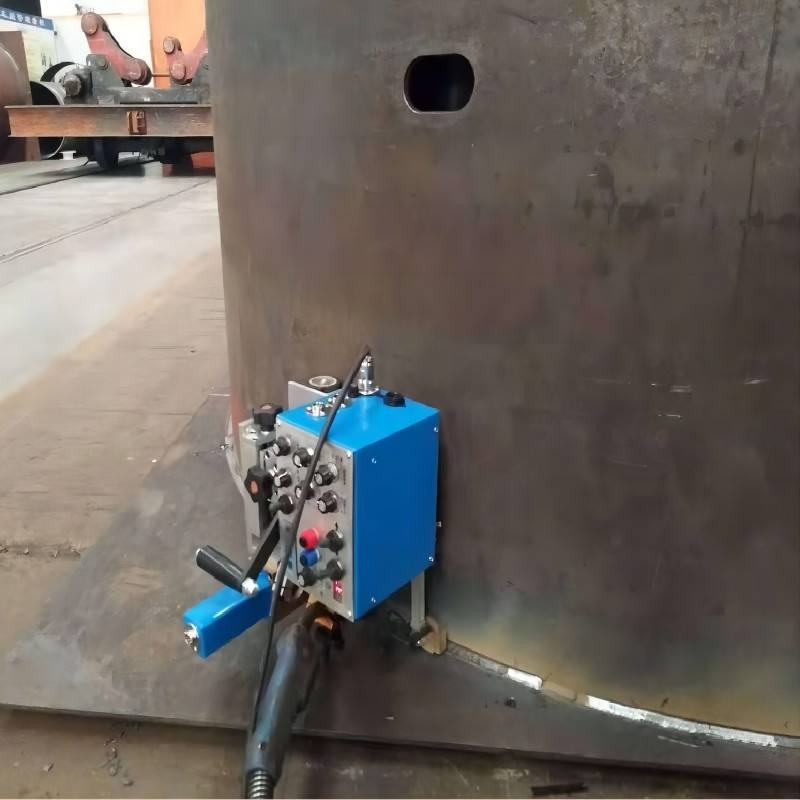
Field construction presents unique challenges, including uneven terrain, wind-induced vibrations, and varying plate thicknesses. Traditional fixed-track systems are often impractical for large-diameter tanks due to the time required for setup and the rigidity of the tracks. The magnetic crawler addresses these issues by utilizing high-flux permanent magnets or switchable electromagnets to adhere directly to the ferromagnetic surface of the tank. This creates a stable platform for the welding torch, maintaining a consistent contact-to-work distance (CTWD) which is critical for arc stability.
Magnetic Adhesion Engineering
The traction force of a magnetic crawler must be calculated to counteract the gravitational pull on the unit and the weight of the wire feeder and torch assembly. For tank fillet welding, the crawler must navigate vertical and overhead positions. Industrial engineers prioritize the ratio of magnetic pull-off force to the total weight of the system, typically targeting a safety factor of 3:1. This ensures that even in the presence of surface scale or rust, the machine maintains its trajectory without slipping, which would otherwise result in weld defects like porosity or lack of fusion.
3D Vision Positioning Systems for Profile Mapping
Unlike basic sensors that only detect a single point of contact, 3D vision systems utilize stereoscopic or structured light patterns to map the entire geometry of the fillet joint in real-time. In the context of tank fillet welding, this allows the machine to identify the exact root of the joint where the pipe profile meets the tank wall. The vision system captures a three-dimensional cloud of data points, which the onboard controller processes to adjust the torch angle and travel speed dynamically.
Real-Time Path Correction
During the welding process, thermal expansion can cause the metal plates to shift or warp slightly. A 3D vision system identifies these deviations as they occur. By comparing the live surface profile against the pre-programmed welding path, the system applies micro-adjustments to the torch’s cross-slide mechanism. This capability is essential for maintaining the “leg length” of the fillet weld according to engineering specifications, ensuring that the weld throat is sufficient to handle the mechanical stresses encountered during construction machinery operation.
Operational Efficiency and Throughput
From an industrial engineering perspective, the primary metric for success is the deposition rate relative to the cycle time. Manual welding of large tank profiles requires frequent stops for the operator to reposition themselves or the equipment. A mechanized crawler capable of continuous travel around the pipe circumference significantly reduces the number of weld starts and stops. Since most weld defects occur at the start or end of a bead, minimizing these interruptions directly correlates with a lower rework rate and higher throughput.
Reduction in Non-Value-Added Time
The setup time for a vision-guided magnetic system is considerably lower than that of manual rigging or bulky gantry systems. Because the crawler is portable and adheres directly to the workpiece, the need for complex jigs and fixtures is minimized. This “lean” approach to field welding allows for a more flexible production schedule, as the field construction stability of the unit allows it to operate in conditions where manual welders might struggle with ergonomics or safety hazards.
Technical Specifications for Torch Trajectory
Fillet welding on curved surfaces requires precise control over the torch’s “work angle” and “travel angle.” When a pipe intersects a tank at an angle, the groove geometry changes constantly along the path. The 3D vision system calculates the bisector of the angle between the two surfaces at every millisecond of the operation. The mechanical arm of the crawler then orients the torch to maintain a consistent 45-degree angle (or specified custom angle) relative to the root. This prevents “undercut” on the tank wall and “overlap” on the pipe, ensuring a smooth transition and optimal stress distribution.
Integration with Flux-Cored and Solid Wire Processes
While the positioning system handles the spatial orientation, the industrial engineer must also synchronize the wire feed speed and voltage. The data from the 3D vision system can be used to adjust heat input. For instance, if the vision system detects a slightly wider gap in the fit-up, it can signal the power source to adjust the oscillation width of the torch or slow the travel speed to ensure full penetration. This level of process integration is what separates mechanized 3D-guided systems from simple motorized carriages.
Durability and Maintenance in Harsh Environments
Construction machinery is often fabricated in environments exposed to dust, moisture, and extreme temperatures. The 3D vision components are typically housed in ruggedized, IP65-rated enclosures with pressurized air curtains to keep the optics clear of welding fumes and spatter. The magnetic drive train is designed with high-torque brushless DC motors that provide consistent motion even at low speeds. Regular maintenance involves checking the magnetic rollers for metallic debris and calibrating the vision sensors against a known reference block to ensure field construction stability remains within the required +/- 0.5mm tolerance.
Conclusion for Industrial Implementation
The deployment of a pipe profile cutting and welding system utilizing 3D vision and magnetic crawlers offers a robust solution for the heavy machinery industry. By focusing on the mechanics of adhesion and the precision of spatial mapping, manufacturers can bypass the limitations of manual labor. This approach not only improves the structural integrity of the tanks but also optimizes the entire fabrication workflow, providing a measurable return on investment through reduced material waste and accelerated production timelines. The synergy of these technologies ensures that the final product meets the rigorous safety and performance standards demanded by modern construction applications.
-


Cantilever Welding Robot solution
-


GF laser cutting machine
-

P3015 plasma cutting machine
-

LFP3015 Fiber Laser Cutter
-

pipe plasma cutting machine
-
LFH 4020 Fiber Laser Cutting Machine
-
LFP4020
-

gantry plasma air cutting machine
-

3D robot cutting machine
-

8 axis plasma cutting machine
-

5 axis plasma cutting machine
-

LT360 tube laser cutting machine
-

robot welding workstation
-

SF6060 fiber laser cutting machine
Advanced Fiber Laser Tube Processing Technology
Our CNC Fiber Laser Tube Cutting systems revolutionize metal fabrication by integrating high-precision cutting, punching, and profiling into a single automated workflow. Designed for versatility, this technology handles a wide array of profiles including Round, Square, Rectangular, and Oval tubes, as well as complex L-shaped and U-shaped channels.
- Precision Punching: High-speed hole punching with micron-level accuracy, eliminating the need for mechanical drilling or die-stamping.
- Complex Profiling: Advanced 3D pathing allows for intricate interlocking joints and specialized notch cuts, ideal for structural frames.
- High Material Efficiency: Intelligent nesting software minimizes scrap, reducing raw material costs across large production runs.
- Clean Finish: Delivers oxide-free, burr-free edges that require zero secondary grinding before welding.

Seamlessly processing multiple profiles with consistent precision.
Global Delivery & Logistics



From our high-tech manufacturing facility directly to your global site. PCL WeldCut ensures secure packaging, professional handling, and reliable international logistics to safeguard your equipment throughout the entire journey.