Industrial Integration of 3D Vision in Heavy-Duty Tank Fabrication
In the sector of heavy construction machinery, the structural integrity of fluid storage and pressurized tanks is non-negotiable. The manufacturing process necessitates a transition from manual oversight to high-precision automated systems that can handle large-scale components. The application of a pipe profile cutting and welding system utilizing 3D vision positioning offers a robust solution for achieving consistent tank Fillet Welding results. Unlike traditional methods that rely on fixed jigs, 3D vision allows the system to adapt to the inherent irregularities of large-diameter pipes and plate surfaces common in field construction.
The core of this technology lies in its ability to map the physical workspace in real-time. By generating a point cloud of the joint geometry, the system compensates for fit-up gaps and deviations in pipe roundness. This is particularly critical when dealing with heavy-walled sections where thermal expansion and material handling can introduce significant tolerances. The industrial engineering focus here is on reducing the rework rate and ensuring that the fillet profile meets strict ISO and AWS standards for penetration and throat thickness.
Mechanical Stability through Magnetic Crawler Systems
Field Construction Challenges and Solutions
Field construction presents environmental variables that factory-based systems rarely encounter. Wind, uneven surfaces, and massive component weights require a delivery system that maintains constant contact with the workpiece. The magnetic crawler provides the necessary traction and stability for these environments. By utilizing high-flux permanent magnets or switchable electromagnets, the crawler adheres to the ferrous surfaces of the tank, allowing for vertical and overhead welding positions without the need for expensive scaffolding or specialized rigging.
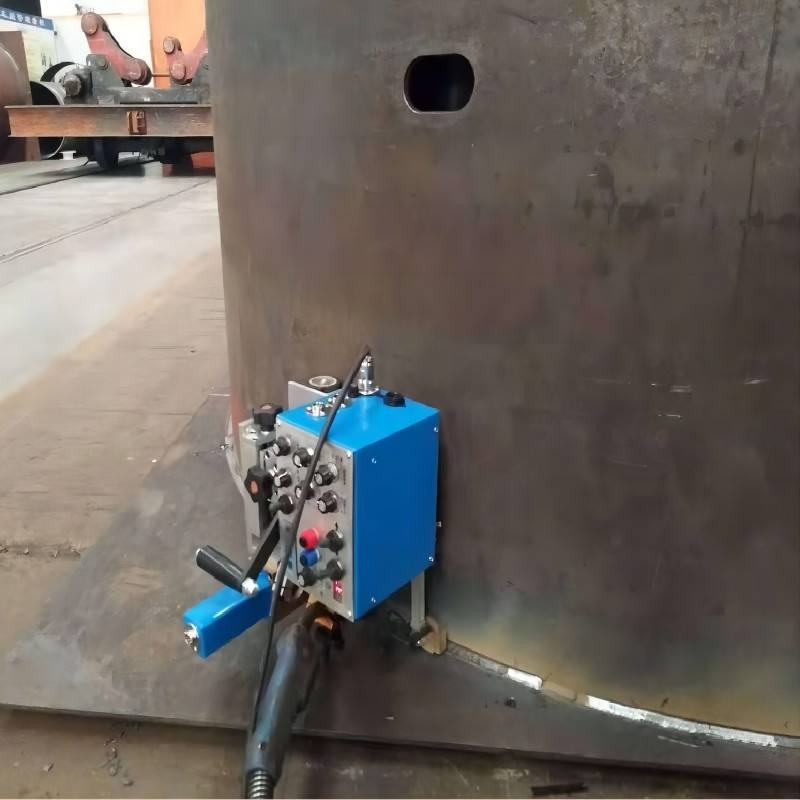
From an efficiency standpoint, the magnetic crawler serves as a mobile platform for the oxy-fuel cutting torch and the welding head. This mobility is synchronized with the 3D vision system. As the crawler moves along the circumference or the longitudinal seam of a tank, the vision sensors continuously update the pathing data. This ensures that the cutting or welding tip remains at the optimal standoff distance and angle, regardless of the surface curvature. The stability provided by the crawler eliminates the vibrations typically associated with lightweight portable tracks, resulting in a cleaner cut and a more uniform weld bead.
Oxy-Fuel Profiling and Fillet Preparation
Thermal Cutting Efficiency in Construction Machinery
While modern manufacturing often leans toward high-energy beam technologies, the heavy construction machinery industry continues to rely on oxy-fuel for its reliability and penetration depth in thick materials. For tank fillet welding, the preparation of the pipe profile is the most labor-intensive phase. Using 3D vision to guide an oxy-fuel torch allows for complex saddle cuts and hole-opening profiles that are perfectly matched to the mating surface of the tank shell.
The 3D vision system identifies the exact contour of the tank’s outer diameter. It then calculates the necessary bevel angles for the pipe profile to ensure a consistent root gap for the subsequent fillet weld. This level of precision is vital for heavy machinery, where dynamic loads demand maximum structural fatigue resistance. By automating the oxy-fuel profile cutting with vision-guided pathing, engineers can achieve a “fit-and-weld” workflow, drastically reducing the time spent on manual grinding and gap filling.
Operational Parameters of 3D Vision Positioning
Spatial Mapping and Point Cloud Processing
The 3D vision sensor operates by projecting a structured light pattern or utilizing stereoscopic cameras to capture the topography of the weld joint. In the context of field construction stability, the software must filter out ambient light interference and surface reflections from raw steel. The industrial engineer configures the system to recognize specific geometric features, such as the intersection between a nozzle and a tank wall. Once the feature is identified, the system aligns the mechanical axes of the crawler to the theoretical path calculated from the CAD model, adjusted for real-world positioning.
Real-Time Seam Tracking and Correction
During the welding process, the 3D vision system performs real-time seam tracking. This is not merely about following a line; it involves monitoring the weld pool’s relationship to the joint sidewalls. If the magnetic crawler encounters a minor obstruction or surface slip, the vision system detects the deviation in the torch’s position relative to the groove. Immediate corrections are sent to the motorized slides, maintaining the arc’s center within a fraction of a millimeter. This closed-loop feedback is essential for maintaining the integrity of the fillet weld, particularly in multi-pass applications where the geometry changes with each layer of deposited metal.
Maximizing Throughput in Large-Scale Tank Production
Workflow Optimization and Labor Reduction
The implementation of vision-guided magnetic crawlers redefines the labor requirements for tank fabrication. Traditionally, a team of fitters and welders would spend days marking, cutting, and tacking pipe segments onto tank shells. With 3D vision positioning, the system handles the layout and the execution of the profile cut in a single setup. The magnetic crawler is placed on the tank, the vision system scans the area, and the machine executes the cut. The same platform can then be switched to welding mode to complete the fillet joinery.
This consolidation of tasks reduces the physical footprint of the equipment and the number of material handling steps. In an industrial environment, every time a massive tank is moved or rotated, risk increases and time is lost. By bringing the machine to the workpiece via the crawler, the “station-to-station” movement is minimized. The 3D vision ensures that even if the tank is not perfectly leveled on the shop floor or the field site, the machine adapts its coordinate system to the actual orientation of the vessel.
Quality Assurance and Digital Traceability
One of the secondary benefits of using 3D vision in construction machinery fabrication is the creation of a digital record. As the system scans the profile and monitors the weld, it logs data regarding the joint geometry and the welding parameters. This data provides 100% traceability for every tank fillet welding operation. If a structural failure occurs in the field, engineers can revisit the digital twin of that specific weld to analyze the fit-up conditions and the execution parameters. This level of accountability is increasingly required by regulatory bodies and clients in the infrastructure and energy sectors.
Conclusion on System Stability and Mechanical Integrity
Final Assessment of Combined Technologies
The synergy between 3D vision positioning, magnetic crawler mobility, and oxy-fuel thermal cutting represents the pinnacle of practical industrial engineering for the construction machinery sector. By focusing on mechanical stability and real-time adaptation, manufacturers bypass the limitations of stationary automation. The result is a robust, field-capable solution that ensures the highest quality fillet welds on complex tank structures. The reliance on vision-based corrections rather than rigid mechanical fixtures allows for a flexible manufacturing approach that can accommodate the varied and often unpredictable demands of large-scale industrial fabrication.
Ultimately, the goal of integrating these technologies is to achieve a balance between speed and precision. The 3D vision system provides the “intelligence,” while the magnetic crawler provides the “muscle,” and the oxy-fuel process provides the “capability” to handle heavy-section steel. Together, they form a cohesive unit that addresses the specific challenges of tank construction, ensuring that every pipe profile and fillet weld contributes to the long-term durability of the machinery.
-
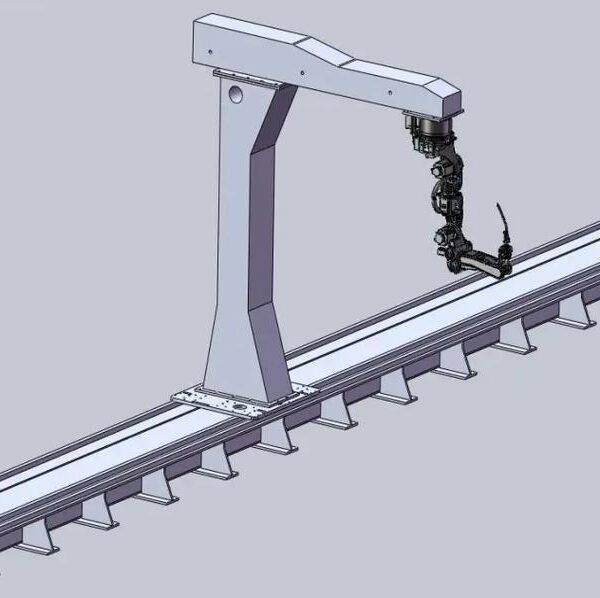

Cantilever Welding Robot solution
-
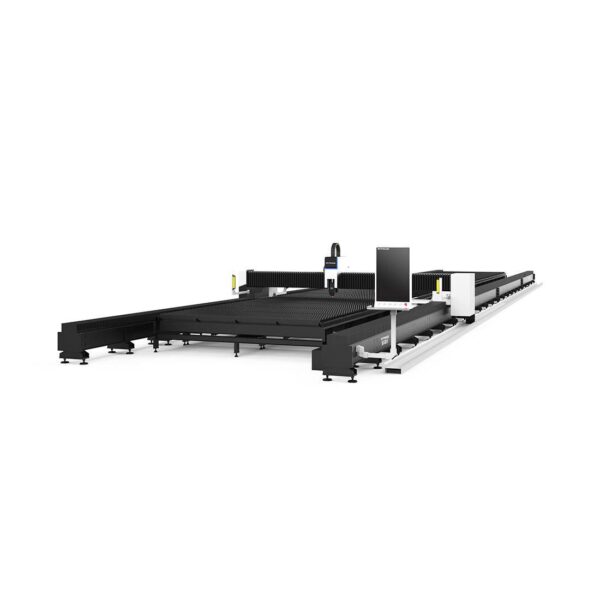

GF laser cutting machine
-
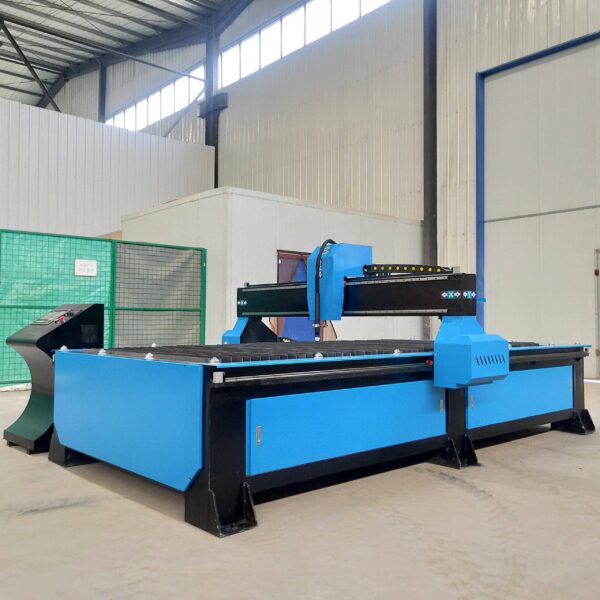
P3015 plasma cutting machine
-

LFP3015 Fiber Laser Cutter
-

pipe plasma cutting machine
-
LFH 4020 Fiber Laser Cutting Machine
-
LFP4020
-
gantry plasma air cutting machine
-
3D robot cutting machine
-
8 axis plasma cutting machine
-
5 axis plasma cutting machine
-

LT360 tube laser cutting machine
-
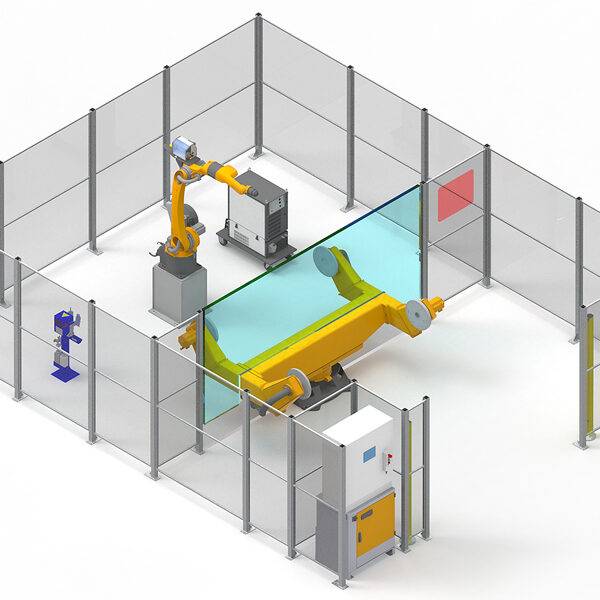
robot welding workstation
-
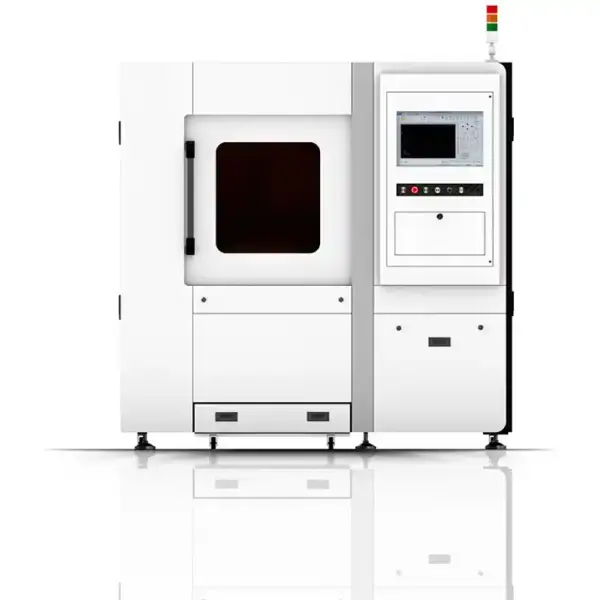
SF6060 fiber laser cutting machine
Advanced Fiber Laser Tube Processing Technology
Our CNC Fiber Laser Tube Cutting systems revolutionize metal fabrication by integrating high-precision cutting, punching, and profiling into a single automated workflow. Designed for versatility, this technology handles a wide array of profiles including Round, Square, Rectangular, and Oval tubes, as well as complex L-shaped and U-shaped channels.
- Precision Punching: High-speed hole punching with micron-level accuracy, eliminating the need for mechanical drilling or die-stamping.
- Complex Profiling: Advanced 3D pathing allows for intricate interlocking joints and specialized notch cuts, ideal for structural frames.
- High Material Efficiency: Intelligent nesting software minimizes scrap, reducing raw material costs across large production runs.
- Clean Finish: Delivers oxide-free, burr-free edges that require zero secondary grinding before welding.

Seamlessly processing multiple profiles with consistent precision.
Global Delivery & Logistics



From our high-tech manufacturing facility directly to your global site. PCL WeldCut ensures secure packaging, professional handling, and reliable international logistics to safeguard your equipment throughout the entire journey.