Mechanical Optimization of Tank Fillet Welding via Magnetic Crawlers
In the domain of heavy industrial fabrication, specifically within the construction of bridge trusses and large-scale storage tanks, the integrity of the fillet weld is a primary factor in structural longevity. Industrial engineers are increasingly moving away from manual welding processes in favor of semi-automated magnetic crawler technology. These systems are designed to navigate the massive vertical and horizontal planes of steel structures, providing a level of consistency that manual operators cannot sustain over long shifts. The core objective is to manage the heat input and bead geometry with mathematical precision, ensuring that the fillet weld meets stringent AWS or ISO standards without the variability introduced by human fatigue.
The transition to fillet welding automation is driven by the need for higher deposition rates and reduced repair cycles. In field construction, the environment is rarely controlled. Wind, humidity, and temperature fluctuations affect the arc stability and the cooling rate of the weld pool. A magnetic crawler provides a rigid platform that maintains a constant torch-to-workpiece distance, which is critical for maintaining voltage stability. By utilizing a heavy-duty carriage equipped with permanent magnets or electromagnets, the system achieves a grip force capable of supporting the welding torch, lead cables, and integrated vision sensors even on vertical surfaces.
Structural Stability and Magnetic Adhesion Mechanics
The primary challenge in field welding for Bridge Trusses is the orientation of the joints. Fillet welds in these environments often require the carriage to operate in the 2F (horizontal) or 3F (vertical) positions. The mechanical design of the crawler must account for the center of gravity to prevent “crabbing” or slipping. High-traction wheels, often coated with specialized heat-resistant polymers, work in tandem with the magnetic base to provide uniform motion. This field construction stability is what allows for a smooth, ripple-free weld bead that requires minimal post-weld grinding.
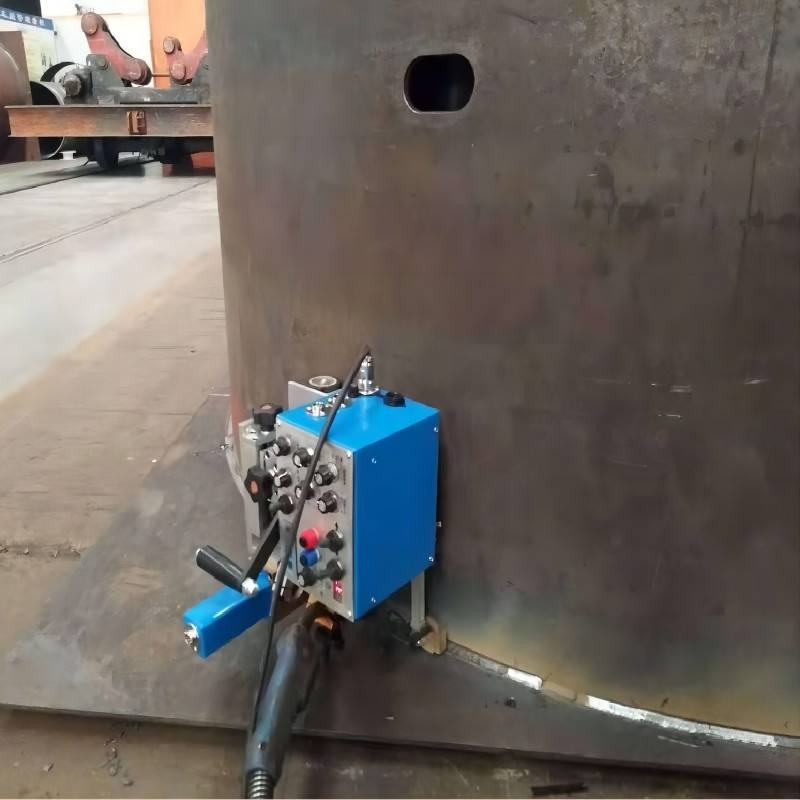
From an engineering perspective, the traction force must exceed the combined weight of the unit and the drag force of the umbilical cables by a factor of at least 3:1. This safety margin ensures that even if the surface has minor scale or rust, the crawler maintains its trajectory. The drive system typically employs high-torque DC motors with planetary gearboxes to ensure slow, steady travel speeds ranging from 100mm to 1000mm per minute, depending on the plate thickness and the required throat size of the fillet.
3D Vision Integration for Path Correction
While the crawler provides the motion, 3D vision systems provide the intelligence for positioning. In bridge truss fabrication, the fit-up of large plates is rarely perfect. Gaps can vary, and the joint line may shift due to thermal expansion during the welding process. The 3D vision system scans the joint geometry ahead of the arc, identifying the exact root of the fillet. This data is fed back to a cross-slide actuator that adjusts the torch position in real-time. This mechanical weld tracking ensures that the arc remains centered in the joint, preventing undercut or lack of fusion.
This vision-guided approach is superior to tactile probes, which can become jammed by weld spatter or surface irregularities. The sensors map the topographical profile of the joint, allowing the system to adjust travel speed or oscillation width to compensate for varying gap widths. This ensures that the weld volume remains constant, satisfying the engineering requirements for load-bearing bridge components without over-welding, which would lead to unnecessary distortion and increased consumable costs.
Operational Efficiency and Heat Input Management
Managing the Heat Affected Zone (HAZ) is a critical requirement for bridge trusses, where the metallurgical properties of the steel must be preserved to handle cyclic loading. Automated crawlers allow for precise control over the heat input (kJ/mm). By maintaining a consistent travel speed and wire feed rate, the crawler ensures that the energy distribution is uniform throughout the length of the weld. This uniformity reduces the risk of hydrogen-induced cracking and ensures that the grain structure of the base metal remains within the specified limits.
In tank construction, where long circumferential or vertical fillet welds are required, the duty cycle of the welding process becomes the bottleneck. Manual welding requires frequent stops to reposition the welder, leading to numerous “start-stop” points which are the most common locations for weld defects. A magnetic crawler can operate continuously for the entire length of a plate, significantly reducing the number of tie-ins and improving the overall leak-tight integrity of the vessel.
Throughput Analysis and Field ROI
From a project management standpoint, the deployment of crawler systems translates to a measurable increase in linear meters welded per shift. While the initial setup time for an automated carriage is longer than that of a manual welder, the “arc-on” time is vastly superior. In a typical 8-hour shift, a manual welder may have an arc-on time of 30-40%, whereas a magnetic crawler can achieve 70-80%. This doubling of productivity is essential for meeting tight deadlines in infrastructure projects.
Furthermore, the reduction in rework is a major cost saver. In bridge construction, the cost of gouging out and repairing a defective fillet weld can be ten times the cost of the initial weld. By utilizing 3D vision for precise positioning and the mechanical stability of a crawler, the first-pass acceptance rate typically exceeds 98%. This reliability simplifies the quality assurance (QA) process, allowing NDT (non-destructive testing) technicians to move through the project more efficiently.
Maintenance of Automated Field Systems
To ensure long-term reliability in the field, the maintenance of these crawlers must be proactive. The magnetic wheels must be cleaned of metallic dust and spatter daily to prevent loss of adhesion. The drive chains and gear assemblies require lubrication that can withstand the high temperatures radiated from the preheated steel plates. Additionally, the 3D vision lenses must be protected by sacrificial clear shields or air-knives to prevent fogging or damage from the intense UV radiation and fumes generated during the welding process.
Conclusion on Technical Implementation
The application of magnetic crawler systems for tank fillet welding represents a peak efficiency model for modern industrial engineering. By focusing on the mechanical synergy between magnetic adhesion and vision-guided path correction, contractors can deliver bridge trusses and storage tanks that meet the highest safety standards. The elimination of manual variance through automation ensures that the structural integrity of our infrastructure is built on a foundation of repeatable, high-quality fabrication. The future of field construction lies not in manual labor, but in the intelligent application of specialized mechanical systems designed to conquer the challenges of large-scale steel assembly.
-


Cantilever Welding Robot solution
-


GF laser cutting machine
-

P3015 plasma cutting machine
-

LFP3015 Fiber Laser Cutter
-

pipe plasma cutting machine
-
LFH 4020 Fiber Laser Cutting Machine
-
LFP4020
-

gantry plasma air cutting machine
-

3D robot cutting machine
-

8 axis plasma cutting machine
-

5 axis plasma cutting machine
-

LT360 tube laser cutting machine
-

robot welding workstation
-

SF6060 fiber laser cutting machine
Advanced Fiber Laser Tube Processing Technology
Our CNC Fiber Laser Tube Cutting systems revolutionize metal fabrication by integrating high-precision cutting, punching, and profiling into a single automated workflow. Designed for versatility, this technology handles a wide array of profiles including Round, Square, Rectangular, and Oval tubes, as well as complex L-shaped and U-shaped channels.
- Precision Punching: High-speed hole punching with micron-level accuracy, eliminating the need for mechanical drilling or die-stamping.
- Complex Profiling: Advanced 3D pathing allows for intricate interlocking joints and specialized notch cuts, ideal for structural frames.
- High Material Efficiency: Intelligent nesting software minimizes scrap, reducing raw material costs across large production runs.
- Clean Finish: Delivers oxide-free, burr-free edges that require zero secondary grinding before welding.

Seamlessly processing multiple profiles with consistent precision.
Global Delivery & Logistics



From our high-tech manufacturing facility directly to your global site. PCL WeldCut ensures secure packaging, professional handling, and reliable international logistics to safeguard your equipment throughout the entire journey.