Optimizing Heavy Structural Fabrication for Construction Machinery
In the manufacture of heavy construction machinery, such as excavator chassis, crane booms, and large-scale loaders, the structural integrity of H-beams is paramount. These components must withstand extreme cyclic loading and high-stress environments. To achieve this, modern production lines have shifted toward narrow gap welding techniques, which significantly reduce the volume of filler metal required and minimize the Heat Affected Zone (HAZ). However, the success of narrow gap welding is entirely dependent on the precision of the initial material preparation. Specifically, the Plasma Cutting stage must deliver unparalleled accuracy in edge geometry and intersection fit-up.
The Criticality of Intersection Accuracy in H-Beam Production
Narrow gap welding requires a highly consistent groove width, often with tolerances measured in fractions of a millimeter. In a traditional H-beam configuration, the web must interface with the flange with absolute precision. High-definition plasma cutting systems utilize advanced CNC algorithms to manage intersection accuracy, ensuring that when the web and flange are positioned, the resulting joint is uniform throughout the entire length of the beam. Any deviation in the cut leads to gaps that exceed the capabilities of narrow gap automation, resulting in burn-through or lack of fusion.
Industrial engineers prioritize plasma systems that incorporate real-time kerf compensation and torch height control (THC). By maintaining a constant distance between the plasma nozzle and the workpiece, the system compensates for any inherent plate waviness. This stability is vital for maintaining the perpendicularity of the cut, which directly influences the fit-up quality at the beam’s intersections. For heavy-duty construction machinery, where beam lengths can exceed 12 meters, maintaining this level of accuracy over a long travel distance is a primary engineering challenge.
High-Definition Plasma Beveling for Narrow Gap Preparation
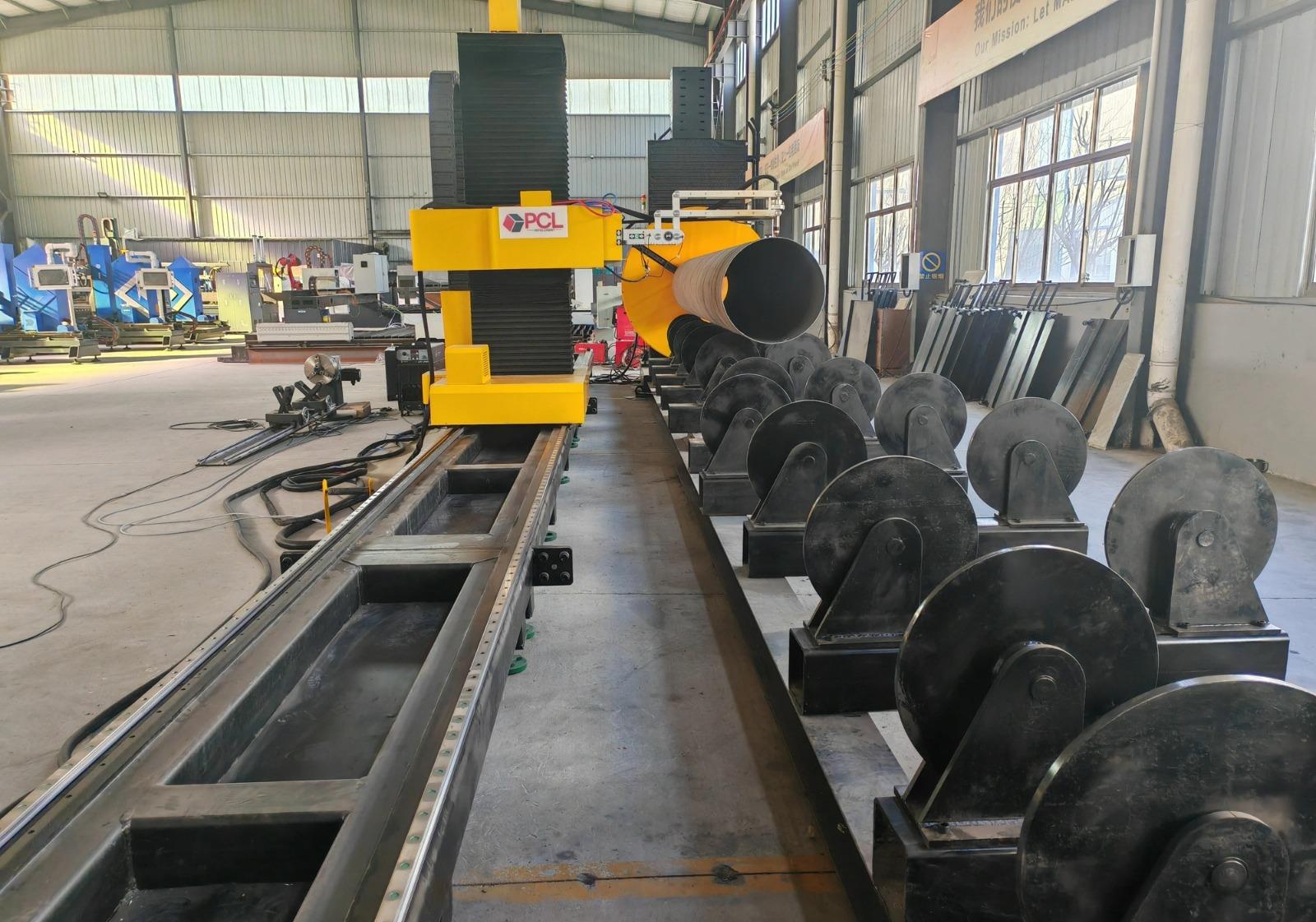
The transition from standard V-grooves to narrow gap geometries requires specialized beveling capabilities. Modern H-Beam Production Lines utilize 5-axis plasma heads capable of complex rotations and tilts. This allows for the creation of precise “J” or deep “V” grooves that are characteristic of narrow gap weld prep. Unlike traditional cutting, which may only require a straight 90-degree edge, beveling for construction machinery components involves varying angles to accommodate the dynamic stress distribution points of the final assembly.
The plasma arc’s energy density is focused through specialized nozzle designs to produce a narrow kerf. This focus allows the system to execute bevels with minimal dross and smooth surface finishes. A smooth surface is non-negotiable for narrow gap welding; any irregularities on the beveled face can trap slag or lead to porosity when the automated welding head passes through the deep, narrow channel. By achieving a high-quality surface finish during the plasma cutting phase, manufacturers eliminate the need for secondary grinding operations, thereby increasing the overall cycle efficiency of the production line.
Mechanical Design and Low Maintenance Requirements
In high-volume H-beam production, downtime is the most significant cost driver. Industrial engineers look for plasma systems that offer H-beam low maintenance characteristics. This is achieved through several robust design features. First, the use of heavy-duty, machined rack-and-pinion drives ensures that the gantry remains stable and accurate over years of operation in dusty fabrication environments. Shielding the linear guides and critical electronic components from metallic dust and plasma overspray is essential for longevity.
Furthermore, the evolution of plasma consumables has dramatically reduced the frequency of maintenance interventions. Long-life electrode technology and silver-contact nozzles extend the operational window between part changes. In the context of H-beam production, where the cutting torch may be active for multiple shifts daily, these advancements translate to a significant reduction in total cost of ownership. Automated gas consoles also play a role in maintenance; by precisely controlling the flow of oxygen, nitrogen, or H35 (argon-hydrogen) based on material thickness, the system prevents premature wear of the torch components.
Integration of CNC Control and Material Handling
A high-performance plasma cutting station within an H-beam line is only as effective as the material handling system that supports it. Automated conveyors and hydraulic clamping systems must synchronize with the plasma gantry to ensure the beam is perfectly squared before cutting begins. The CNC controller acts as the brain of the operation, often integrating with CAD/CAM software that specializes in structural steel. This integration allows for the nesting of parts and the pre-calculation of lead-ins and lead-outs to avoid thermal distortion at the start and end of the cut.
For construction machinery, where material thicknesses can vary significantly between the web and the flange, the plasma cutting system must be capable of dynamic parameter switching. The ability to adjust amperage and gas pressures on-the-fly ensures that both thin-gauge webs and thick-walled flanges are cut with the same degree of accuracy. This flexibility is what allows a single production line to handle various H-beam sizes for different machinery models without extensive retooling or manual setup changes.
Thermal Management and Distortion Control
One of the primary concerns when cutting heavy structural H-beams is the management of thermal expansion. Large amounts of heat are injected into the steel during the plasma process. To maintain intersection accuracy, engineers employ specific cutting sequences that distribute the heat load evenly across the workpiece. By strategically skipping sections or using water-table technology to dissipate heat, the system prevents the “bowing” effect that can ruin a 12-meter beam. This thermal management is critical because a distorted beam cannot be successfully processed by a narrow gap welding station, which relies on a straight and predictable weld path.
Economic Implications of Precision Plasma in Fabrication
The shift toward high-precision plasma cutting in H-beam production lines offers a compelling ROI for construction machinery manufacturers. By increasing the accuracy of the bevel and the intersection, the volume of weld metal is reduced by up to 40% compared to traditional wide-groove methods. This not only saves on material costs but also reduces the energy consumption and time associated with multi-pass welding. The H-beam low maintenance design further ensures that the line operates at peak capacity, meeting the rigorous delivery schedules of the global construction market.
In conclusion, the synergy between high-definition plasma cutting and narrow gap welding represents the pinnacle of modern structural engineering for heavy machinery. By focusing on intersection accuracy and robust mechanical design, manufacturers can produce H-beams that meet the highest standards of structural integrity while maintaining a highly efficient and low-maintenance production environment.
-


LT240S tube laser cutting machine
-
LT120S tube laser cutting machine
-
Sale

Tank Fillet Welding Machine
Original price was: $1,000.00.$900.00Current price is: $900.00. -
Sale

MAK100 tube laser cutting machine
Original price was: $5,500.00.$5,000.00Current price is: $5,000.00. -

portable plasma air cutting machine
$1,200.00 -

2in1 fiber laser cutting machine
-

Air cooling Laser welding machine
-

HF h beam laser cutting machine
-

LT240 laser cutting machine
-

Laser welding machine
-


Cobot Welding Station
-

Gantry welding robot solution
-

Tracked Wheeled AGV Welding robot
-

LFH6020 Fiber laser cutting machine
-
LFP6020
-

robotic welidng machine
Advanced Fiber Laser Tube Processing Technology
Our CNC Fiber Laser Tube Cutting systems revolutionize metal fabrication by integrating high-precision cutting, punching, and profiling into a single automated workflow. Designed for versatility, this technology handles a wide array of profiles including Round, Square, Rectangular, and Oval tubes, as well as complex L-shaped and U-shaped channels.
- Precision Punching: High-speed hole punching with micron-level accuracy, eliminating the need for mechanical drilling or die-stamping.
- Complex Profiling: Advanced 3D pathing allows for intricate interlocking joints and specialized notch cuts, ideal for structural frames.
- High Material Efficiency: Intelligent nesting software minimizes scrap, reducing raw material costs across large production runs.
- Clean Finish: Delivers oxide-free, burr-free edges that require zero secondary grinding before welding.

Seamlessly processing multiple profiles with consistent precision.
Global Delivery & Logistics



From our high-tech manufacturing facility directly to your global site. PCL WeldCut ensures secure packaging, professional handling, and reliable international logistics to safeguard your equipment throughout the entire journey.