Engineering Precision in Wind Tower H-Beam Fabrication
The fabrication of wind tower internal structures—specifically platforms, ladders, and secondary supports—demands rigorous adherence to geometric tolerances. Unlike standard structural steel applications, wind tower internals must interface with the curved inner diameter of the tower shell. This requires H-beams to be processed with extreme intersection accuracy to ensure that every contact point aligns perfectly with the radius of the section.
Industrial engineers are increasingly moving toward automated Plasma Cutting lines equipped with sophisticated Arc Voltage Control (AVC). This technology is not merely a height adjustment tool; it is the primary mechanism for maintaining thermal stability and cut quality across varying material thicknesses and flange-to-web transitions. In the context of H-beam processing, where the torch must navigate the complex geometry of flanges and webs, AVC ensures that the plasma arc remains at the optimal standoff distance to prevent kerf deviation and dross accumulation.
The Mechanics of Arc Voltage Control (AVC)
Arc Voltage Control operates on the principle of a closed-loop feedback system. During the plasma cutting process, the voltage between the torch electrode and the workpiece is directly proportional to the distance between them. As the H-beam moves through the production line, any slight bowing in the material or mechanical vibration can alter this distance.
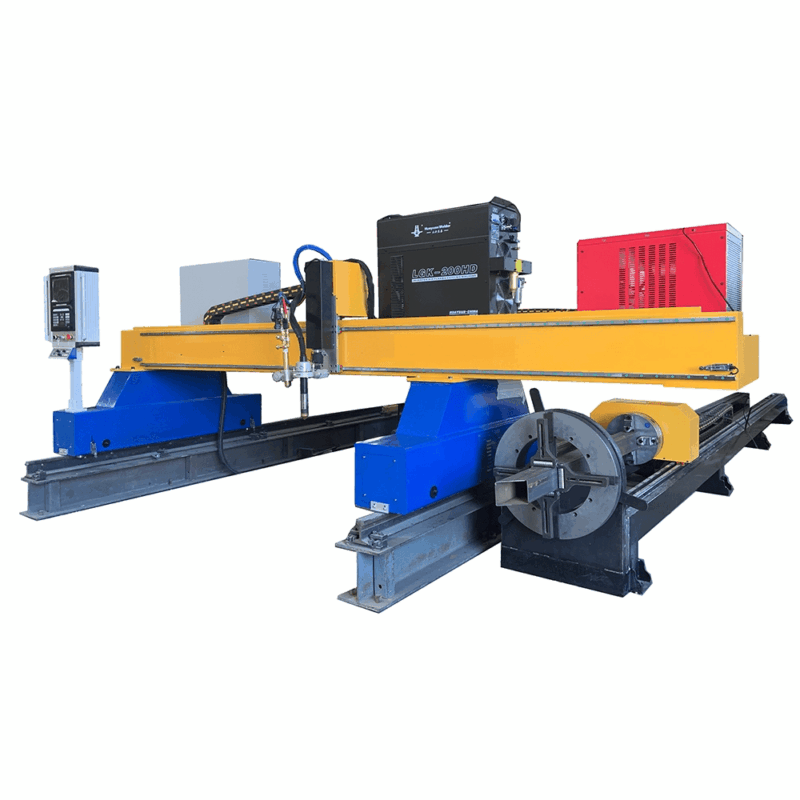
The AVC system monitors the arc voltage height control parameters in real-time, adjusting the Z-axis motor to raise or lower the torch. For wind tower components, this is critical. If the torch is too high, the arc spreads, leading to a wider kerf and rounded top edges. If it is too low, the risk of torch collision and nozzle damage increases. By maintaining a constant voltage, the system guarantees a uniform energy density, which translates to a consistent heat-affected zone (HAZ) and superior edge finish.
Achieving Intersection Accuracy in Complex Geometries
The primary challenge in H-beam processing for wind towers is the intersection between the beam end and the tower’s cylindrical wall. These cuts are rarely 90-degree profiles; they often involve complex saddle cuts or specialized coping.
Geometric Compensation and Software Integration
Modern plasma lines utilize 5-axis or 6-axis robotic heads governed by CNC software that calculates the intersection profile. However, mechanical precision alone is insufficient if the thermal process is unstable. The integration of AVC allows the software to execute these complex paths without manual intervention. By stabilizing the arc, the system ensures that the calculated path matches the actual cut, maintaining the intersection accuracy required for seamless fit-up against the curved shell. This precision reduces the need for manual grinding and secondary processing, significantly lowering the total man-hours per tower section.
Advancing Multi-Axis Beveling Protocols
Wind tower internals are subjected to significant vibration and structural loads. To ensure the integrity of the joints, H-beam ends must be prepared with precise bevels. Plasma cutting systems are uniquely suited for this, provided they are equipped with an agile torch head and responsive height control.
V, Y, and K-Groove Preparations
The ability to perform beveling on both the flanges and the web of an H-beam in a single pass is a major throughput advantage. The AVC system must be finely tuned during beveling operations because the effective material thickness increases as the torch tilts. Advanced controllers automatically adjust the voltage set-point based on the bevel angle to compensate for the longer arc path. This ensures that the root face and the bevel angle remain consistent across the entire width of the flange, a necessity for meeting the stringent quality standards of the wind energy sector.
Low Maintenance Architecture for Heavy Industry
From a maintenance engineering perspective, plasma-based H-beam lines offer a robust solution suited for the dusty, high-vibration environment of a wind tower factory. Unlike other thermal cutting technologies that rely on sensitive optical components and clean-room environments, plasma systems are designed for high duty cycles in rugged conditions.
Durability of the Plasma Torch and Consumables
The low maintenance profile of these systems stems from their mechanical simplicity. The primary wear parts are the nozzle and electrode, which are easily replaceable and relatively inexpensive. Because the AVC prevents torch crashes—the leading cause of premature torch failure—the lifespan of the equipment is significantly extended. Furthermore, modern plasma power sources are modular, allowing for rapid troubleshooting and component replacement without extensive downtime. This reliability is vital for wind tower production, where a bottleneck in the H-beam line can stall the entire assembly process.
Optimization of Material Handling and Throughput
Integrating an H-Beam Production Line into a wind tower facility requires a focus on material flow. The plasma cutting station is usually positioned after the shot-blasting unit, ensuring that the AVC can maintain a stable arc on a clean, conductive surface.
The throughput of the line is optimized by the speed of the plasma arc. High-definition plasma systems can achieve cutting speeds that far exceed traditional mechanical methods while maintaining tight tolerances. By eliminating the need for layout marking and manual cutting, the automated line ensures that every H-beam is a geometric clone of the CAD model. This consistency is the cornerstone of industrial engineering—reducing variability to improve overall system efficiency.
Conclusion: The Engineering Rationale
The selection of a plasma-based H-beam production line with Arc Voltage Control for Wind Tower fabrication is driven by the need for structural reliability and operational efficiency. The synergy between AVC and multi-axis torch movement allows for the high-level intersection accuracy and beveling precision required for curved-surface fit-up.
By focusing on a low maintenance design that can withstand the rigors of heavy industrial fabrication, engineers can ensure a high Return on Investment (ROI). The elimination of secondary grinding through superior cut quality and the reduction of scrap through precise height control make this technology the standard for modern wind energy component manufacturing. As tower diameters increase and internal structures become more complex, the role of automated, high-precision plasma cutting will only become more central to the fabrication workflow.
-


LT240S tube laser cutting machine
-
LT120S tube laser cutting machine
-
Sale

Tank Fillet Welding Machine
Original price was: $1,000.00.$900.00Current price is: $900.00. -
Sale

MAK100 tube laser cutting machine
Original price was: $5,500.00.$5,000.00Current price is: $5,000.00. -

portable plasma air cutting machine
$1,200.00 -

2in1 fiber laser cutting machine
-

Air cooling Laser welding machine
-

HF h beam laser cutting machine
-

LT240 laser cutting machine
-

Laser welding machine
-


Cobot Welding Station
-

Gantry welding robot solution
-

Tracked Wheeled AGV Welding robot
-

LFH6020 Fiber laser cutting machine
-
LFP6020
-

robotic welidng machine
Advanced Fiber Laser Tube Processing Technology
Our CNC Fiber Laser Tube Cutting systems revolutionize metal fabrication by integrating high-precision cutting, punching, and profiling into a single automated workflow. Designed for versatility, this technology handles a wide array of profiles including Round, Square, Rectangular, and Oval tubes, as well as complex L-shaped and U-shaped channels.
- Precision Punching: High-speed hole punching with micron-level accuracy, eliminating the need for mechanical drilling or die-stamping.
- Complex Profiling: Advanced 3D pathing allows for intricate interlocking joints and specialized notch cuts, ideal for structural frames.
- High Material Efficiency: Intelligent nesting software minimizes scrap, reducing raw material costs across large production runs.
- Clean Finish: Delivers oxide-free, burr-free edges that require zero secondary grinding before welding.

Seamlessly processing multiple profiles with consistent precision.
Global Delivery & Logistics



From our high-tech manufacturing facility directly to your global site. PCL WeldCut ensures secure packaging, professional handling, and reliable international logistics to safeguard your equipment throughout the entire journey.