Engineering Optimization of H-Beam Fabrication for Pressure Vessel Frameworks
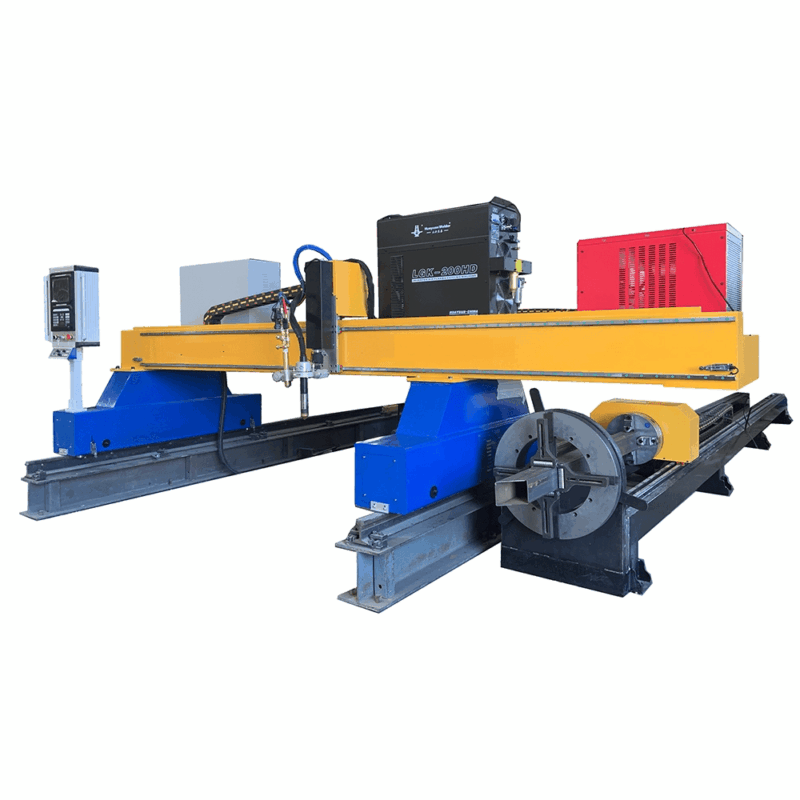
In the heavy industrial sector, specifically regarding the fabrication of support structures for Pressure Vessels, the structural integrity of H-beams is non-negotiable. The manufacturing workflow must prioritize dimensional stability and repeatable tolerance levels. An H-beam Production line integrated with sophisticated plasma systems allows for the high-speed processing of thick-walled structural steel while maintaining the tight tolerances required for safety-critical environments. Unlike general construction-grade steelwork, pressure vessel supports demand a higher degree of precision at the junction points to ensure load distribution is uniform and predictable.
The shift toward automated Plasma Cutting in these lines is driven by the need to handle heavy sections with minimal human intervention. By utilizing advanced CNC protocols, engineers can synchronize the movement of the gantry with real-time feedback loops, ensuring that every cut—whether a straight flange trim or a complex web penetration—adheres to the digital twin model.
The Technical Mechanics of Arc Voltage Control (AVC)
The core of precision in plasma-based H-beam lines lies in Arc Voltage Control. In a plasma cutting environment, the distance between the torch tip and the workpiece—known as the standoff distance—is directly proportional to the arc voltage. As the torch moves across an H-beam, even minor deviations in material flatness or beam camber can alter this distance.
An AVC system functions as a high-speed feedback mechanism. It continuously monitors the voltage across the plasma arc and compares it to a pre-set reference value determined by the material thickness and gas mixture. If the voltage increases, indicating a widening gap, the system drives the Z-axis motor to lower the torch. Conversely, a voltage drop triggers an immediate lift. This millisecond-response regulation is critical for maintaining a constant kerf width. For pressure vessel components, where a 1mm deviation can lead to significant fit-up issues during final assembly, AVC provides the foundational stability required for high-grade industrial output.
Achieving Superior Intersection Accuracy in Complex Geometries
One of the most significant challenges in H-beam fabrication is the execution of intersections where one beam meets another at varying angles. In pressure vessel support skids, these intersections are rarely simple 90-degree joints. They often involve complex saddle cuts or mitered notches that must wrap around the vessel’s cylindrical surface or its conical ends.
Intersection Accuracy is achieved through the synchronization of multi-axis motion and the aforementioned AVC. When the plasma torch transitions from the web to the flange of an H-beam, the sudden change in material orientation can cause traditional systems to lose their pathing accuracy. However, a dedicated H-beam line uses specialized kinematics to rotate the torch head around the beam’s profile. Because the AVC keeps the torch at the optimal focal point of the plasma flame, the resulting cut faces are square and true. This precision eliminates the “gapping” often seen in manual layouts, ensuring that when the beams are positioned for the final assembly, the contact points are seamless.
Automated Plasma Cutting Beveling for Weld Preparation
For pressure vessel applications, the edges of the H-beam must be prepared for full-penetration welds. This necessitates complex beveling profiles, including V, Y, and K-cuts. Integrated Plasma Cutting Beveling heads on H-beam lines allow these profiles to be cut in a single pass, directly on the production line.
The engineering advantage of using plasma for beveling lies in its ability to maintain a consistent heat-affected zone (HAZ) while moving through thick sections. By utilizing a 5-axis or 6-axis robotic arm or a tilting gantry head, the system can vary the angle of the torch in real-time. The AVC is particularly vital during beveling; as the torch tilts, the perceived distance to the metal changes. The control software must calculate the hypotenuse of the arc path to maintain the correct tip-to-workpiece distance. This level of automation ensures that the bevel angle remains constant throughout the entire length of the beam, providing a perfect “V” groove that facilitates high-quality volumetric integrity in subsequent assembly phases.
Low Maintenance Design and Operational Longevity
From an Industrial Engineering perspective, the Total Cost of Ownership (TCO) is a primary metric for production line selection. Plasma-based H-beam lines are engineered for rugged, 24/7 operation in environments characterized by dust, vibration, and thermal fluctuations.
The H-beam low maintenance profile of these machines is a result of several design choices:
Consumable Life Optimization
Modern plasma systems utilize “long-life” electrode technology. By controlling the ramp-up and ramp-down of gas flow and current, the system minimizes the erosion of the hafnium insert. AVC also prevents “torch crashes”—where the nozzle hits the plate—which is the leading cause of premature consumable failure.
Mechanical Robustness
Unlike sensitive optical systems, plasma components are relatively resistant to the metallic dust inherent in heavy steel fabrication. The drive systems typically use oversized rack-and-pinion or ball-screw mechanisms that are shielded from slag and sparks.
Simplified Calibration
Because the arc voltage is a physical property of the plasma stream, the calibration of the height control is straightforward. It does not require complex recalibration of sensors or lenses, allowing floor operators to maintain peak performance with minimal specialized training.
Enhancing Throughput through Material Handling Integration
The efficiency of a plasma H-beam line is not solely dependent on the cutting speed, but on the integration of material handling. In a pressure vessel support production environment, raw H-beams are fed into the line via cross-conveyors and longitudinal rollers.
As the beam enters the cutting zone, laser or mechanical probes first measure the actual dimensions of the beam, accounting for any mill tolerances or “toe-in/toe-out” of the flanges. This data is fed back into the CNC system, which adjusts the cutting path and the AVC setpoints accordingly. This “measure-then-cut” workflow ensures that the final part is dimensionally accurate regardless of the inconsistencies in the raw structural steel. The result is a significant reduction in waste and a streamlined path to the final assembly stage.
Conclusion: The Strategic Impact on Pressure Vessel Integrity
The integration of Arc Voltage Control within a plasma-based H-Beam Production Line represents a significant leap in structural fabrication technology. By focusing on intersection accuracy and the automation of complex beveling, manufacturers can produce support structures that meet the rigorous demands of the pressure vessel industry.
The mechanical reliability and low maintenance requirements of these systems ensure that production schedules are met without the frequent downtime associated with more fragile cutting technologies. For the industrial engineer, the goal is clear: utilize AVC to transform the plasma arc into a precision instrument, ensuring that every H-beam produced is a perfect fit for its high-pressure application. Through these advancements, the industry moves closer to a fully autonomous, high-precision fabrication model that prioritizes both structural safety and operational efficiency.
-


LT240S tube laser cutting machine
-
LT120S tube laser cutting machine
-
Sale

Tank Fillet Welding Machine
Original price was: $1,000.00.$900.00Current price is: $900.00. -
Sale

MAK100 tube laser cutting machine
Original price was: $5,500.00.$5,000.00Current price is: $5,000.00. -

portable plasma air cutting machine
$1,200.00 -

2in1 fiber laser cutting machine
-

Air cooling Laser welding machine
-

HF h beam laser cutting machine
-

LT240 laser cutting machine
-

Laser welding machine
-


Cobot Welding Station
-

Gantry welding robot solution
-

Tracked Wheeled AGV Welding robot
-

LFH6020 Fiber laser cutting machine
-
LFP6020
-

robotic welidng machine
Advanced Fiber Laser Tube Processing Technology
Our CNC Fiber Laser Tube Cutting systems revolutionize metal fabrication by integrating high-precision cutting, punching, and profiling into a single automated workflow. Designed for versatility, this technology handles a wide array of profiles including Round, Square, Rectangular, and Oval tubes, as well as complex L-shaped and U-shaped channels.
- Precision Punching: High-speed hole punching with micron-level accuracy, eliminating the need for mechanical drilling or die-stamping.
- Complex Profiling: Advanced 3D pathing allows for intricate interlocking joints and specialized notch cuts, ideal for structural frames.
- High Material Efficiency: Intelligent nesting software minimizes scrap, reducing raw material costs across large production runs.
- Clean Finish: Delivers oxide-free, burr-free edges that require zero secondary grinding before welding.

Seamlessly processing multiple profiles with consistent precision.
Global Delivery & Logistics



From our high-tech manufacturing facility directly to your global site. PCL WeldCut ensures secure packaging, professional handling, and reliable international logistics to safeguard your equipment throughout the entire journey.