Optimizing Bridge Truss Fabrication via Advanced Plasma Integration
The structural integrity of bridge trusses hinges on the geometric precision and material properties of their primary members. In modern steel construction, the H-Beam Production Line serves as the critical node for transforming raw structural sections into finished truss components. Unlike general construction, bridge trusses demand higher load-bearing capacities and resistance to cyclic fatigue. This necessitates a transition from manual processing to automated systems that utilize Plasma Cutting as the primary material removal and shaping mechanism. The adoption of plasma technology in this sector is driven by its ability to handle thick-gauge structural steel with high thermal efficiency and speed.
The Critical Role of Arc Voltage Control (AVC)
In a high-output production environment, maintaining a constant distance between the plasma torch and the workpiece is essential. The Arc Voltage Control system functions as the primary feedback loop for the Z-axis modulation. In H-beam processing, flanges and webs are rarely perfectly flat; they often exhibit slight camber, sweep, or mill-scale irregularities. If the torch height fluctuates, the arc length changes, which directly impacts the kerf width and the angle of the cut. By monitoring the voltage between the electrode and the plate, the AVC adjusts the torch position in real-time—often within milliseconds—to maintain a consistent arc length. This ensures that the energy density remains uniform, preventing “dross” or slag buildup and ensuring the dimensional stability of the H-beam profile.
Ensuring Intersection Accuracy in Complex Truss Geometries
Bridge trusses, whether they follow a Warren, Pratt, or Howe configuration, rely on complex intersections where diagonal members meet vertical and horizontal chords. The Intersection Accuracy required for these joints leaves zero margin for error. A plasma-based H-beam line utilizes multi-axis CNC controllers to synchronize the movement of the beam along the conveyor with the lateral and vertical motion of the plasma head. Because the AVC keeps the torch at the optimal focal point, the system can execute precise “bird-mouth” cuts, web openings, and bolt-hole perforations with sub-millimeter repeatability. This precision is vital for ensuring that when the truss components are assembled on-site or in the shop, the fit-up is seamless, reducing the need for corrective mechanical grinding or excessive gap-filling.
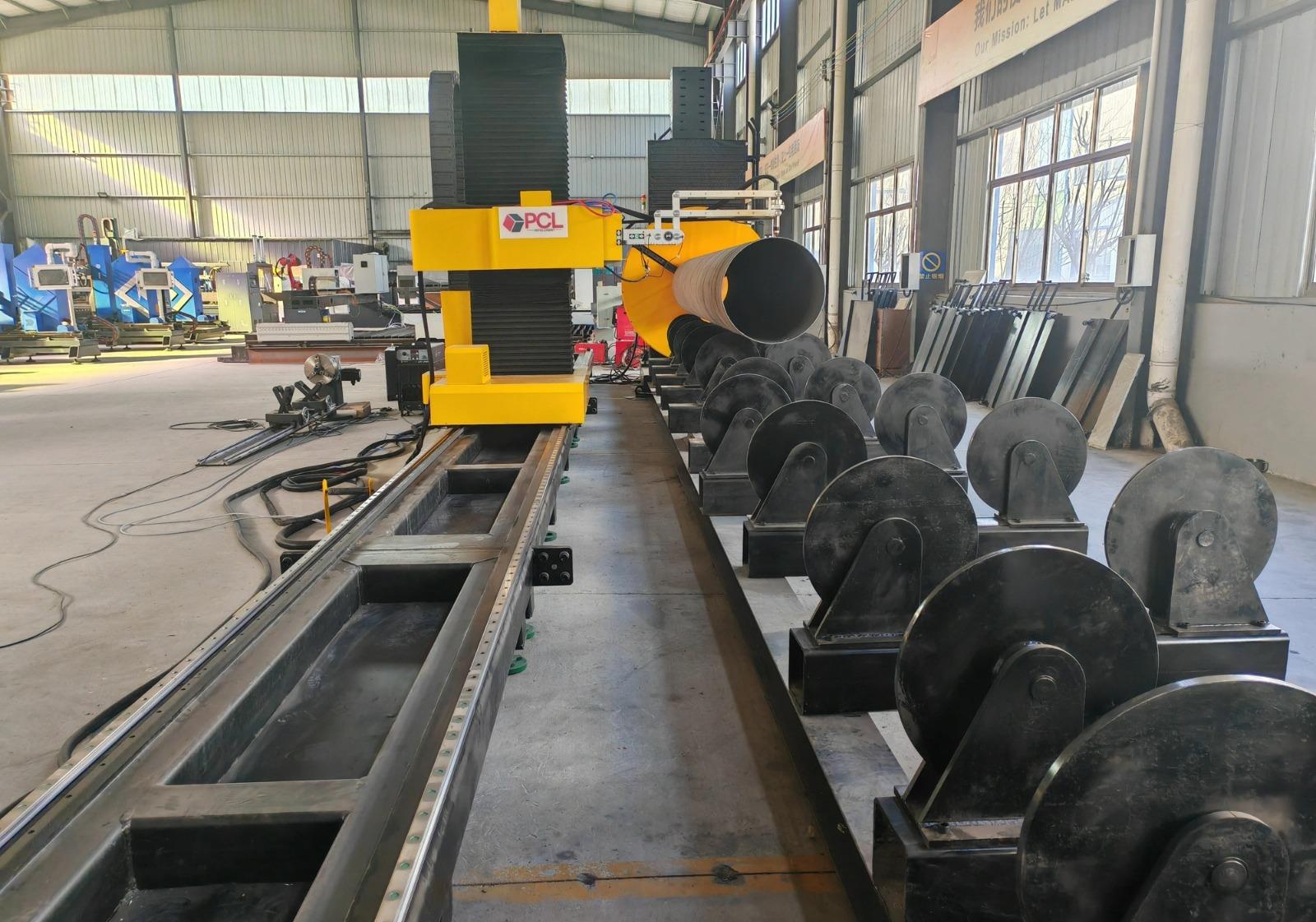
Advanced Beveling for High-Strength Structural Joints
For bridge applications, simple perpendicular cuts are rarely sufficient. Most primary structural members require complex beveling to prepare the edges for full-penetration welding. The integrated plasma systems in an H-beam line are typically equipped with a 3D tilting head capable of executing V, Y, K, and X-type bevels. The Bridge Truss Fabrication process relies on these bevels to ensure that deep penetration can be achieved across the thickness of the flange. Using plasma for this process is significantly faster than mechanical milling. The AVC system is particularly crucial during beveling operations because the effective distance to the plate changes as the torch tilts. Advanced algorithms compensate for this geometric shift, ensuring the bevel angle remains constant throughout the entire length of the cut, regardless of the beam’s surface condition.
Low Maintenance Requirements in Heavy Industrial Environments
One of the primary advantages of plasma systems in an H-beam Production Line is their inherent ruggedness. Industrial steel environments are characterized by dust, vibration, and extreme temperature fluctuations. Plasma torches are designed for these conditions. Unlike more sensitive optical systems, plasma components are relatively simple to maintain and replace. The “low maintenance” aspect comes from the durability of the consumables (electrodes and nozzles) and the robustness of the drive systems. In a high-volume bridge truss facility, downtime is the primary enemy of profitability. Modern plasma systems feature quick-change torch bodies and self-diagnostic AVC units that alert operators to potential issues before they lead to part rejection. This reliability ensures that the production line can maintain a high duty cycle, processing tons of steel daily without requiring specialized clean-room environments or frequent recalibration.
Material Handling and Throughput Efficiency
The efficiency of the production line is not just measured by the speed of the cut, but by the logistics of moving H-beams through the plasma station. Automated loading and unloading systems utilize heavy-duty rollers and drag chains to position the beam. The CNC system reads the CAD data and translates it into a toolpath that minimizes travel time. Because the plasma arc can pierce material almost instantly, the start-to-finish cycle time for a complex bridge chord is significantly lower than that of mechanical drilling or sawing. Furthermore, the ability to perform marking, cutting, and beveling in a single pass on one machine eliminates the need for multiple setups, further reducing the physical footprint of the production facility.
Thermal Stress and Heat Affected Zone (HAZ) Management
A common concern in structural engineering is the Heat Affected Zone (HAZ) created by thermal cutting. However, modern high-definition plasma systems, controlled by precise AVC, operate at such high speeds that the total heat input into the H-beam is minimized. This rapid movement prevents the distortion of the flange and maintains the metallurgical integrity of the structural steel. for Bridge Trusses, where the material must meet specific Charpy V-Notch toughness requirements, the controlled plasma process ensures that the edges are ready for subsequent joining processes without degrading the base metal’s performance characteristics.
Conclusion: The Future of Structural Steel Processing
The integration of plasma technology with Arc Voltage Control represents a significant leap forward for H-beam processing in the infrastructure sector. By focusing on the mechanical and electrical synergies of the cutting process, manufacturers can produce bridge truss components that meet the highest standards of accuracy and durability. The combination of high-speed beveling, intersection precision, and low maintenance overhead makes plasma the logical choice for industrial engineers tasked with building the next generation of transportation infrastructure. As bridge designs become more complex and material requirements more stringent, the role of the automated H-beam production line will only continue to grow in importance.
-


LT240S tube laser cutting machine
-
LT120S tube laser cutting machine
-
Sale

Tank Fillet Welding Machine
Original price was: $1,000.00.$900.00Current price is: $900.00. -
Sale

MAK100 tube laser cutting machine
Original price was: $5,500.00.$5,000.00Current price is: $5,000.00. -

portable plasma air cutting machine
$1,200.00 -

2in1 fiber laser cutting machine
-

Air cooling Laser welding machine
-

HF h beam laser cutting machine
-

LT240 laser cutting machine
-

Laser welding machine
-


Cobot Welding Station
-

Gantry welding robot solution
-

Tracked Wheeled AGV Welding robot
-

LFH6020 Fiber laser cutting machine
-
LFP6020
-

robotic welidng machine
Advanced Fiber Laser Tube Processing Technology
Our CNC Fiber Laser Tube Cutting systems revolutionize metal fabrication by integrating high-precision cutting, punching, and profiling into a single automated workflow. Designed for versatility, this technology handles a wide array of profiles including Round, Square, Rectangular, and Oval tubes, as well as complex L-shaped and U-shaped channels.
- Precision Punching: High-speed hole punching with micron-level accuracy, eliminating the need for mechanical drilling or die-stamping.
- Complex Profiling: Advanced 3D pathing allows for intricate interlocking joints and specialized notch cuts, ideal for structural frames.
- High Material Efficiency: Intelligent nesting software minimizes scrap, reducing raw material costs across large production runs.
- Clean Finish: Delivers oxide-free, burr-free edges that require zero secondary grinding before welding.

Seamlessly processing multiple profiles with consistent precision.
Global Delivery & Logistics



From our high-tech manufacturing facility directly to your global site. PCL WeldCut ensures secure packaging, professional handling, and reliable international logistics to safeguard your equipment throughout the entire journey.