Fiber Laser Cutting Machine with Offline Programming for Steel Structure
In this article
- Technical Integration of Fiber Laser Technology in Structural Steel
- The Trifecta of Efficiency: Punch, Mark, and Cut
- High-Precision Hole Creation
- Automated Part Marking
- Precision Perimeter Cutting
- Eliminating Secondary Operations: No Grinding Required
- The Role of Offline Programming (OLP) and BIM Integration
- Direct DSTV and IFC Data Conversion
- Advanced Nesting Algorithms
- Operational Impact: Throughput and Quality Control
- Conclusion: The Future of Structural Steel Fabrication
Technical Integration of Fiber Laser Technology in Structural Steel
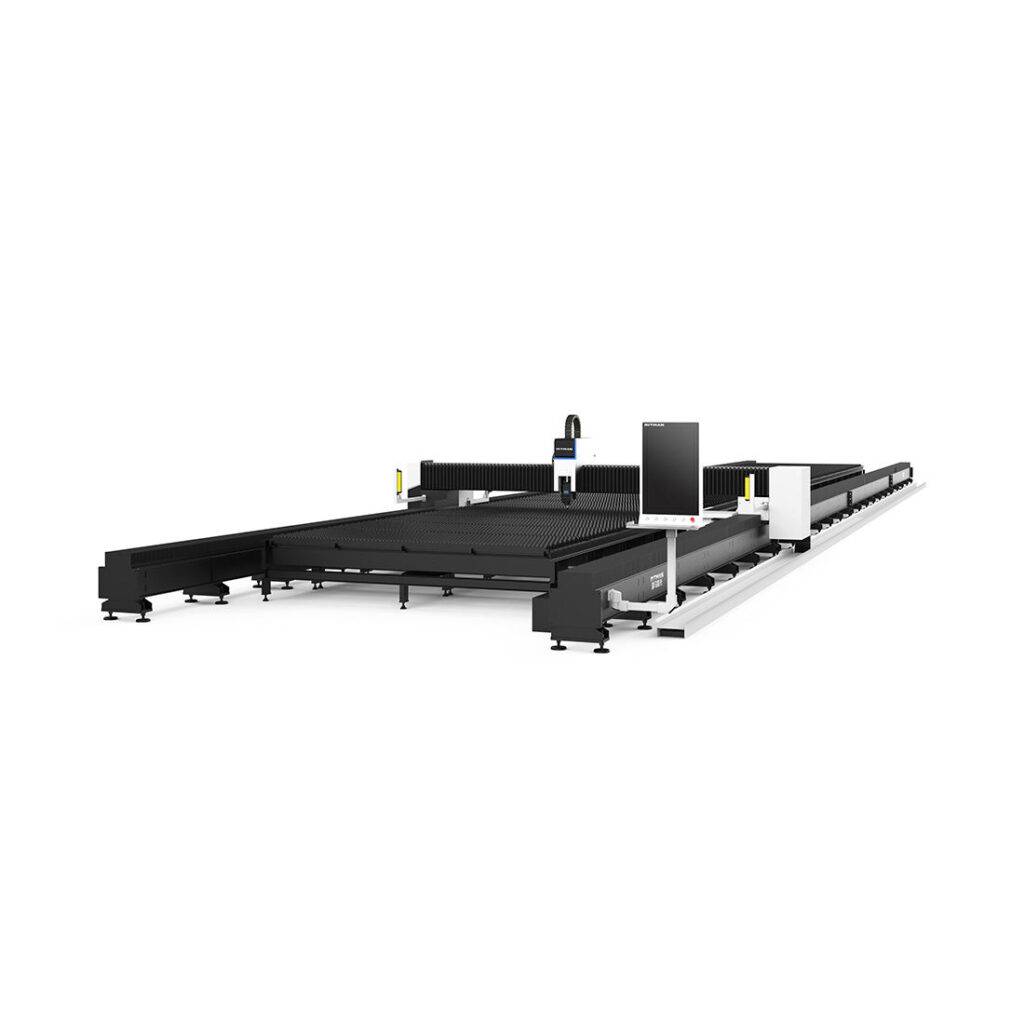
The transition from traditional mechanical fabrication to fiber Laser Cutting represents a fundamental shift in structural engineering workflows. In the context of steel structures—ranging from I-beams and H-channels to square tubing—the requirement for dimensional precision is paramount. Traditional methods often involve disparate stages: manual layout, mechanical drilling or punching, and separate cutting processes. A fiber laser system consolidates these steps into a single-pass operation, driven by high-density light energy that ensures a kerf width significantly narrower than any mechanical alternative.
From an industrial engineering perspective, the fiber laser’s advantage lies in its solid-state gain medium. Unlike CO2 lasers, fiber lasers utilize an optical fiber doped with rare-earth elements, resulting in a beam wavelength of approximately 1.06 microns. This shorter wavelength is more readily absorbed by steel, allowing for faster feed rates and the ability to process reflective materials with high efficiency. The result is a concentrated heat source that minimizes the Heat Affected Zone (HAZ), preserving the metallurgical integrity of the structural members.
The Trifecta of Efficiency: Punch, Mark, and Cut
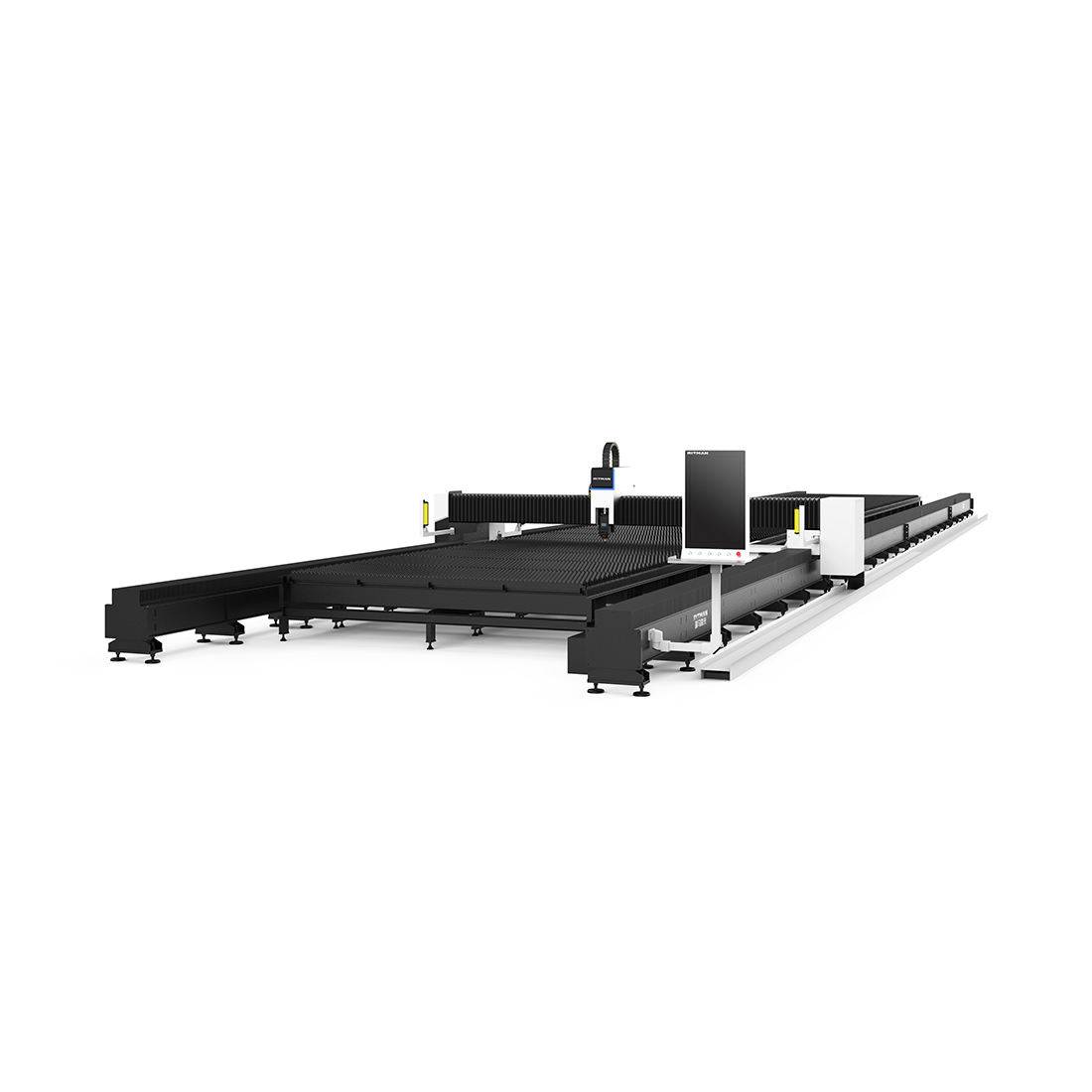
One of the most significant advancements in modern steel structure fabrication is the ability to execute three distinct functions—punching (hole creation), marking (layout and part identification), and cutting—on a single CNC platform. This multi-process capability eliminates the need for workpieces to be moved between different stations, which is the primary source of cumulative tolerance errors in a shop environment.
High-Precision Hole Creation
In structural steel, bolt hole accuracy is critical for site assembly. Fiber lasers can “punch” holes with tolerances exceeding ISO 9013 standards. Because the laser is a non-contact tool, there is no tool wear or mechanical stress applied to the beam or plate. This ensures that the 100th hole is as precise as the first. The software manages lead-ins and lead-outs to ensure perfectly circular apertures, ready for immediate bolting without the need for reaming.
Automated Part Marking
Offline programming allows for the automatic engraving of part numbers, assembly orientations, and weld preparation lines directly onto the steel. By adjusting the laser frequency and power, the machine “marks” the surface without penetrating the material’s structural depth. This eliminates manual layout using soapstone or center punches, drastically reducing the potential for human error during the downstream assembly of complex trusses.
Precision Perimeter Cutting
The cutting phase utilizes high-pressure assist gases (typically Oxygen or Nitrogen) to expel molten material. For structural steel, the use of fiber lasers results in a perpendicularity and surface roughness that meets the highest industry classifications. This leads us to one of the most significant cost-saving factors in the modern plant: the elimination of secondary finishing.
Eliminating Secondary Operations: No Grinding Required
In traditional fabrication, edges produced by mechanical shears or older thermal methods often require manual grinding to remove dross, slag, or hardened edges. Fiber laser cutting produces a clean, square edge with minimal dross. In an industrial time-motion study, the removal of the grinding stage can save between 15% and 25% of total labor hours per ton of steel processed.
The lack of a hardened edge also benefits subsequent processing. Because the fiber laser’s cooling rate is tightly controlled through CNC parameters, the edge remains workable. This is crucial for structural components that must undergo further machining or specific surface treatments. The “ready-to-assemble” state of laser-cut parts streamlines the entire production flow, allowing for a Just-In-Time (JIT) manufacturing approach in the construction sector.
The Role of Offline Programming (OLP) and BIM Integration
The hardware is only as effective as the data driving it. Offline programming (OLP) serves as the bridge between the structural engineer’s 3D model (often created in Tekla, Revit, or SDS2) and the CNC controller. OLP allows programmers to generate G-code and simulate the cutting process in a virtual environment, away from the machine. This ensures that the machine remains in “green light” status—actually cutting—rather than being idled for manual data entry.
Direct DSTV and IFC Data Conversion
Modern OLP software can import DSTV or IFC files directly. These files contain all the geometric data, hole locations, and marking requirements for a structural member. The software automatically maps these features to the laser’s toolpath. This digital thread ensures that the physical component is a 1:1 replica of the engineering design, fulfilling the requirements of Building Information Modeling (BIM) Level 3 compliance.
Advanced Nesting Algorithms
Material cost typically accounts for 50-70% of a structural project’s budget. OLP software utilizes sophisticated nesting software to arrange parts on a plate or along a beam to maximize material yield. Common-line cutting, where two parts share a single cut path, further reduces cycle time and gas consumption. By simulating the nest offline, engineers can predict exact material requirements and minimize “drops” or scrap, directly impacting the project’s bottom line.
Collision Avoidance and Path Optimization
Structural steel parts can be heavy and awkward. OLP software includes collision avoidance algorithms that calculate the movement of the laser head relative to the workpiece and any tipped-up parts. By optimizing the “non-cutting” movement (rapid traverse), the software shaves seconds off every part, which adds up to hours over a large production run.
Operational Impact: Throughput and Quality Control
Implementing a fiber laser with OLP transforms the fabrication shop into a precision manufacturing facility. The speed of fiber laser cutting on thin-to-medium thickness steel is unmatched, but even on heavy plate (20mm+), the consistency of the cut provides a level of quality control that manual processes cannot mirror.
From a Quality Assurance (QA) perspective, the digital nature of the process allows for total traceability. Each cut is performed according to a verified digital file. If a part fails to fit during field erection, the digital log can be reviewed to determine if the issue was in the design file or the execution. However, with the high repeatability of fiber laser systems (often within +/- 0.1mm), the error usually resides in the source data, not the machine.
Conclusion: The Future of Structural Steel Fabrication
The integration of fiber laser technology and offline programming is no longer a luxury for high-end shops; it is a necessity for maintaining competitiveness in an industry with tightening margins and shorter delivery schedules. By focusing on the precision of the fiber laser—specifically its ability to punch, mark, and cut without the need for secondary grinding—industrial engineers can create a seamless, high-throughput production line. The reduction in labor, the elimination of manual layout errors, and the optimization of material through OLP nesting result in a significant return on investment. As structural designs become more complex, the reliance on this digital-to-physical precision will only increase, cementing the fiber laser’s role as the cornerstone of modern steel fabrication.






